
Homes for Hornbills (2025)
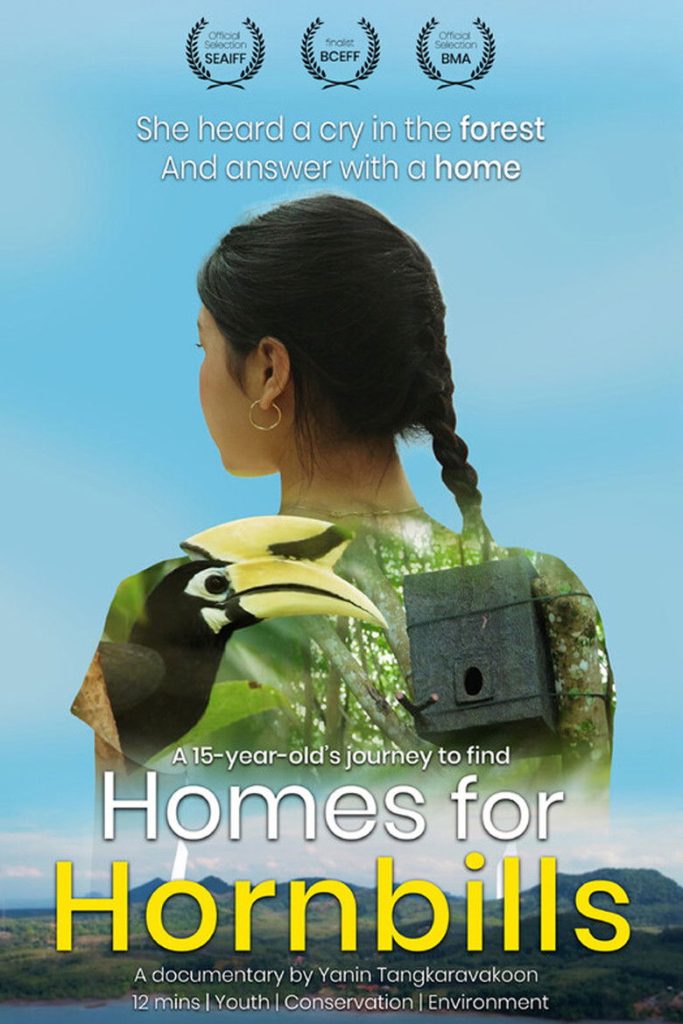
Story overview
This 12-minute documentary follows Yanin Tangkaravakoon's journey to help Thailand's hornbills, known as 'farmers of the forest' for their crucial role in seed dispersal and ecosystem regeneration. As deforestation threatens their ancient nesting trees, Yanin uses her family's polymer lab and collaborates with the Hornbill Research Foundation to develop and install artificial nests on Yao Noi Island, where hornbill nesting is in crisis.
Parent Guide
Educational documentary about wildlife conservation with no concerning content. Suitable for all ages with parental guidance for very young children due to complex ecological concepts.
Content breakdown
No violence or peril depicted. The documentary shows humans helping animals, not harming them.
Nothing scary or disturbing. The tone is educational and hopeful, focusing on solutions rather than dwelling on environmental problems.
No inappropriate language. The narration is scientific and educational.
No sexual content or nudity.
No substance use depicted.
Mild emotional content related to concern for endangered species and habitat loss, balanced with hopeful problem-solving.
Parent tips
This gentle documentary focuses on environmental conservation and problem-solving. The 12-minute runtime makes it accessible for young viewers. No concerning content is present - just scientific observation and positive human intervention to help wildlife.
Parent chat guide
Parent follow-up questions
- What sounds do hornbills make?
- Why do birds need homes?
- What colors did you see in the forest?
- How do hornbills help forests grow?
- Why are ancient trees important for nesting?
- What materials were used to make the artificial nests?
- What ecosystem services do hornbills provide?
- How does the polymer nest compare to natural tree cavities?
- What other species might benefit from this conservation effort?
- What economic and social factors drive deforestation in Thailand?
- How does this case study illustrate the intersection of science, technology, and community engagement?
- What long-term monitoring would be needed to assess the success of artificial nests?
🎭 Story Kernel
Homes for Hornbills delves into the delicate ecological balance of Thailand's Budo-Sungai Padi National Park, focusing on the symbiotic relationship between the Great Hornbill and the local community. The film explores the Hornbill Research Foundation's efforts to mitigate the shortage of natural nesting sites caused by deforestation and aging trees. It moves beyond a simple nature documentary by centering on the human element: the transformation of former poachers into dedicated nest guardians. The narrative expresses a profound message of redemption and environmental stewardship, illustrating how local wisdom and scientific intervention can converge to save a species. It highlights the hornbill's role as a forest engineer, whose survival is inextricably linked to the health of the entire rainforest ecosystem through seed dispersal and forest regeneration.
🎬 Visual Aesthetics
The cinematography captures the verticality of the rainforest, utilizing intimate close-ups of the hornbills and wide, sweeping shots of the Budo mountain range. There is a stark visual contrast between the organic, chaotic beauty of the primary forest and the geometric, man-made artificial nests being hoisted into the canopy. The lighting often filters through the dense foliage, creating a dappled, ethereal atmosphere that emphasizes the forest's ancient mystery. Symbolically, the act of climbing these massive trees represents a bridge between the terrestrial world of humans and the celestial world of the birds. The camera remains unobtrusive, allowing the natural sounds of the jungle to provide a rhythmic, immersive soundtrack that underscores the urgency of the conservation work being depicted without the need for heavy-handed narration.
🔍 Details & Easter Eggs
💡 Behind the Scenes
Director Yanin Tangkaravakoon produced this work while exploring the intersections of community-based conservation and documentary storytelling. The film features the work of the Hornbill Research Foundation, which was pioneered by Dr. Pilai Poonswad, often called the Great Mother of Hornbills. The production involved filming in challenging terrain within Southern Thailand, requiring the crew to navigate the same steep slopes and high-canopy environments as the nest guardians. It has been recognized in regional film festivals for its sensitive portrayal of environmental issues and its focus on the human-nature connection in the Budo-Sungai Padi region.
Where to watch
Streaming availability has not been announced yet.