
Hotel Rwanda (2004)
Story overview
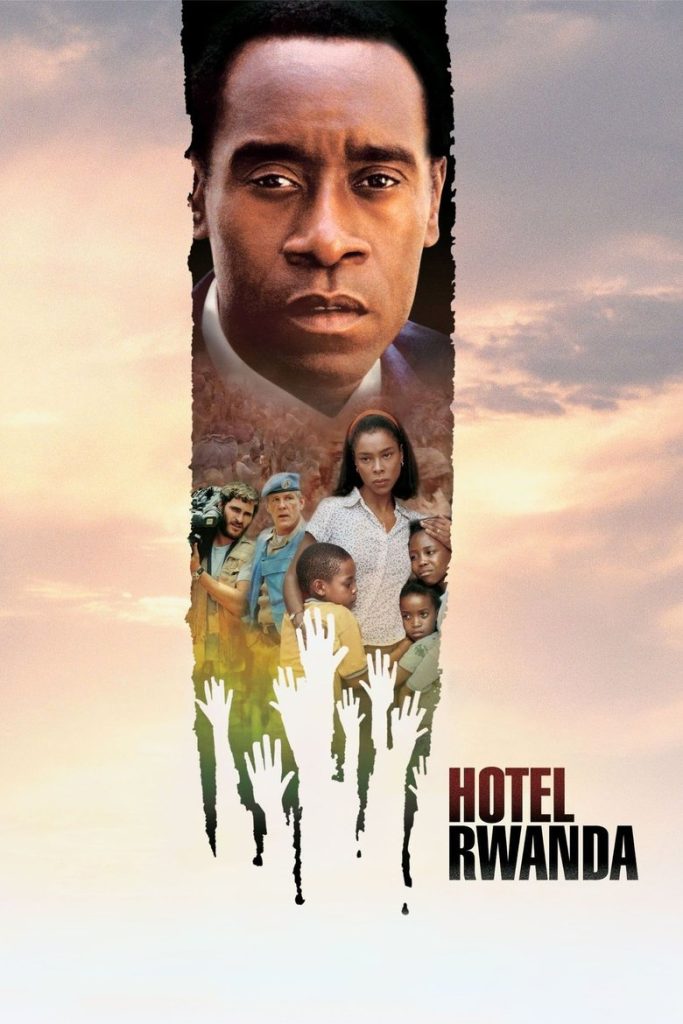
Hotel Rwanda is a historical drama based on true events during the 1994 Rwandan genocide. The film follows hotel manager Paul Rusesabagina as he shelters over a thousand refugees in his hotel to protect them from the violence outside. It portrays themes of courage, humanity, and survival during a tragic period when over a million people were killed. The story highlights how one person's actions can make a significant difference in desperate circumstances.
Parent Guide
A powerful historical drama about genocide and humanitarian courage that requires mature understanding and parental guidance.
Content breakdown
Contains scenes of armed conflict, threats with weapons, and perilous situations. While not graphically violent, there are intense moments of danger and implied violence.
Themes of genocide, mass violence, and racial conflict are central to the story. Scenes show emotional distress, fear, and life-threatening situations that may be disturbing.
Some tense dialogue and emotional exchanges, but no strong profanity noted in the context provided.
No sexual content or nudity mentioned in the provided information.
No substance use mentioned in the provided information.
High emotional intensity due to life-and-death situations, themes of genocide, and the weight of historical tragedy.
Parent tips
Hotel Rwanda deals with the difficult subject of genocide and contains intense scenes of peril and violence. While not graphically explicit, the film shows armed conflict, threats, and emotional distress that may be disturbing for younger viewers. The PG-13 rating reflects mature themes including war, death, and racial conflict that require parental guidance. This film is best suited for mature teenagers who can process historical tragedies with appropriate context and support.
Parent chat guide
Parent follow-up questions
- What did you notice about how people helped each other?
- How did the main character show he cared about others?
- What makes someone a good helper?
- What did you learn about being brave?
- How can we be kind to people who need help?
- Why was it important for Paul to help the refugees?
- How did people show courage in difficult situations?
- What does it mean to protect someone?
- How do you think the refugees felt during the story?
- What can we learn about helping others from this movie?
- What challenges did Paul face in helping the refugees?
- How did the film show the importance of standing up for what's right?
- What historical events does this movie help us understand?
- How do people make difficult decisions during crises?
- What does this story teach us about human resilience?
- How does the film portray the international response to the genocide?
- What ethical dilemmas did Paul face throughout the story?
- How does the film balance historical accuracy with storytelling?
- What contemporary parallels can you draw from this historical event?
- How does the film explore themes of leadership during crises?
🎭 Story Kernel
Hotel Rwanda is less about the mechanics of survival than the anatomy of moral courage in a vacuum of international will. Paul Rusesabagina's journey isn't a heroic transformation but a chilling demonstration of how ordinary decency becomes a radical, life-saving act when the world chooses to look away. The film's core engine is the tension between Paul's belief in civilized rules—bribes, favors, the currency of the old world—and the horrifying realization that those rules no longer apply. His drive isn't initially altruistic; it's pragmatic, rooted in protecting his immediate family. Yet, as the genocide escalates, his pragmatism expands, forced by conscience to encompass strangers, making his hotel a fragile ark in a flood of hatred. The movie ultimately asks: what is the value of a single good man when institutions fail?
🎬 Visual Aesthetics
Director Terry George employs a restrained, almost documentary-like visual style that amplifies the horror through intimacy rather than spectacle. The camera often stays at eye-level or in close quarters within the hotel, creating a claustrophobic sense of sanctuary amidst chaos. The color palette is desaturated, leaning into grays and muted tones, mirroring the moral ambiguity and bleakness of the situation. Notably, the film avoids graphic, sensationalist violence; the terror is often heard off-screen or implied, making the psychological impact more profound. Key symbolic visuals include the recurring shots of the hotel's gates—initially a symbol of exclusivity, they become a fragile barrier between life and death, and the haunting image of the Red Cross truck driving away, a stark visualization of abandoned hope.
🔍 Details & Easter Eggs
💡 Behind the Scenes
Don Cheadle, who delivers a masterfully understated performance as Paul, spent time with the real Paul Rusesabagina to understand his calm, diplomatic demeanor under extreme pressure. The film was shot primarily in South Africa, as filming in Rwanda itself was deemed too sensitive so soon after the events. The hotel used as the primary set, the 'Hotel des Mille Collines,' is a real location in Kigali, though the interiors were recreated on soundstages. Director Terry George co-wrote the script with Keir Pearson, aiming to focus on a story of survival and courage rather than graphic horror, a choice that garnered criticism from some but was intended to make the film's message more accessible to a wider audience.
Where to watch
Choose region:
- MGM Plus
- Amazon Video
- Apple TV
- Google Play Movies
- YouTube
- Fandango At Home
- Spectrum On Demand
- Plex
- The Roku Channel
- Tubi TV
- Kanopy
- Hoopla
Trailer
Trailer playback is unavailable in your region.