
I Lost My Body (2019)
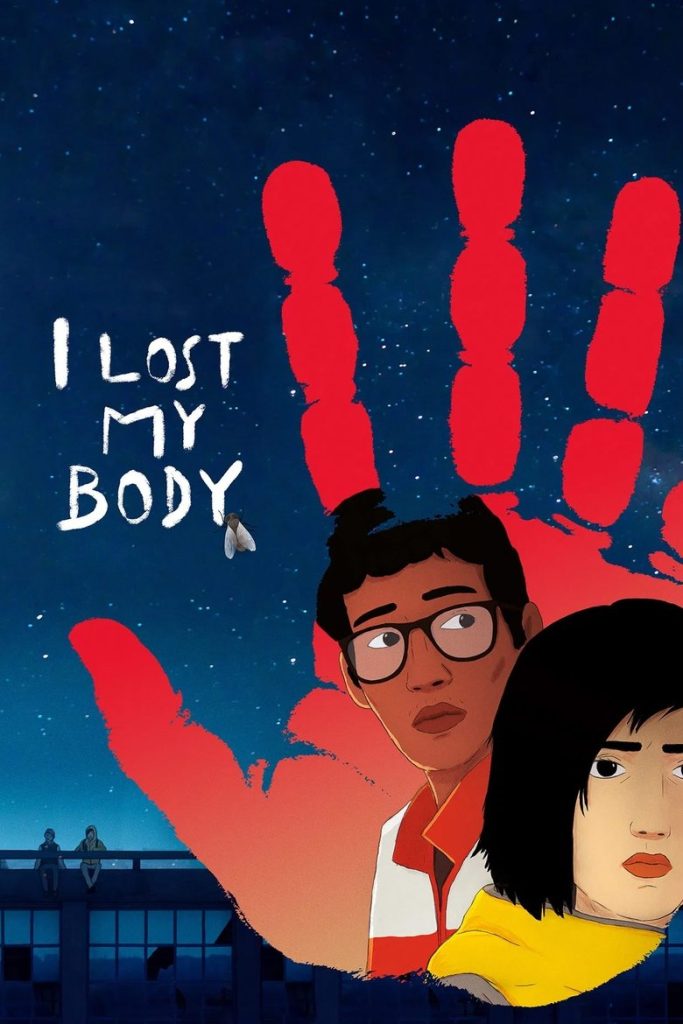
Story overview
This animated film tells two parallel stories. One follows a young man named Naoufel who develops feelings for a woman named Gabrielle. The other follows a severed hand that escapes from a laboratory and journeys through the city trying to reunite with its body. The film explores themes of loss, connection, and finding one's way through life's challenges. It blends realistic drama with surreal fantasy elements in its storytelling approach.
Parent Guide
A mature animated film with complex themes and some disturbing imagery that requires emotional maturity.
Content breakdown
Contains scenes of a severed hand, implied accidents, and perilous situations as the hand navigates urban environments. No graphic violence but the premise itself may be unsettling.
The central concept of a severed hand moving independently may disturb some viewers. Contains dark, atmospheric scenes and themes of loss and isolation.
May contain some mild language typical of dramatic storytelling. No excessive or aggressive profanity noted.
Contains romantic themes and relationships but no explicit sexual content. Some emotional intimacy between characters.
No notable substance use depicted in the film.
Deals with themes of trauma, loss, loneliness, and emotional connection. Characters experience significant emotional challenges throughout the story.
Parent tips
This film is rated TV-MA for mature audiences due to its complex themes and some intense content. The central premise involves a severed hand, which may be disturbing or confusing for younger viewers. The story deals with themes of trauma, loss, and emotional isolation that require emotional maturity to process. While animated, this is not a children's film and contains mature philosophical and emotional content.
Parent chat guide
Parent follow-up questions
- What was your favorite part of the movie?
- How did the hand move around the city?
- What colors did you notice in the animation?
- How do you think the hand felt being alone?
- What sounds did you hear in the movie?
- What do you think the hand was trying to do?
- How do you think Naoufel felt when he met Gabrielle?
- What was the scariest part for you?
- Why do you think the movie showed two different stories?
- What would you do if you saw a hand moving by itself?
- What themes did you notice in the movie?
- How did the animation style help tell the story?
- What do you think the hand's journey represents?
- How did the movie show characters dealing with difficult feelings?
- What connections did you see between the two stories?
- How does the film explore themes of loss and connection?
- What symbolic meaning might the severed hand represent?
- How does the animation medium affect how serious themes are presented?
- What did you think about the film's approach to storytelling?
- How do the characters' emotional journeys reflect real human experiences?
🎭 Story Kernel
At its core, 'I Lost My Body' is about the haunting persistence of trauma and the desperate search for connection in its wake. Naoufel, the protagonist, isn't driven by a quest to reclaim his hand, but by the memory of Gabrielle—a chance encounter that represents a life unlived before a tragic accident severed his future. The hand's parallel odyssey through Paris is a physical manifestation of this unresolved past, a piece of him literally trying to crawl back to a moment before everything broke. The film argues that we are defined by our losses, but true agency comes not from retrieving what was taken, but from choosing what to release. The poignant, ambiguous ending suggests that healing might mean accepting the void, rather than fruitlessly trying to fill it.
🎬 Visual Aesthetics
The film's visual language masterfully contrasts two realities. Naoufel's memories and present are rendered in a muted, desaturated palette, often framed through windows, glass, and barriers, emphasizing his isolation. In stark contrast, the hand's journey is a visceral, hyper-detailed adventure through a magnified, gritty Paris—dripping water becomes a deluge, carpet fibers a forest. This POV shift turns the mundane into the epic, making the hand's struggle feel mythic. The animation style is raw and textured, with visible pencil lines and a tactile sense of grime and moisture, immersing us in a world that feels painfully, beautifully real. The camera often adopts low, claustrophobic angles, mirroring the hand's perspective and Naoufel's trapped emotional state.
🔍 Details & Easter Eggs
💡 Behind the Scenes
The film is an adaptation of Guillaume Laurant's novel 'Happy Hand', with Laurant also writing the screenplay. Director Jérémy Clapin chose a distinct, rough-hewn 2D animation style to avoid a 'clean' digital look, aiming for something more organic and emotional. The haunting score by Dan Levy is performed almost entirely on a prepared piano, its unconventional, percussive sounds mirroring the film's themes of fragmentation and reassembly. Voice actor Hakim Faris (Naoufel) recorded his lines while physically performing the character's movements and limitations to capture authentic breath and strain.
Where to watch
Choose region:
- Netflix
- Netflix Standard with Ads
Trailer
Trailer playback is unavailable in your region.