Interstellar (2014)
Story overview
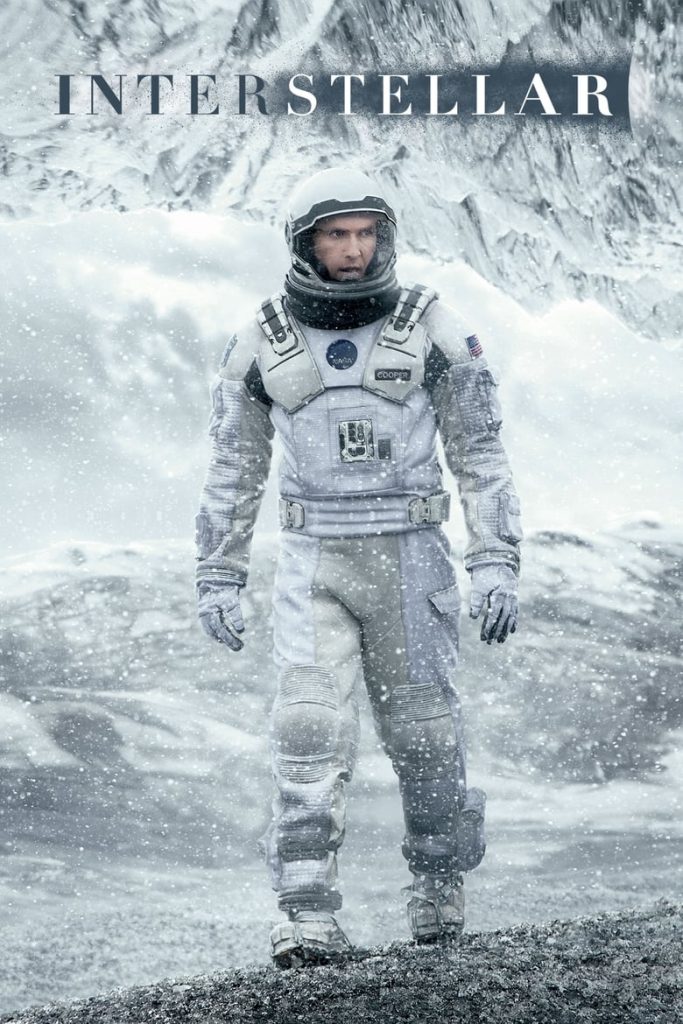
Interstellar follows a team of astronauts who embark on a daring mission through a wormhole to find a new habitable planet for humanity. The story explores themes of love, sacrifice, and survival across vast distances of space and time. It combines scientific concepts with emotional family drama as characters face impossible choices.
Parent Guide
A thought-provoking space adventure with emotional depth and scientific complexity best suited for mature pre-teens and teenagers.
Content breakdown
Contains intense space survival situations, dangerous planetary environments, and life-threatening scenarios without graphic violence.
Features tense survival sequences, existential themes about humanity's extinction, and emotional family separation.
Occasional mild language appropriate for the PG-13 rating.
No sexual content or nudity present.
No substance use depicted.
High emotional stakes involving family separation, sacrifice, and existential themes that may be intense for sensitive viewers.
Parent tips
This film is rated PG-13 for intense sequences and some thematic elements. The nearly three-hour runtime and complex scientific concepts may challenge younger viewers' attention spans. Parents should be prepared to discuss themes of parental separation, environmental crisis, and theoretical physics that drive the narrative.
Parent chat guide
Parent follow-up questions
- What was your favorite spaceship?
- How did the family feel when they were apart?
- What colors did you see in space?
- Why do you think the characters went to space?
- How would you feel leaving your family for a long time?
- What was the scariest part for you?
- What scientific ideas in the movie interested you most?
- How did the characters show courage?
- What would you sacrifice to help others?
- How does the film explore the relationship between science and emotion?
- What ethical dilemmas did the characters face?
- How did the movie change your perspective on time and distance?
🎭 Story Kernel
Interstellar is fundamentally about humanity's relationship with time and the paradox of survival. The film posits that our greatest evolutionary leap isn't technological but emotional—specifically, the ability to perceive love as a quantifiable force transcending spacetime. Cooper's journey isn't driven by heroism but by paternal desperation, while Murph's adult work is fueled by childhood abandonment. The 'they' we're saving turns out to be our future selves, creating a bootstrap paradox where humanity's salvation depends on humanity having already survived to provide it. The film suggests that our connection to those we love might literally shape reality.
🎬 Visual Aesthetics
Nolan employs a visual language of confinement versus expanse. The Dust Bowl scenes use desaturated browns and tight framing, making Earth feel claustrophobic. Space sequences shift to deep blacks punctuated by celestial bodies, with the camera often floating to simulate zero gravity. The tesseract scene's visual design—bookshelves as temporal coordinates—makes abstract physics tangible. The rotating Endurance set (built practically) creates disorienting perspectives that mirror the narrative's temporal distortions. Water planet's towering waves aren't just spectacle—they're liquid mountains representing time's crushing weight.
🔍 Details & Easter Eggs
💡 Behind the Scenes
The black hole visualization (Gargantua) required new scientific software and generated papers in astrophysics journals. Kip Thorne consulted extensively, ensuring the depiction was scientifically plausible. Matthew McConaughey didn't see the script until meeting Nolan—he accepted based on their conversation alone. The cornfield scenes used real crops planted six months prior, not CGI. Hans Zimmer composed the score without knowing the plot—Nolan gave him one page describing 'a father leaving his child' to capture raw emotion before intellectualizing the sci-fi elements.
Where to watch
Choose region:
- Paramount+ Amazon Channel
- Paramount+ Roku Premium Channel
- MGM Plus
- Paramount Plus Essential
- Paramount Plus Premium
- Amazon Video
- Google Play Movies
- YouTube
- Fandango At Home
- JustWatchTV
- Spectrum On Demand
- Plex
- Kanopy
Trailer
Trailer playback is unavailable in your region.