
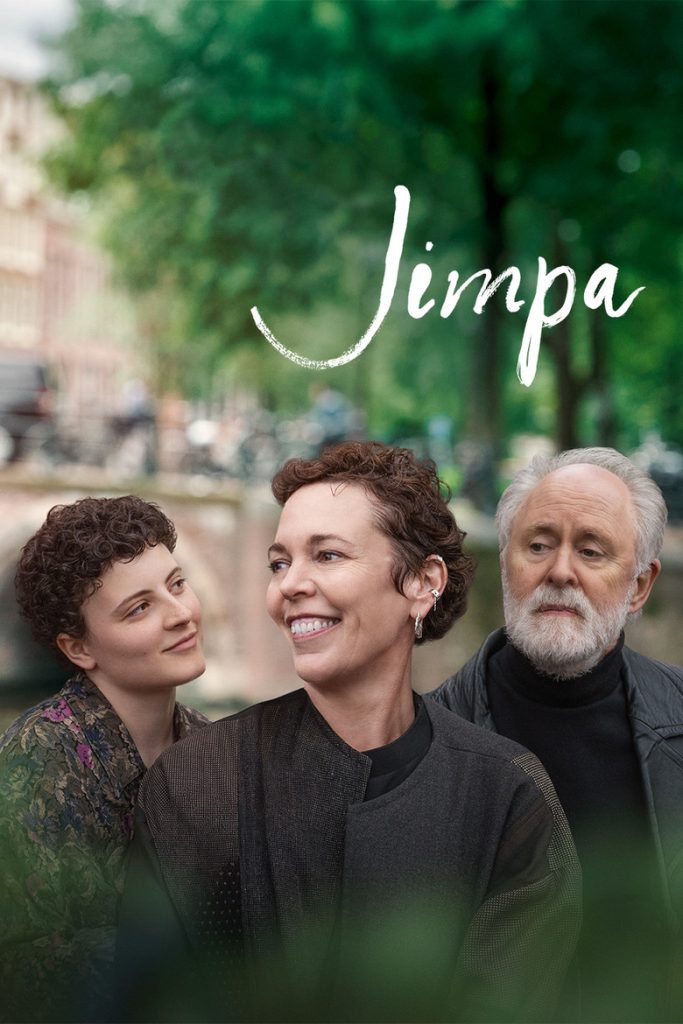
Jimpa (2026)

Released: 2026-02-06 Recommended age: 8+ IMDb 5.8
Jimpa

Movie details

  • Genres: Drama
  • Director: Sophie Hyde
  • Main cast: Olivia Colman, John Lithgow, Aud Mason-Hyde, Daniel Henshall, Kate Box
  • Country / region: Australia, Netherlands, United States of America
  • Original language: en
  • Premiere: 2026-02-06

Story overview

Jimpa is a 2026 Australian-Dutch-American drama directed by Sophie Hyde, starring Olivia Colman, John Lithgow, and Aud Mason-Hyde. The film follows Hannah and her non-binary teenager Frances as they visit Hannah's gay grandfather, Jimpa, in Amsterdam. Frances expresses a desire to stay with Jimpa for a year, which challenges Hannah's parenting beliefs and forces her to confront unresolved past issues. The story explores themes of family dynamics, identity, acceptance, and intergenerational relationships in a thoughtful, character-driven narrative.

Parent Guide

A thoughtful family drama exploring identity, acceptance, and intergenerational relationships. Suitable for mature children 8+ with parental guidance for discussions about LGBTQ+ themes and family dynamics.

Content breakdown

Violence & peril
None

No violence, physical conflict, or perilous situations. The tension is emotional and relational rather than physical.

Scary / disturbing
Mild

Some emotional intensity from family conflicts and discussions about identity and acceptance. No frightening imagery or jump scares.

Language
None

No strong language expected in this drama. Dialogue is thoughtful and character-appropriate.

Sexual content & nudity
None

No sexual content or nudity. The film deals with identity and relationships in a non-sexual context.

Substance use
None

No depiction of substance use. Social drinking might be shown in Amsterdam settings but not emphasized.

Emotional intensity
Moderate

Emotional scenes involving family conflict, parenting challenges, and discussions about identity and acceptance. Characters experience personal growth through difficult conversations.

Parent tips

This drama deals with mature family themes that may require parental guidance for younger viewers. Key considerations: 1) The film explores non-binary identity and LGBTQ+ relationships through Frances's character and Jimpa's life. 2) Family conflict arises as Hannah confronts parenting challenges and past issues. 3) Emotional intensity comes from family discussions about identity, acceptance, and personal growth. 4) No violence, strong language, or substance use is expected in this character-driven story. 5) The 123-minute runtime and thoughtful pacing may test younger children's attention spans. Recommended for families with children 8+ who can engage with complex family dynamics and identity themes.

Parent chat guide

After watching 'Jimpa,' consider discussing: 1) How did Hannah's parenting beliefs change throughout the film? What made her reconsider her approach? 2) What did Frances learn about themselves during their time with Jimpa? How did their relationship with their grandfather help them grow? 3) How did the film portray different generations understanding identity and acceptance? What can we learn from Jimpa's perspective? 4) What family conflicts did the characters face, and how did they work through them? 5) How did the Amsterdam setting contribute to the story's themes of freedom and self-discovery? These questions can help children process the film's themes of identity, family acceptance, and personal growth.

Parent follow-up questions

  • What was your favorite part of the movie?
  • How did the characters show they cared about each other?
  • What places in Amsterdam did you think looked interesting?
  • Why do you think Frances wanted to stay with Jimpa?
  • How did Hannah feel when Frances wanted to stay in Amsterdam?
  • What does it mean to be 'non-binary' as shown in the movie?
  • How did different generations in the film view identity differently?
  • What parenting challenges did Hannah face, and how did she handle them?
  • Why was Amsterdam an important setting for this story about self-discovery?
  • How does the film explore the tension between parental protection and adolescent autonomy?
  • What does Jimpa's character reveal about historical vs. contemporary attitudes toward LGBTQ+ identities?
  • How do the film's themes of family legacy and personal truth intersect with the characters' journeys?
⚠️ Deep Film Analysis (Contains Spoilers) · Click to Expand
A haunting meditation on memory's unreliable architecture, where every recollection rebuilds reality.

🎭 Story Kernel

At its core, 'Jimpa' explores the terrifying fluidity of identity when memory becomes untethered from objective truth. The protagonist's journey isn't about recovering lost memories but confronting how each remembered fragment actively reconstructs his present self. The film suggests we aren't the sum of our experiences but rather the ongoing narrative we choose to believe about them. This creates profound tension as supporting characters represent fixed versions of the protagonist that he can no longer recognize, revealing how relationships fracture when personal histories diverge. The climax's revelation that key memories were implanted questions whether any identity can be considered authentic when memory itself is malleable.

🎬 Visual Aesthetics

The film employs a desaturated, almost monochromatic palette that gradually introduces subtle color as memories become 'clearer,' visually representing the protagonist's shifting perception. Shallow depth of field creates intimate yet claustrophobic frames, mirroring his narrowed psychological focus. Camera movements are deliberately disorienting—Dutch angles and unstable handheld shots during memory sequences contrast with rigid, static compositions in 'present' scenes, visually distinguishing between fluid recollection and fixed reality. The production design incorporates architectural elements with subtle asymmetries and repeating patterns that become increasingly noticeable upon rewatch, reflecting the film's theme of constructed reality.

🔍 Details & Easter Eggs

1
The protagonist's watch appears in every scene but shows different times that don't match scene chronology, foreshadowing the nonlinear nature of his experience before the plot reveals it.
2
Background television news reports in early scenes contain distorted audio that, when cleaned and slowed, reveal phrases directly related to the film's final revelation about memory implantation.
3
A recurring visual motif shows characters reflected in surfaces with slight distortions—windows, puddles, mirrors—that become progressively more pronounced as the protagonist's grip on reality weakens.

💡 Behind the Scenes

The lead actor prepared by undergoing supervised sensory deprivation sessions to simulate memory disorientation, reporting afterward that he struggled to distinguish between memories from the script and actual experiences for weeks. Key memory sequence scenes were shot at an abandoned psychiatric hospital in rural Japan, chosen for its distinctive mid-century architecture that subtly influenced the film's aesthetic. The director implemented an unusual shooting schedule where scenes were filmed completely out of order and actors received only their immediate scene pages, creating genuine confusion that translated authentically to screen. The minimalist score was composed using manipulated recordings of neural activity during memory recall experiments.

Where to watch

Streaming availability has not been announced yet.

Trailer

Trailer playback is unavailable in your region.

SkyMe App
SkyMe Guide Download on the App Store
VIEW