
Judah Friedlander: America Is the Greatest Country in the United States (2017)
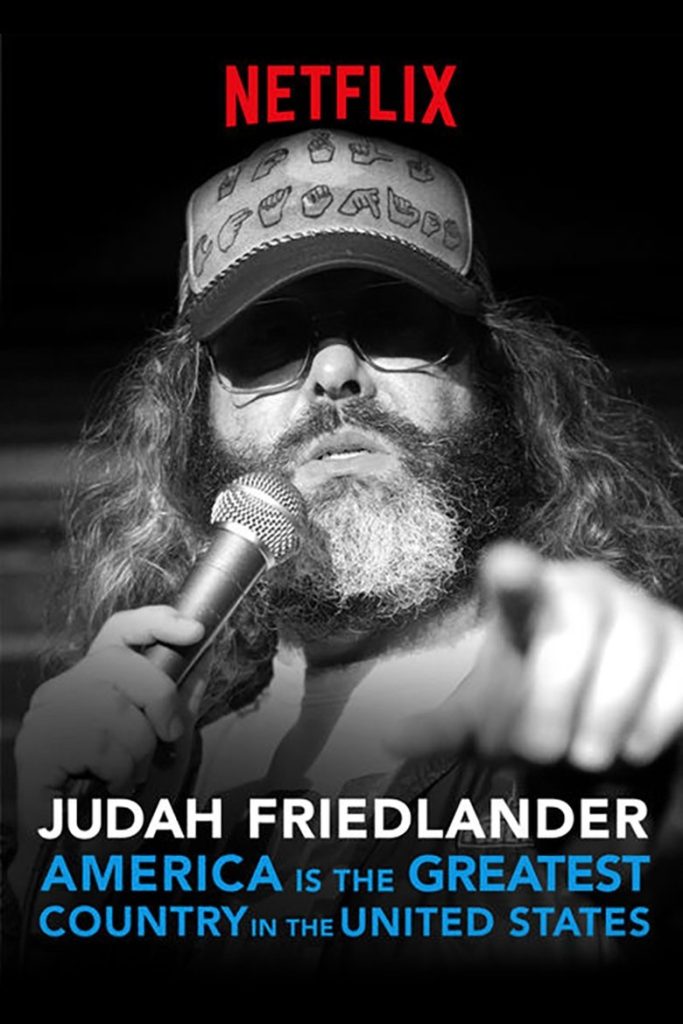
Story overview
This 2017 comedy documentary features comedian Judah Friedlander performing a stand-up routine where he humorously critiques and celebrates American culture and politics. The film blends observational comedy with documentary elements, offering satirical commentary on contemporary society. Friedlander's performance is characterized by his trademark deadpan delivery and absurdist humor.
Parent Guide
A stand-up comedy documentary featuring political and social satire that requires maturity to understand context and humor.
Content breakdown
No physical violence or peril depicted.
Some comedic references to political or social issues that younger children might find confusing or concerning.
Stand-up comedy may include occasional strong language or adult humor typical of the genre.
Possible comedic references to adult topics typical of stand-up comedy routines.
No substance use depicted.
Political and social commentary may provoke thought but is presented in comedic context.
Parent tips
This film contains mature comedic content that may not be suitable for younger children. The humor often involves political satire and social commentary that requires some understanding of current events and cultural references. Parents should be aware that stand-up comedy can include unexpected topics and edgy humor that might not align with family values.
Consider previewing the material or watching together with older children to discuss the comedic approach and underlying messages. The documentary format might create expectations of factual content, but this is primarily a comedy performance with exaggerated perspectives for humorous effect.
Parent chat guide
Encourage critical thinking about media by asking questions like: 'What do you think the comedian was trying to say with that joke?' and 'How can we tell when someone is being serious versus when they're joking?' This can lead to valuable conversations about media literacy and different forms of expression.
Parent follow-up questions
- What was your favorite funny part?
- Did you understand what the man was talking about?
- How did the man make you feel when he was talking?
- What colors or things did you see in the movie?
- Was there anything that confused you?
- What kind of jokes did the comedian tell?
- What topics did he talk about in his comedy?
- How is this different from a regular documentary?
- What did you learn about comedy from watching this?
- Why do you think people make jokes about serious topics?
- What social or political issues did the comedian address?
- How does satire help people think about serious topics?
- What techniques did the comedian use to make people laugh?
- How can we tell the difference between factual information and comedic exaggeration?
- What did you think about the comedian's perspective on America?
- How effective was the comedian's use of satire to comment on American society?
- What cultural assumptions or biases did you notice in the comedy?
- How does this performance compare to other political comedy you've seen?
- What role does comedy play in social and political discourse?
- How might different audiences interpret the comedian's messages differently?
🎭 Story Kernel
The film isn't a narrative but a sustained satirical performance. Friedlander's entire persona—the 'World Champion'—is the story kernel. He embodies the absurd, unshakeable confidence of American self-mythology. The driving force is the tension between his deadpan delivery of increasingly ludicrous claims of personal and national superiority and the audience's recognition of the real-world rhetoric it mirrors. It's a character study of a fictional champion who is a metaphor for a national psyche, exploring how grandiosity and insecurity are two sides of the same coin. The 'plot' is the deconstruction of this persona through its own logical extremes.
🎬 Visual Aesthetics
The visual language is deliberately stark and intimate, focusing entirely on Friedlander's performance. The single-camera setup in a modest club creates a documentary-like authenticity, contrasting with the fantastical content of his monologue. The color palette is muted, with Friedlander's iconic trucker hat and shirts serving as the only consistent visual motifs—symbols of a working-class facade worn by a self-proclaimed deity. There are no cutaways or B-roll; all symbolism is conveyed through his physical presence and the reaction of the live audience, making the comedy feel immediate and the critique uncomfortably direct.
🔍 Details & Easter Eggs
💡 Behind the Scenes
The special was filmed at The Stand in New York City. Friedlander's 'World Champion' persona was developed over years of stand-up and late-night TV appearances, but this special represents its most fully realized and politically pointed incarnation. The title is a direct quote from the act, highlighting the recursive, nonsensical logic of the bit. Notably, the production is minimalist, relying on Friedlander's long-honed performance rather than cinematic flair, which amplifies the feeling of watching a cult leader hold court in a small room.
Where to watch
Choose region:
- Netflix
- Netflix Standard with Ads
Trailer
Trailer playback is unavailable in your region.