
Justice League: War (2014)
Story overview
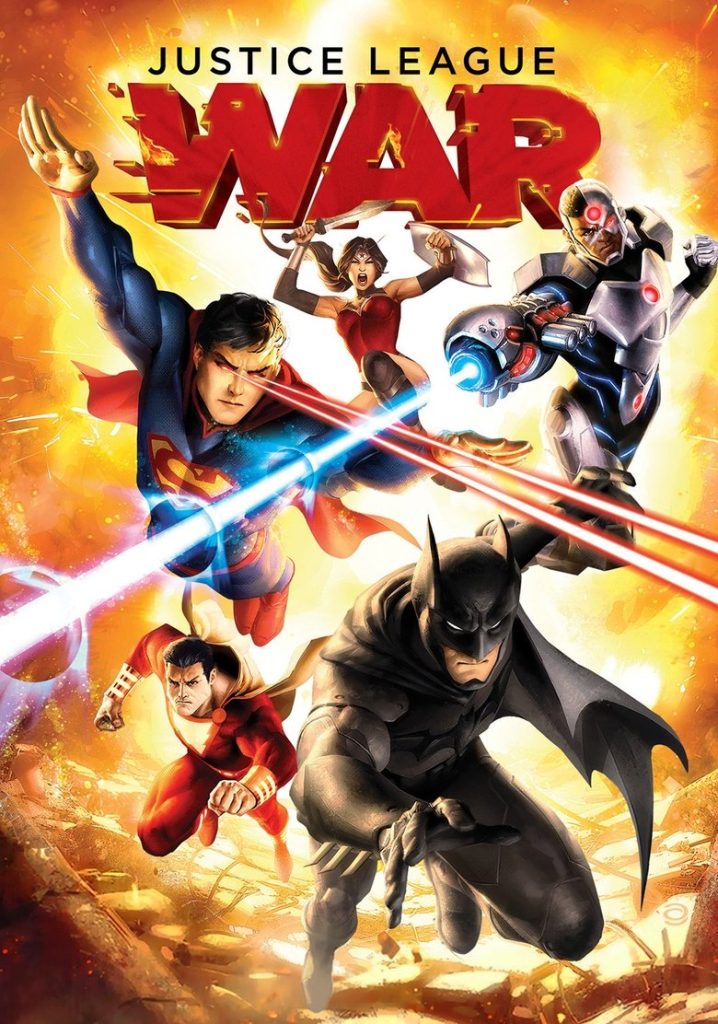
Justice League: War is an animated superhero film where Earth faces invasion by the alien warlord Darkseid and his forces. A diverse group of powerful heroes, including Superman, Batman, Wonder Woman, The Flash, Green Lantern, Cyborg, and Shazam, must overcome their initial conflicts and unite to protect the planet. The story focuses on their journey from individual heroes to a cohesive team battling overwhelming extraterrestrial threats.
Parent Guide
An action-packed superhero team-up film with intense combat sequences and themes of unity against overwhelming threats. Best suited for older children who can handle sustained action and peril.
Content breakdown
Frequent superhero combat with punching, energy attacks, and large-scale destruction. Alien forces attack cities and threaten civilians. No graphic injuries shown, but intense battle sequences throughout.
Alien invasion scenario with intimidating antagonists and widespread destruction. Cities under attack and civilians in peril. The scale of threat might be frightening for sensitive viewers.
Occasional mild insults or confrontational dialogue between characters. No strong profanity.
No sexual content or nudity present.
No substance use depicted.
Sustained tension from global threat scenario. Characters experience conflict, frustration, and high-stakes pressure. Positive resolution with themes of unity and protection.
Parent tips
This PG-13 animated film features intense superhero action with frequent combat scenes against alien invaders. While the violence is stylized and non-graphic, it includes punching, energy blasts, and large-scale destruction that might be overwhelming for younger viewers. The themes of teamwork and overcoming differences are positive, but the perilous situations and aggressive alien antagonists create sustained tension throughout the movie.
Parents should note that the film presents a world under catastrophic threat with cities under attack and civilians in danger. The heroes themselves engage in conflicts with each other before uniting, which includes some verbal confrontations. The animation style is dynamic and the action sequences are fast-paced, which could be exciting for older children but potentially frightening for sensitive viewers.
Parent chat guide
For younger viewers, you could emphasize that the heroes are working to keep people safe and that their special abilities help them protect Earth. With older children, you might discuss more complex themes like how people with different personalities can collaborate effectively. Always provide reassurance that the movie is fictional and that real-world conflicts are resolved differently.
Parent follow-up questions
- Which superhero did you like the most and why?
- How did the heroes help each other?
- What was your favorite part when they worked together?
- How do you think the people felt when the heroes saved them?
- What makes someone a good teammate?
- Why do you think the heroes had trouble working together at first?
- What special abilities did different heroes use to help the team?
- How did the heroes show bravery during the battle?
- What would you do if you saw someone needing help?
- What does it mean to be a hero in real life?
- What challenges did the team face in learning to cooperate?
- How did different heroes' personalities affect how they worked together?
- What responsibilities come with having special powers or abilities?
- How do you handle disagreements with friends when working on a project?
- What real-world situations require people to work together like the Justice League?
- What does the film suggest about leadership in diverse groups?
- How do the heroes balance their individual strengths with team needs?
- What ethical considerations arise when using force to protect others?
- How might the film's portrayal of alien threats reflect real-world fears?
- What makes an effective team in challenging situations?
🎭 Story Kernel
Justice League: War is less about heroism and more about forced collaboration under existential threat. The core theme explores the friction of disparate egos—like Batman's calculated pragmatism clashing with Green Lantern's brash arrogance—uniting only when humanity faces annihilation by Darkseid's invasion. It's driven by a survivalist necessity rather than altruistic ideals, portraying the League as a dysfunctional team that stumbles into unity. The movie expresses the raw, chaotic birth of a legend, where trust is earned through shared combat, not camaraderie, highlighting how crisis can forge alliances from animosity.
🎬 Visual Aesthetics
The film employs a stark, high-contrast color palette, with Darkseid's invasion bathed in ominous reds and blacks, symbolizing impending doom, while the heroes' vibrant costumes pop against the gloom. Camera language favors dynamic, fast-paced angles during action sequences, emphasizing the chaotic scale of battle, though the animation style can feel rigid at times. Symbolism is minimal but effective, such as Superman's initial hostility reflecting his alien isolation, with the visual focus on kinetic, bone-crunching fights that prioritize visceral impact over emotional depth.
🔍 Details & Easter Eggs
💡 Behind the Scenes
Justice League: War is based on the 2011 DC Comics storyline 'Justice League: Origin' by Geoff Johns and Jim Lee, with voice actors like Jason O'Mara as Batman bringing a gritty tone. Filmed through traditional animation processes, it marked a reboot of the DC Animated Movie Universe, setting a darker, more action-oriented precedent. Production involved adapting Lee's detailed comic art into fluid motion, though some fans noted deviations in character designs for cinematic pacing.
Where to watch
Choose region:
- HBO Max
- HBO Max Amazon Channel
- Amazon Video
- Apple TV
- Google Play Movies
- YouTube
- Fandango At Home
Trailer
Trailer playback is unavailable in your region.