Kingdom: Return of the Great General (2024)
Story overview
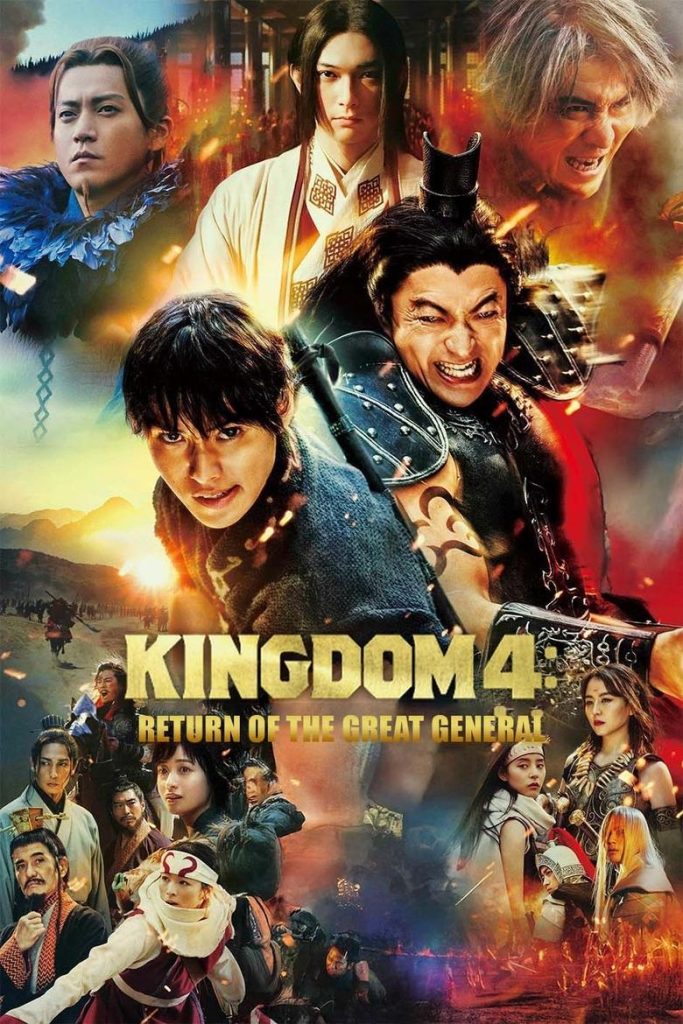
This 2024 Japanese action-adventure film continues the story from the previous movie 'Flame of Fate,' focusing on the Battle of Mayang. Shin and Wang Ki lead an all-out war against the neighboring country Zhao, depicting intense military conflicts, strategic battles, and personal struggles of soldiers in a historical war setting.
Parent Guide
A war-focused action film with extensive battle sequences and military violence. Suitable for mature tweens and teens who can handle war themes, but too intense for younger children.
Content breakdown
Extensive war violence including sword fighting, hand-to-hand combat, battlefield scenes, military strategy, and character peril. Soldiers are shown fighting, being wounded, and facing death in battle sequences. The entire film revolves around an all-out war with sustained action violence.
War scenes with injured soldiers, battlefield carnage, and tense military situations. The depiction of large-scale warfare and character peril during battles could be disturbing to sensitive viewers. No supernatural or horror elements, but realistic war violence.
No indication of strong language or profanity. As a Japanese film, any dialogue would be in Japanese with subtitles, and war-themed films in this genre typically avoid modern profanity.
No sexual content or nudity indicated. The film focuses entirely on military action and war strategy without romantic subplots or sexual elements.
No substance use shown. The film depicts historical warfare without modern elements like alcohol, drugs, or tobacco use in the context shown.
High-stakes war situations, character peril during battles, themes of sacrifice and loyalty. The 146-minute runtime maintains consistent tension through battle sequences. Emotional moments related to wartime struggles and military camaraderie.
Parent tips
This film contains extensive war violence with combat scenes, sword fighting, and battle sequences. The 146-minute runtime may be challenging for younger viewers. Consider the emotional maturity needed to handle war themes and character peril. No sexual content, substance use, or strong language is indicated, but the primary concern is the sustained action violence.
Parent chat guide
Parent follow-up questions
—
- Which character did you like best and why?
- What was the most exciting part of the movie?
- How did the soldiers help each other during battles?
- What strategies did the armies use in the battles?
- How did the film show the difference between good leadership and poor leadership?
- What do you think the movie was trying to say about war?
- How does this film compare to other war movies you've seen?
- What historical accuracy issues might exist in this fictional war story?
- How did the film balance action sequences with character development?
- What themes about loyalty, sacrifice, or duty were explored?
🎭 Story Kernel
At its heart, the film is an exploration of legacy and the philosophical weight of leadership. While previous installments focused on Shin’s physical growth, this chapter shifts the thematic burden to the definition of a Great General. Centered on the Battle of Bayou, the narrative serves as a crucible where the old guard’s wisdom meets the new generation’s ambition. It is not merely about conquering territory; it is about the spiritual inheritance passed from Ouki to Shin. The story examines the heavy cost of unification and the responsibility of carrying the dreams of fallen comrades. The film successfully transitions from a standard action epic into a poignant tragedy, emphasizing that a true leader is defined by the lives they have touched and the era they helped shape, rather than just their individual prowess on the battlefield.
🎬 Visual Aesthetics
Director Shinsuke Sato masterfully balances the macro-scale of warring states with the micro-intensity of personal vendettas. The cinematography utilizes wide, sweeping shots to establish the overwhelming odds of the Zhao army’s encirclement, creating a sense of claustrophobia despite the vast landscape. Symbolism is heavy in the lighting; Ouki is often framed against a blinding sun or bathed in a golden hue, reinforcing his near-divine status. The duel between Ouki and Houken is choreographed with a visceral, heavy impact that contrasts with the fluid, acrobatic movements seen in earlier films. The visual language shifts during the climax, stripping away the spectacle to focus on the raw, bloodied faces of the protagonists, effectively grounding the epic fantasy in a gritty, human reality that emphasizes the physical toll of their legendary ambitions.
🔍 Details & Easter Eggs
💡 Behind the Scenes
Takao Osawa underwent a rigorous physical transformation to portray Ouki, gaining significant muscle mass to match the character's superhuman proportions from the manga. This film marks the fourth installment in the franchise, filmed largely in tandem with the third movie to maintain continuity in the actors' performances and the visual tone. The production utilized thousands of extras and sophisticated CGI to recreate the scale of the Warring States period, making it one of the most expensive and ambitious live-action manga adaptations in Japanese cinema history, specifically concluding the long-awaited Battle of Bayou arc.
Where to watch
Choose region:
- Netflix
- Netflix Standard with Ads
Trailer
Trailer playback is unavailable in your region.