
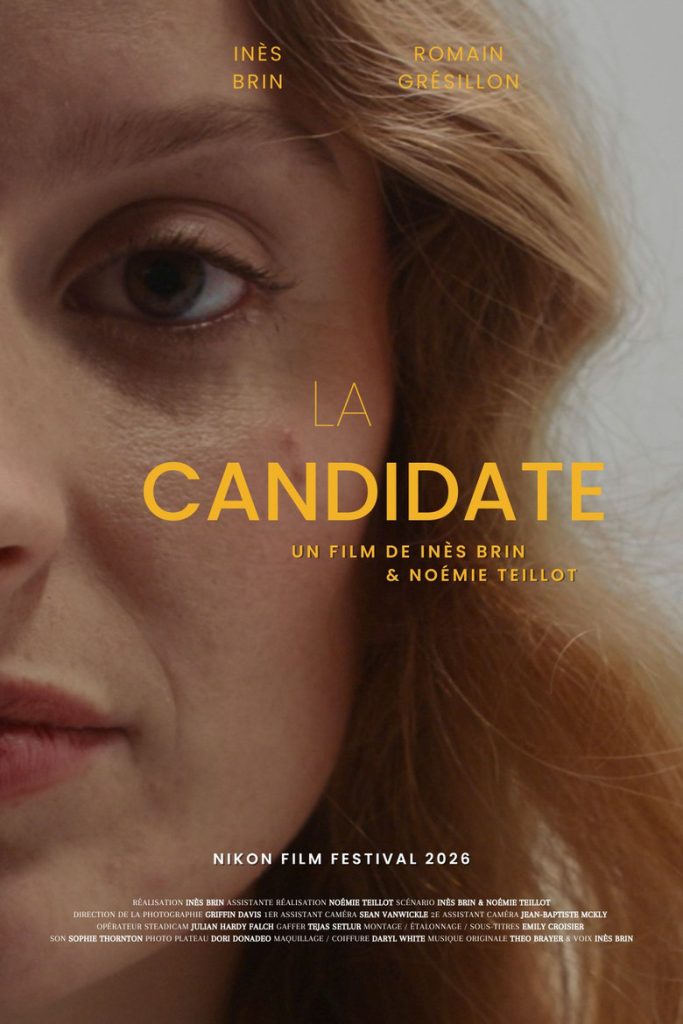
La Candidate (2026)

Released: 2026-01-31 Recommended age: 10+ No IMDb rating yet
La Candidate

Movie details

  • Genres: Drama
  • Director: Inès Brin
  • Main cast: Inès Brin, Romain Grésillon, Gwendoline Poilane, Victoria Fataki, Jay Grushkin
  • Country / region: United States of America
  • Original language: fr
  • Premiere: 2026-01-31

Story overview

In this French-language drama, a candidate attends a casting call where she's asked the profound question 'What is beauty?' This query becomes an obsession for her, leaving her initially speechless. As she grapples with this philosophical challenge, her determination to find an answer becomes the central focus of the film, exploring themes of self-discovery, artistic expression, and personal growth.

Parent Guide

A contemplative drama exploring philosophical questions about beauty through the experience of a casting candidate. The film focuses on internal struggle, determination, and artistic expression without significant mature content.

Content breakdown

Violence & peril
None

No violence, physical conflict, or perilous situations depicted.

Scary / disturbing
None

No frightening or disturbing imagery. The film's tension comes from internal philosophical struggle rather than external threats.

Language
None

No offensive language expected. Dialogue focuses on artistic and philosophical discussion.

Sexual content & nudity
None

No sexual content or nudity anticipated given the film's focus on casting and philosophical discussion.

Substance use
None

No depiction of alcohol, drugs, or tobacco use.

Emotional intensity
Mild

Moderate emotional intensity related to self-doubt, determination, and philosophical questioning. The protagonist experiences frustration and deep contemplation but no extreme emotional distress.

Parent tips

This thoughtful drama explores philosophical questions about beauty and self-expression through the lens of an aspiring performer. The film focuses on internal struggle and determination rather than action or conflict. Parents should be prepared to discuss abstract concepts about art, identity, and what makes something or someone beautiful. The French dialogue may require subtitles for non-French speakers.

Parent chat guide

This film provides excellent opportunities to discuss: 1) How we define beauty in ourselves and others, 2) The pressure of performing or being evaluated, 3) What it means to be 'at a loss for words' when facing important questions, 4) How determination helps us overcome challenges, and 5) Different cultural perspectives on art and expression. The film's contemplative nature encourages reflection rather than providing easy answers.

Parent follow-up questions

  • What do you think is beautiful?
  • How do you feel when someone asks you a hard question?
  • What does it mean to be determined?
  • Why do you think the question about beauty was so hard to answer?
  • Have you ever felt speechless when asked something important?
  • How can determination help solve problems?
  • How does society define beauty, and should we question those definitions?
  • What might the film be saying about artistic expression?
  • How do different cultures view beauty differently?
  • What philosophical approaches to beauty does the film suggest?
  • How does the film comment on performance anxiety and self-presentation?
  • In what ways can silence or being 'at a loss for words' be powerful?
  • How might the film's French cultural context influence its perspective on art?
⚠️ Deep Film Analysis (Contains Spoilers) · Click to Expand
A political thriller that reveals how power corrupts not through grand gestures, but through tiny, daily compromises.

🎭 Story Kernel

At its core, 'La Candidate' explores the erosion of personal integrity within political systems. The protagonist's journey isn't about achieving power but about how ambition gradually reshapes identity. What begins as genuine reformist zeal becomes calculated positioning. The film suggests that political corruption isn't just about illegal acts but about the slow normalization of ethical shortcuts. The driving force isn't villainy but the seductive logic of 'necessary compromises'—each small betrayal of principle justified as essential for greater influence. Ultimately, the film questions whether meaningful change is possible within systems that reward conformity over conviction.

🎬 Visual Aesthetics

The cinematography employs tight framing and shallow focus to create a sense of claustrophobia, mirroring the protagonist's shrinking moral space. Cool blue tones dominate political scenes, while warmer hues appear only in private moments that become increasingly rare. Camera movements are restrained and deliberate, with sudden handheld sequences during moments of crisis. Visual symbolism appears subtly—notice how reflective surfaces (windows, mirrors) gradually show the protagonist's image becoming distorted as her compromises accumulate. The editing rhythm accelerates as her political career advances, creating a breathless pace that mirrors her loss of control.

🔍 Details & Easter Eggs

1
Early scenes show the protagonist always wearing practical flats; her shift to power heels coincides with her first major ethical compromise, visually marking her transformation.
2
Background television news broadcasts in multiple scenes subtly track the deteriorating political situation she claims to be fighting against, creating ironic counterpoint.
3
The recurring motif of closed doors—initially she enters rooms confidently, but later scenes show her hesitating before handles, visually representing her growing isolation.

💡 Behind the Scenes

The film was shot almost entirely in natural light to enhance realism, requiring meticulous scheduling around Madrid's daylight hours. Lead actress Marina Salas prepared by shadowing actual political aides for two weeks. Several scenes were filmed during real political rallies with hidden cameras to capture authentic crowd reactions. The minimalist score was composed using only sounds recorded within government buildings—typewriters, footsteps in marble halls, elevator bells—creating an unsettling auditory landscape of bureaucracy.

Where to watch

Streaming availability has not been announced yet.

SkyMe App
SkyMe Guide Download on the App Store
VIEW