
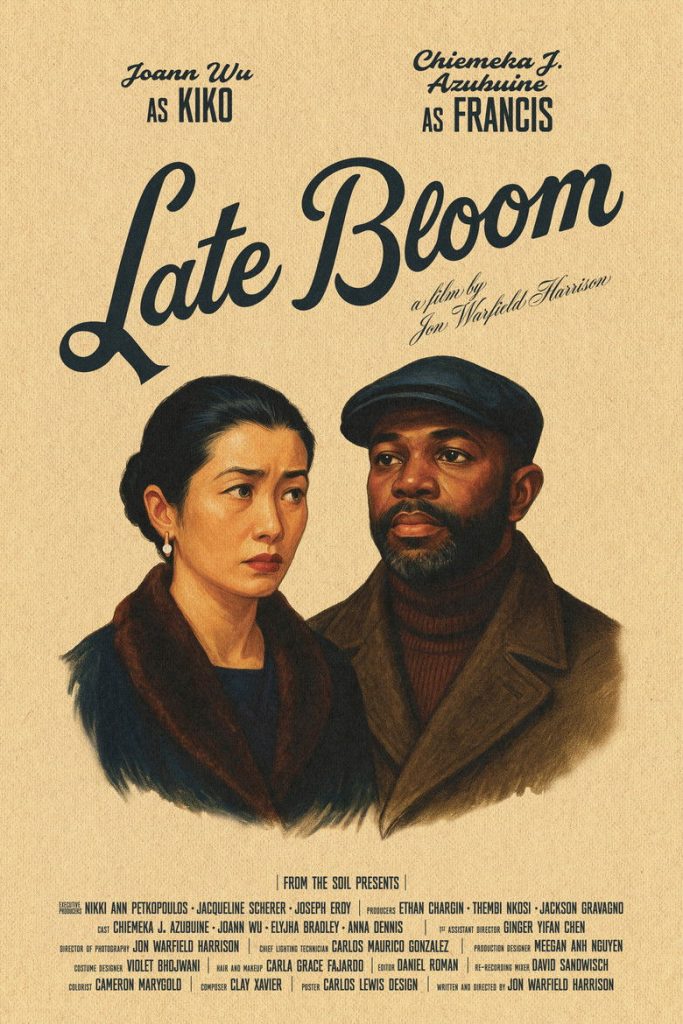
Late Bloom (2025)

Released: 2025-01-01 Recommended age: 12+ No IMDb rating yet
Late Bloom

Movie details

  • Genres: Drama
  • Director: Jon Warfield Harrison
  • Main cast: Chiemeka J. Azubuine, Joann Wu, Anna Dennis, Elyjah Bradley, Russell Johnson
  • Country / region: United States of America
  • Original language: en
  • Premiere: 2025-01-01

Story overview

Late Bloom is a 13-minute drama about Francis, a 43-year-old Black man, and his partner Kiko, a 40-year-old Asian woman, who visit the site where Francis's childhood home once stood. The film explores how Francis's unresolved childhood trauma affects their present relationship. Through quiet conversation and reflection in a foggy, secluded field, they work together to unpack suppressed emotions and foster personal growth.

Parent Guide

A contemplative short drama about processing childhood trauma within an adult relationship. Contains mature emotional themes but no explicit content. Suitable for mature pre-teens and teens with parental guidance.

Content breakdown

Violence & peril
None

No violence, action, or physical peril depicted. The film consists entirely of conversation and reflection in a peaceful natural setting.

Scary / disturbing
Mild

Themes of childhood trauma and emotional distress are discussed, but presented in a thoughtful, non-graphic manner. The foggy, isolated setting creates a melancholic but not frightening atmosphere.

Language
None

No profanity or strong language expected given the film's contemplative nature and short runtime.

Sexual content & nudity
None

No sexual content, nudity, or romantic physical contact. The focus is on emotional intimacy and conversation between partners.

Substance use
None

No depiction of alcohol, drugs, or substance use.

Emotional intensity
Moderate

Emotionally weighty themes of childhood trauma, memory, and relationship strain. The conversation is serious but ultimately constructive, focusing on healing and growth. May be emotionally challenging for sensitive viewers or those with similar personal experiences.

Parent tips

This short drama deals with mature themes of childhood trauma and emotional healing in a relationship context. While there's no explicit content, the emotional weight and abstract nature of the conversation may be difficult for younger children to grasp. Best suited for pre-teens and teens who can engage with complex emotional themes. Watch together to discuss healthy communication and processing difficult emotions.

Parent chat guide

This film provides an opportunity to discuss how past experiences can affect present relationships and the importance of open communication in partnerships. You might ask: 'What do you think Francis is feeling as he revisits his childhood home site?' or 'How do Kiko and Francis support each other through difficult conversations?' For older viewers: 'Why is it important to address childhood trauma as an adult?' Focus on themes of emotional resilience, partnership support, and healthy emotional processing.

Parent follow-up questions

  • What colors did you see in the movie?
  • How do you think the characters felt in the foggy field?
  • What does it mean to be a good friend to someone who is sad?
  • Why do you think Francis wanted to visit where his old house was?
  • How did Kiko help Francis talk about his feelings?
  • What are some ways people can feel better when remembering sad things from the past?
  • What does 'childhood trauma' mean, and how can it affect adults?
  • Why is it sometimes hard to talk about painful memories?
  • What did you notice about how Francis and Kiko communicated with each other?
  • How does the film portray the process of emotional healing in relationships?
  • What role does the setting (foggy field, secluded road) play in creating the film's mood?
  • How might Francis's experience reflect broader conversations about intergenerational trauma and mental health?
⚠️ Deep Film Analysis (Contains Spoilers) · Click to Expand
A queer coming-of-age story where the real transformation happens in the quiet moments between explosions.

🎭 Story Kernel

At its core, 'Late Bloom' is less about discovering one's sexuality and more about the terrifying freedom of claiming agency over one's own narrative. The protagonist's journey isn't driven by a desire to 'come out' but by the exhaustion of performing a version of herself that no longer fits. What propels the characters isn't external conflict but the internal pressure of unspoken truths becoming unbearable. The film suggests that self-discovery isn't a single revelation but a series of small, courageous choices that accumulate into a new identity. It's about the quiet rebellion of choosing authenticity over comfort.

🎬 Visual Aesthetics

The film employs a deliberate visual dichotomy: warm, saturated flashbacks contrast with the cooler, desaturated present, visually mapping emotional temperature against time. Cinematography favors intimate close-ups during conversations, making the audience complicit in unspoken tensions, while wider shots emphasize the protagonist's isolation within familiar spaces. The color palette subtly shifts as her self-awareness grows—muted blues and grays give way to warmer tones in key moments of connection. The camera often lingers on empty spaces after characters exit, emphasizing the emotional residue they leave behind.

🔍 Details & Easter Eggs

1
The recurring motif of clocks and watches—always slightly out of sync or stopped—visually represents the protagonist's feeling of being out of step with her own life timeline.
2
In early scenes, she's consistently framed behind barriers (windows, doorways, furniture), which gradually disappear as she becomes more self-assured.
3
The soundtrack uses diegetic sound (traffic, distant conversations) during her moments of doubt, then falls into silence when she makes decisive choices, emphasizing internal resolution.

💡 Behind the Scenes

The film was shot chronologically over 22 days to preserve the natural evolution of the protagonist's emotional state. Several key scenes were improvised based on the actors' personal experiences with similar moments of self-discovery. The director intentionally cast actors who hadn't previously played queer roles to avoid preconceived audience expectations. The neighborhood scenes were filmed in the director's actual childhood neighborhood, with many locals appearing as background extras.

Where to watch

Streaming availability has not been announced yet.

SkyMe App
SkyMe Guide Download on the App Store
VIEW