
Lava (2014)
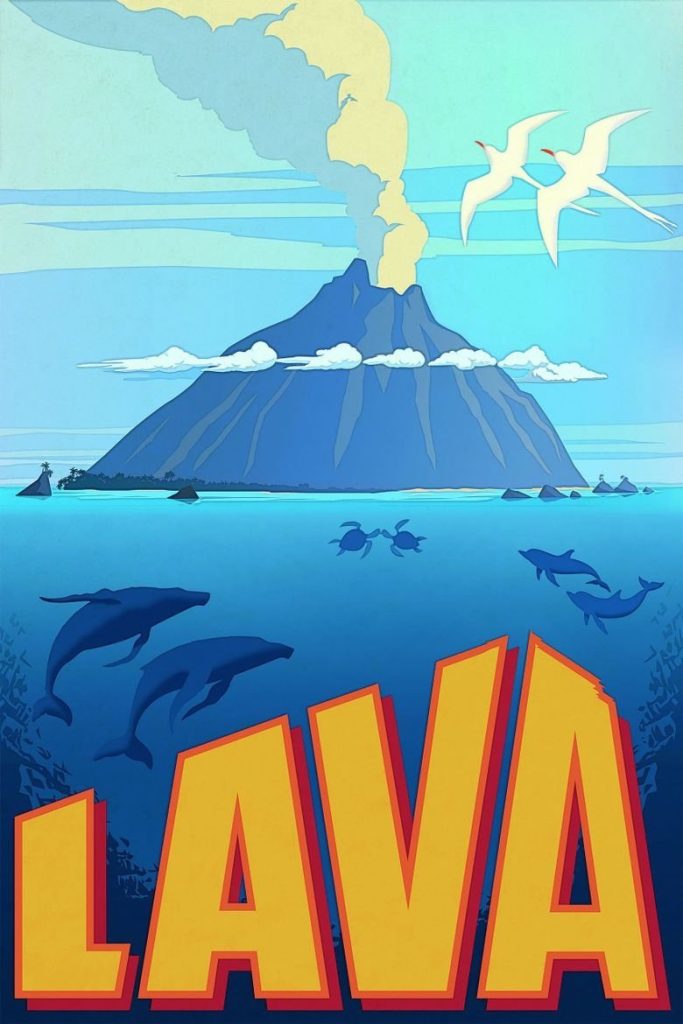
Story overview
Lava is a short animated musical that tells a love story spanning millions of years through the perspective of two volcanoes. Set against the backdrop of tropical islands and ocean volcanoes, it explores themes of patience, longing, and connection through beautiful visuals and heartfelt songs. The film uses geological time scales to create a unique perspective on enduring relationships and the natural world.
Parent Guide
A gentle, musical short film suitable for all ages with no concerning content.
Content breakdown
No violence or peril present.
Nothing scary or disturbing; volcanoes are portrayed gently.
No problematic language.
No sexual content or nudity.
No substance use depicted.
Mild themes of loneliness and longing, resolved positively.
Parent tips
This G-rated short film is completely family-friendly with no concerning content. The 9-minute runtime makes it perfect for young children's attention spans. The musical format and simple love story are accessible to all ages, though very young children might not fully grasp the geological time concepts.
Parent chat guide
Parent follow-up questions
- What colors did you see in the movie?
- Did you like the music?
- How did the volcanoes feel?
- What was your favorite part?
- Have you seen a volcano before?
- What do you think the volcanoes were waiting for?
- How did the music help tell the story?
- Why do you think the story took so long?
- What does this story teach us about patience?
- How are the volcanoes like people?
- How does the film use nature to represent emotions?
- What does the passage of time add to the story?
- How does the animation style enhance the mood?
- What themes about love does this story explore?
- Why do you think they chose volcanoes for this story?
- How effective is the musical format for this type of story?
- What commentary does the film make about loneliness and connection?
- How does the geological perspective change how we view relationships?
- What artistic choices stood out to you?
- How does this short film compare to feature-length animations?
🎭 Story Kernel
At its core, 'Lava' explores the universal human longing for connection through geological time scales. The film's true subject isn't volcanic activity but the quiet desperation of solitude—what happens when a being exists for millennia without companionship. The male volcano Uku's singing isn't just courtship; it's an existential act of faith, maintaining hope across centuries that someone might hear. The arrival of the female volcano Lele represents more than romance—it's the validation that persistence matters, that even in a seemingly indifferent universe, waiting and hoping can be rewarded. The film cleverly inverts typical romance narratives by making its protagonists immobile yet emotionally dynamic.
🎬 Visual Aesthetics
The animation employs a warm, saturated color palette dominated by oranges, yellows, and blues that mirror the film's elemental themes—fire, water, and sky. Director James Ford Murphy uses the camera as a geological observer, with sweeping pans that emphasize the vast timescale and stationary shots that make us feel the volcanoes' immobility. The character designs are brilliantly simple—faces emerge from mountain contours through minimal line work, proving emotional expression doesn't require complex features. Watercolor-style backgrounds create a dreamlike quality, while the ocean's constant movement provides visual contrast to the volcanoes' stillness. The sunrise/sunset transitions aren't just time markers—they're emotional barometers.
🔍 Details & Easter Eggs
💡 Behind the Scenes
The seven-minute short took Pixar animators nearly five years to complete, with director James Ford Murphy drawing inspiration from his honeymoon in Hawaii. The song 'Lava' was written first—the entire film was built around the music, unusual for Pixar's typically story-first approach. Voice actor Kuana Torres Kahele, who sings Uku's parts, is actually a native Hawaiian musician, not a professional voice actor. The film's minimal dialogue (just the song lyrics) was a deliberate choice to make it universally understandable without translation. Interestingly, the team consulted with geologists to ensure the volcanic formations were scientifically plausible despite the magical realism.
Where to watch
Choose region:
- Disney Plus
- Apple TV
- Google Play Movies
- YouTube
- Fandango At Home