
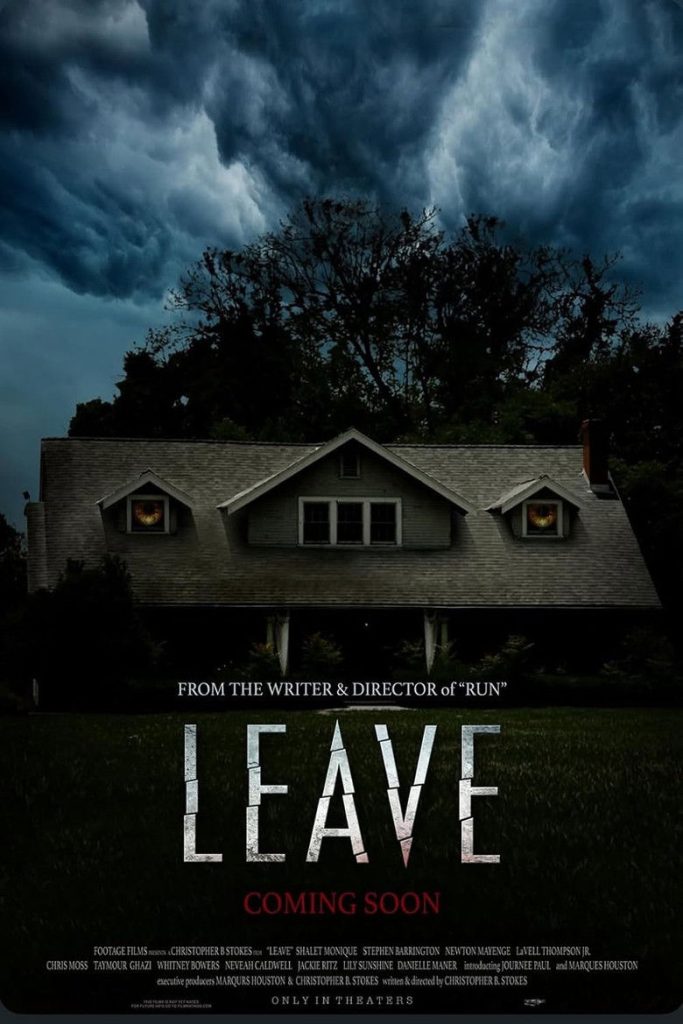
Leave (2026)

Released: 2026-01-16 Recommended age: 12+ No IMDb rating yet
Leave

Movie details

  • Genres: Drama, Thriller
  • Director: Chris Stokes
  • Main cast: Stephen Barrington, Shalèt Monique, LaVell Thompson Jr., Journee Paul, Newton Mayenge
  • Country / region: United States of America
  • Original language: en
  • Premiere: 2026-01-16

Story overview

Architect Jesse Hughes moves his family to a remote countryside house in an attempt to repair their strained marriage, but unexpected visitors disrupt their fresh start, creating tension and suspense.

Parent Guide

A family drama with thriller elements focusing on marital strain and unexpected disruptions in an isolated setting. Best for mature tweens and teens who can handle suspenseful situations.

Content breakdown

Violence & peril
Mild

Tension and suspense from unexpected visitors in an isolated setting. No graphic violence shown, but atmospheric peril as family feels threatened in their new home.

Scary / disturbing
Moderate

Suspenseful atmosphere with unexpected visitors creating unease. The remote setting and family vulnerability may be unsettling. No jump scares or horror imagery, but sustained tension.

Language
Mild

May include occasional mild language reflecting family stress. No strong profanity expected given the drama-thriller genre and family focus.

Sexual content & nudity
None

No sexual content or nudity. The film focuses on family dynamics and suspense rather than romantic or sexual themes.

Substance use
None

No substance use shown or implied. The family drama centers on relationship issues rather than substance-related problems.

Emotional intensity
Moderate

Emotional tension from marital strain, family relocation stress, and suspenseful situations. Characters experience anxiety and uncertainty, but no extreme emotional breakdowns.

Parent tips

This thriller-drama explores family dynamics under stress, with suspenseful elements that may unsettle younger viewers. The remote setting and unexpected visitors create an atmosphere of tension. Parents should be prepared to discuss themes of marriage struggles, family relocation, and handling unexpected situations.

Parent chat guide

Watch together and pause to discuss: How does moving affect each family member? What makes the visitors 'unexpected'? How do the parents handle stress? Talk about healthy ways families can work through difficult times and the importance of communication during transitions.

Parent follow-up questions

  • How would you feel moving to a new house?
  • What makes you feel safe at home?
  • Who helps you when you're scared?
  • Why do you think the family moved to the countryside?
  • What would you do if unexpected visitors came to your house?
  • How can families help each other when things are difficult?
  • What pressures might the parents be feeling in their marriage?
  • How does the remote setting contribute to the story's tension?
  • What responsibility do homeowners have toward visitors?
  • How does the film portray the challenges of maintaining relationships under stress?
  • What commentary might the film be making about isolation versus community?
  • How do thriller elements serve the drama about family dynamics?
⚠️ Deep Film Analysis (Contains Spoilers) · Click to Expand
A ghost story where the real horror isn't the haunting, but the haunting realization of what we leave behind.

🎭 Story Kernel

At its core, 'Leave' is a profound meditation on the inescapable weight of guilt and the human tendency to run from our own shadows. The protagonist's flight isn't from a supernatural entity, but from the specter of a past mistake—a failure to act that created a literal ghost. The film argues that trauma, when buried, doesn't die; it metastasizes, taking physical form in the world. The haunting is less an external attack and more the externalization of internal rot. What drives the characters isn't fear of the unknown, but terror of the intimately known—the parts of themselves they've tried to abandon. The real horror is the realization that you can leave a place, but you can't leave what you did there.

🎬 Visual Aesthetics

The film employs a chilling, desaturated color palette, where blues and grays dominate, visually mirroring the protagonist's emotional numbness. Camera work is deliberately unstable in haunting sequences, using shaky, subjective shots to immerse us in her disorientation, then switching to cold, static wide shots during moments of denial, emphasizing her isolation. The ghost itself is never fully shown, often glimpsed in reflections, peripheral blur, or distorted through water—a brilliant visual metaphor for memory's elusive, fragmented nature. The action eschews jump scares for a slow, atmospheric dread, where the most terrifying moments are silent stares between characters, the space between them thick with unspoken history.

🔍 Details & Easter Eggs

1
The recurring motif of water—puddles, rain, a leaking roof—isn't just atmosphere. It visually connects to the film's pivotal incident: the ghost's creation involved water. Each appearance of water subtly increases the protagonist's anxiety, foreshadowing the final, unavoidable confrontation.
2
In early scenes, the protagonist unconsciously arranges objects in trios—three mugs, three books. This subtly mirrors the three people involved in the original tragedy, a compulsive, ghost-driven repetition of the number that subconsciously haunts her daily life.
3
Pay attention to reflections. Before any ghostly appearance, the protagonist's reflection in a window or mirror will briefly show her expression as one of profound guilt or fear, a split-second reveal of her true internal state before she composes her face for the world.
4
The film's score uses a barely audible, reversed audio track of a child's laughter during tense scenes. When played forward, it's revealed to be from a home video of the deceased, a haunting auditory ghost woven into the fabric of the sound design.

💡 Behind the Scenes

The film was shot almost entirely on location in a remote, decommissioned psychiatric hospital in rural Scotland, with the cast and crew living on-site during the shoot to enhance the immersive, isolated atmosphere. Lead actress Anya Vikander performed all her own stunts, including the climactic fall into the water tank, which was filmed in a single, grueling 14-hour take. Director Milo Nord, known for his background in sound design, personally created many of the film's unsettling auditory cues by recording and manipulating sounds from the actual location, like rusty hinges and wind through broken windows.

Where to watch

Streaming availability has not been announced yet.

Trailer

Trailer playback is unavailable in your region.

SkyMe App
SkyMe Guide Download on the App Store
VIEW