
Lend a Paw (1941)
Story overview
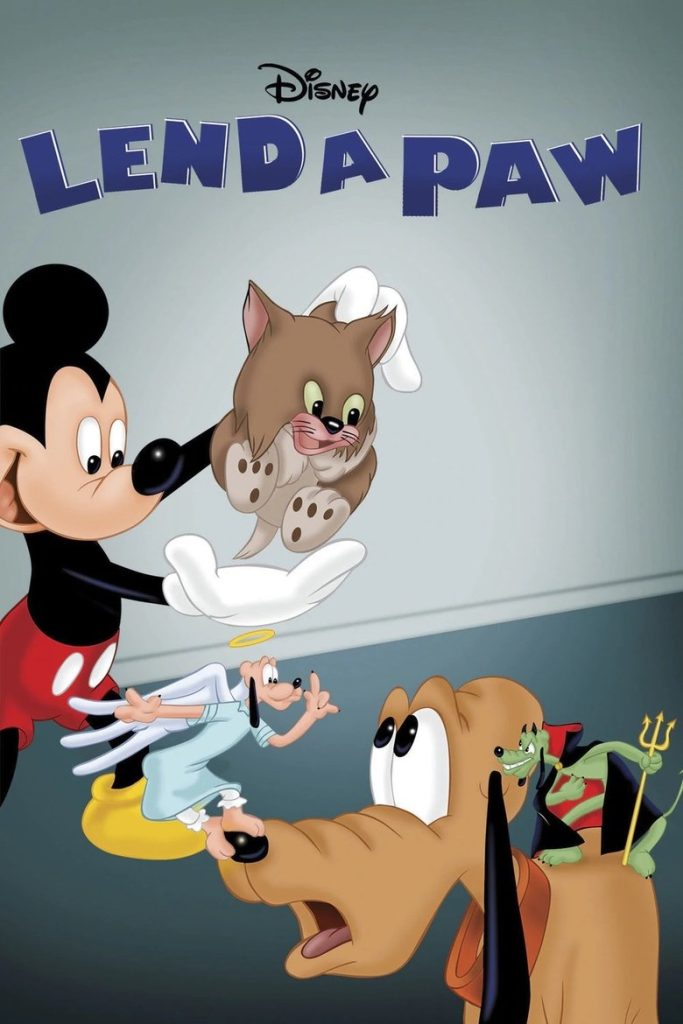
This 1941 animated short from Disney features Pluto the dog experiencing jealousy when Mickey Mouse shows attention to a kitten. Pluto's internal conflict is portrayed through a devil and angel version of himself debating whether to help when the kitten falls into a well. After rescuing the kitten, Pluto becomes a hero and ultimately forms a friendship with the kitten. The story explores themes of jealousy, moral choices, and redemption in a simple, accessible way.
Parent Guide
A gentle, classic Disney short with positive moral lessons about jealousy and helping others, suitable for most children.
Content breakdown
A kitten falls into a well, creating mild peril that is quickly resolved with a rescue. No actual violence occurs.
The depiction of Pluto's 'devil-self' might be slightly unsettling for very sensitive young children, but it's cartoonish and not frightening.
No problematic language.
No sexual content or nudity.
No substance use.
Mild emotional themes of jealousy and moral conflict, resolved positively with friendship.
Parent tips
This classic Disney short is generally appropriate for most children, featuring simple moral lessons about jealousy and doing the right thing. The conflict is mild and resolved positively, with no real violence or scary content. At just 8 minutes long, it's a good option for young viewers with shorter attention spans.
Parents should note that the depiction of Pluto's 'devil-self' might be confusing for very young children who take things literally. The angel/devil imagery is cartoonish and not frightening, but some children might need explanation that this represents Pluto's internal thoughts rather than actual supernatural beings.
The film's themes of jealousy and moral decision-making provide good conversation starters about emotions and behavior. The positive resolution shows that even when we feel jealous or conflicted, choosing to help others leads to friendship and appreciation.
Parent chat guide
After watching, discuss how Pluto felt when Mickey paid attention to the kitten and how he resolved his feelings. Ask what your child thinks about the angel and devil imagery and whether they've ever had similar internal debates about doing the right thing. You could also talk about times they've helped someone even when they didn't initially want to.
For younger children, you might focus on the friendship that develops at the end. For older children, you could discuss more abstract concepts like moral dilemmas and how we make ethical decisions when our emotions conflict with what we know is right.
Parent follow-up questions
- How did Pluto feel when Mickey played with the kitten?
- Was it nice that Pluto helped the kitten?
- Do you think Pluto and the kitten will be friends now?
- Have you ever felt like you wanted all the attention?
- What does it mean to be a hero?
- Why do you think Pluto was jealous of the kitten?
- What do the angel and devil versions of Pluto represent?
- How did helping the kitten change how Pluto felt?
- Have you ever had to choose between what you want and what's right?
- What does this story teach us about friendship?
- How does the film show internal conflict in a visual way?
- What might have happened if Pluto hadn't rescued the kitten?
- How do jealousy and heroism relate in this story?
- Do you think the angel/devil metaphor is effective for showing moral choices?
- What real-life situations might involve similar dilemmas?
- How does this short film use animation to represent psychological concepts?
- What cultural or historical context might influence how we interpret the angel/devil imagery?
- How does the resolution reflect traditional moral narratives?
- Could this story be told differently for modern audiences?
- What does this say about how media portrays ethical decision-making?
🎭 Story Kernel
At its core, 'Lend a Paw' explores the tension between instinct and morality through Pluto's internal conflict. The film presents a simple ethical dilemma—saving a drowning kitten versus following Mickey's orders—that reveals profound questions about compassion versus obedience. Pluto's struggle isn't just about rescuing a cat; it's about whether to act on empathy despite potential consequences. The kitten represents vulnerability that triggers Pluto's protective instincts, while Mickey's initial disapproval creates a moral quandary. Ultimately, the film suggests that true virtue lies in acting compassionately even when it contradicts authority or self-interest, with Pluto's redemption coming through selfless action rather than blind loyalty.
🎬 Visual Aesthetics
The animation employs stark visual contrasts to emphasize moral choices. Pluto's world is rendered in warm, earthy tones when he's behaving 'properly,' but shifts to cold blues and threatening shadows during his internal conflict. The water sequences use fluid, almost impressionistic animation to convey the kitten's vulnerability. Notice how the camera adopts Pluto's perspective during key moments—low-angle shots when he's conflicted, close-ups on his expressive eyes during decision points. The kitten's design emphasizes helplessness through oversized eyes and delicate movements, while Pluto's physical comedy (like his exaggerated reactions) contrasts with subtle emotional moments. The Oscar-winning animation balances slapstick with genuine pathos through this visual storytelling.
🔍 Details & Easter Eggs
💡 Behind the Scenes
This 1941 Disney short won the Academy Award for Best Animated Short Film, marking Pluto's only Oscar-winning starring role. Director Clyde Geronimi would later helm 'Cinderella' and 'Sleeping Beauty.' The kitten's vocalizations were created by sound effects artist Jimmy MacDonald using modified squeak toys. Interestingly, the film was re-released during WWII with modified scenes removing potentially frightening elements for wartime audiences. The water animation techniques developed for this short were later used in 'Bambi's' rain sequences. Voice actor Pinto Colvig, who performed Pluto's growls and whimpers, based the character's conflicted sounds on his own dog's behavior.
Where to watch
Choose region:
- Disney Plus