
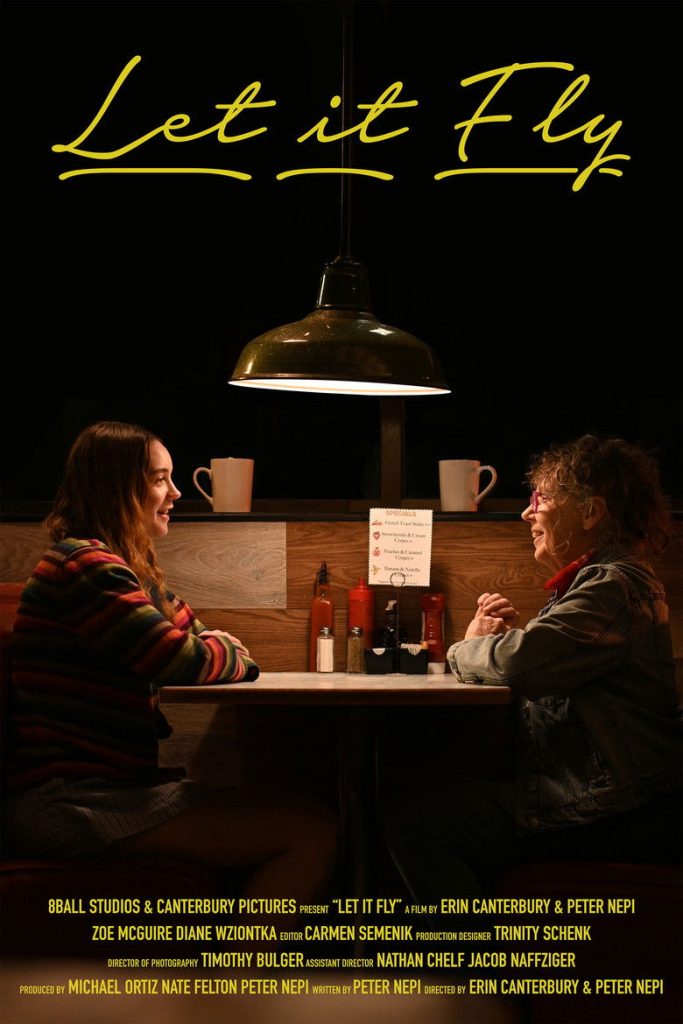
Let it Fly (2026)

Released: 2026-01-01 Recommended age: 8+ No IMDb rating yet
Let it Fly

Movie details

  • Genres: Adventure, Comedy, Drama
  • Director: Erin Canterbury, Peter Nepi
  • Main cast: Zoe McGuire, Diane Wziontka, Karen Gonzalez, Skyler Studholme, Nate Felton
  • Original language: en
  • Premiere: 2026-01-01

Story overview

Let it Fly is an adventure-comedy-drama about Zoe, an eccentric young woman who forms an unexpected bond with a wild elderly woman, discovering shared quirks and life perspectives through their interactions.

Parent Guide

A gentle adventure-comedy about friendship across generations with positive messages about acceptance and personal growth. Minimal concerning content makes it appropriate for most children with parental guidance for younger viewers.

Content breakdown

Violence & peril
Mild

May include light comedic peril typical of adventure films (e.g., minor mishaps during outdoor activities) but no serious violence or danger.

Scary / disturbing
None

No frightening or disturbing content. The 'wild' elderly character is portrayed as eccentric and free-spirited, not threatening.

Language
None

No offensive language expected in this family-friendly film.

Sexual content & nudity
None

No sexual content or nudity.

Substance use
None

No depiction of substance use.

Emotional intensity
Mild

Light emotional moments related to friendship and personal discovery, but nothing overly intense or distressing.

Parent tips

This film focuses on intergenerational friendship and personal growth with lighthearted adventure elements. It's suitable for family viewing with minimal concerning content, but younger children might need help understanding some character dynamics.

Parent chat guide

After watching, discuss how Zoe and the elderly woman connect despite their age difference. Talk about what makes someone 'eccentric' or 'wild' and whether those traits are positive. Explore how friendships can form between very different people and what we can learn from others' life experiences.

Parent follow-up questions

  • What was your favorite part of the movie?
  • How did Zoe and the lady become friends?
  • What adventures did they have together?
  • Why do you think Zoe connected with someone so much older?
  • What made the elderly woman 'wild' in the story?
  • What did Zoe learn from her new friend?
  • How does the movie show that age doesn't define friendship?
  • What does 'eccentric' mean and how is it portrayed positively?
  • What challenges might come from such an unusual friendship?
  • How does the film explore themes of authenticity versus social conformity?
  • What commentary might the film be making about intergenerational relationships in modern society?
  • How do the adventure elements serve as metaphors for personal growth?
⚠️ Deep Film Analysis (Contains Spoilers) · Click to Expand
A poignant exploration of grief disguised as a sports drama, where every catch is a metaphor for letting go.

🎭 Story Kernel

The movie is less about baseball and more about the silent, suffocating weight of unresolved grief. The protagonist's obsession with perfecting his pitching form isn't driven by athletic ambition, but by a desperate attempt to control the one thing he couldn't—the tragic accident that took his brother. His journey to the championship isn't a quest for glory, but a reluctant pilgrimage to the emotional ground zero he's been avoiding. The final game-winning pitch isn't a triumph of skill, but an act of surrender, releasing the ball—and his guilt—into the ether, finally allowing himself to miss the target and be human.

🎬 Visual Aesthetics

The cinematography masterfully uses a desaturated, almost sepia-toned palette for flashbacks and emotional lows, contrasting with the stark, bright whites and greens of the baseball field in the present—visualizing the protagonist's compartmentalization. Camera work is intimate and shaky during personal moments, locking us into his disorientation, then switches to sweeping, stable wide shots during games, emphasizing the isolating vastness of his public performance. Key symbolism appears in recurring shots of empty doorways and the brother's untouched bedroom, framing absence as a physical space he must walk through.

🔍 Details & Easter Eggs

1
The protagonist's persistent habit of adjusting his cap three times before each pitch is a subtle ritual he shared with his brother; in the final scene, he does it only once, visually breaking the chain of memory.
2
Early in the film, a shattered photo frame is hastily taped back together, mirroring the protagonist's fractured psyche; the tape is visibly still there in the background of later scenes, a permanent, ugly repair.
3
The score during the climactic pitch incorporates a faint, distorted echo of the cheerful tune from the opening scene's car ride—the last moment of innocence before the accident.

💡 Behind the Scenes

The lead actor, who had no prior baseball experience, underwent three months of intensive training with a former minor league pitcher to achieve authentic mechanics. The pivotal game scenes were filmed at a historic, since-demolished minor league stadium, giving the finale its uniquely nostalgic atmosphere. Director insisted on using practical effects for the accident sequence, modifying a vintage car rather than relying on CGI to ground the tragedy in tangible, brutal reality.

Where to watch

Streaming availability has not been announced yet.

SkyMe App
SkyMe Guide Download on the App Store
VIEW