
Madagascar (2005)
Story overview
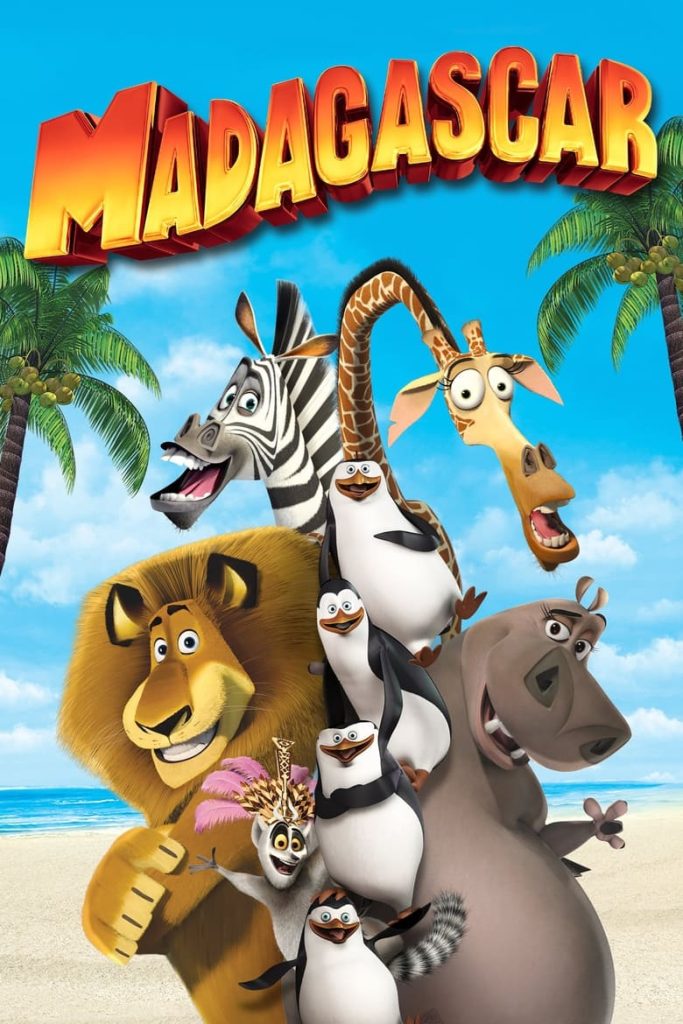
Madagascar is a 2005 animated comedy adventure film that follows four animal friends from the Central Park Zoo—Alex the lion, Marty the zebra, Gloria the hippo, and Melman the giraffe—who accidentally find themselves stranded on the island of Madagascar after a series of misadventures. The film explores themes of friendship, identity, and adapting to new environments as the animals navigate the wild, contrasting their pampered zoo lives with the realities of nature.
Parent Guide
Madagascar is a lighthearted animated film with minimal content concerns, making it appropriate for most children. It features cartoonish action, mild peril, and comedic elements that are typical of family movies. Parents can expect a fun, engaging story with positive messages about friendship and adaptability.
Content breakdown
Includes cartoonish violence and peril, such as animals being chased or in danger (e.g., Alex hallucinating and seeing his friends as steaks, brief scenes of animals fighting or falling). No graphic injuries or real harm is depicted; it's played for comedy.
Some scenes might be slightly intense for very young children, such as when Alex acts aggressively due to hunger or when characters are lost at sea. However, these moments are brief and resolved humorously, with no lasting fright.
Includes very mild language like 'butt' and 'shut up,' used infrequently in a comedic context. No strong profanity or offensive terms.
No sexual content or nudity. The film focuses on animal characters in a family-friendly manner.
No depiction of substance use, drugs, or alcohol. The characters are animals in a natural setting.
Emotional moments are light, such as when the animals miss their home or face challenges. There's no intense sadness or trauma; themes are handled with humor and positivity.
Parent tips
Madagascar is a family-friendly animated film with mild humor and action. It's suitable for most children, but parents should note some scenes of cartoonish peril and comedic violence. The film includes brief moments where characters are in danger (e.g., Alex hallucinating steaks as his friends) and mild language like 'butt.' There's no sexual content, substance use, or intense emotional themes. It's a good choice for family viewing, especially for kids who enjoy animal adventures and slapstick comedy.
Parent chat guide
Parent follow-up questions
- Which animal was your favorite and why?
- What was the funniest part of the movie?
- How did the animals help each other in Madagascar?
- Why do you think Alex had trouble adapting to the wild?
- What did Marty learn about being a zebra?
- How did the penguins' plan change the animals' lives?
- Discuss the theme of 'home' in the movie. Did the animals find a better home in Madagascar?
- How does the film use humor to address serious topics like survival?
- What does the movie say about friendship under pressure?
- Analyze the cultural references in the film, such as the portrayal of 'wild' vs. 'civilized.'
- How does Madagascar comment on consumerism and zoo life?
- Discuss the character development of Alex from a performer to a wild lion.
🎭 Story Kernel
At its core, 'Madagascar' is a satirical exploration of the nature-versus-nurture debate and the illusion of freedom. The film questions whether our desires are innate or constructed by our environment. The four protagonists—Alex the lion, Marty the zebra, Gloria the hippo, and Melman the giraffe—are driven by a romanticized notion of 'the wild' born from captivity-induced boredom. Their journey reveals that the grass isn't always greener; Alex's predatory instincts reawaken not out of malice, but biological necessity, forcing the group to confront the harsh realities their cushy zoo life insulated them from. The real conflict isn't escaping the zoo, but reconciling their cultivated identities with their primal natures.
🎬 Visual Aesthetics
The film employs a stark visual dichotomy to underscore its themes. The opening Manhattan sequences are rendered with clean lines, saturated but controlled colors, and geometric precision, mirroring the structured, artificial life of the zoo. Upon reaching Madagascar, the palette explodes into untamed vibrancy—lush greens, chaotic foliage, and organic, flowing shapes. The camera work shifts from static, framed shots in New York to dynamic, sweeping movements on the island, visually representing the transition from order to chaos. The character animation brilliantly uses exaggerated, rubbery physics for comedic effect, particularly in the lemurs' manic movements, contrasting with the more weighted, realistic movements of the larger animals when conveying drama or fear.
🔍 Details & Easter Eggs
💡 Behind the Scenes
The film's iconic penguins—Skipper, Kowalski, Rico, and Private—were originally minor background characters. Their scene-stealing antics and deadpan military humor resonated so strongly with test audiences that their roles were significantly expanded, eventually leading to their own spin-off franchise. Ben Stiller (Alex) and Chris Rock (Marty) recorded many of their dialogue sessions together to capture authentic comedic chemistry, a rarity in animated voice acting where actors usually work solo. The animators studied real animals at the Central Park Zoo for movement reference but were given license to exaggerate expressions for emotional clarity, leading to the film's distinctive, elastic style.
Where to watch
Choose region:
- Amazon Video
- Apple TV Store
- Google Play Movies
- YouTube
- Fandango At Home
Trailer
Trailer playback is unavailable in your region.