
Maggie Simpson in “The Longest Daycare” (2012)
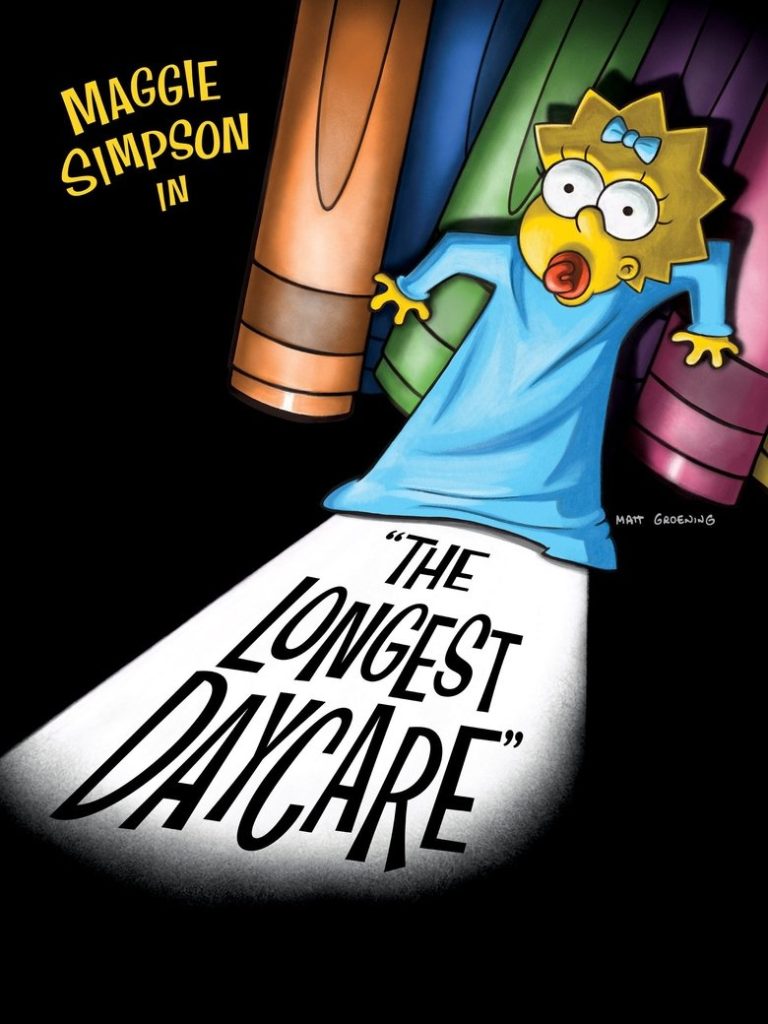
Story overview
Maggie Simpson experiences her first day at a daycare center called the Ayn Rand School for Tots. After being assessed as having average intelligence, she is separated from the gifted children and placed with less advanced classmates. Maggie befriends a caterpillar and becomes determined to protect it from another child who wants to harm it, leading to a heartfelt adventure about friendship and protection.
Parent Guide
A gentle animated short about a baby's first daycare experience, featuring themes of friendship and protection with mild peril.
Content breakdown
Mild peril involving a caterpillar that might be harmed by another child. No actual violence occurs, but there is tension around protecting the small creature.
Some children might find the idea of a caterpillar being threatened slightly unsettling, but the tone remains gentle throughout.
No dialogue or language concerns in this wordless animated short.
No sexual content or nudity.
No substance use depicted.
Mild emotional moments related to feeling excluded and wanting to protect a vulnerable creature. The resolution is positive and reassuring.
Parent tips
This short animated film explores themes of intelligence labeling, friendship, and empathy in a daycare setting. While mostly gentle, there is mild peril involving a caterpillar that might be harmed, which could be concerning for very young or sensitive viewers. The story presents an opportunity to discuss how we treat others who are different and the importance of kindness toward all creatures.
Parent chat guide
Parent follow-up questions
- How did Maggie feel when she couldn't play with the gifted kids?
- Why did Maggie want to help the caterpillar?
- What would you do if you saw someone being mean to a bug or animal?
- How do you make friends at school or daycare?
- What was your favorite part of Maggie's day?
- What does it mean to be 'average' or 'gifted' at school?
- Why do you think the other child wanted to hurt the caterpillar?
- Have you ever felt left out like Maggie did? How did you handle it?
- What does this story teach us about protecting smaller creatures?
- How did Maggie show she was smart even though she was called 'average'?
- What message does this film send about intelligence testing and labeling?
- How does the daycare setting reflect real-world social structures?
- What does Maggie's protection of the caterpillar symbolize about empathy?
- Have you ever seen someone treated differently because of abilities or labels?
- What qualities besides intelligence make someone valuable or special?
- How does this short film comment on educational tracking and early childhood assessment?
- What parallels can you draw between the daycare's social dynamics and broader societal structures?
- How does Maggie's journey challenge conventional definitions of intelligence and worth?
- What does the caterpillar represent in terms of vulnerability and protection?
- How might this story apply to real-world situations of exclusion or bullying?
🎭 Story Kernel
At its core, 'The Longest Daycare' is a miniature existential drama about institutional determinism versus individual agency. Maggie Simpson, labeled 'average' by the Ayn Rand School for Tots' cold assessment system, becomes an unlikely hero when she recognizes a rare caterpillar's potential for beauty. The film explores how systems categorize and discard life based on arbitrary metrics, while Maggie's quiet rebellion—protecting the caterpillar from the destructive Gerald—becomes a profound act of defiance against a world that has already written her off. The butterfly's eventual fate, crushed by Gerald's mallet despite Maggie's efforts, delivers a surprisingly poignant commentary on the fragility of beauty in a chaotic world.
🎬 Visual Aesthetics
The animation masterfully uses visual shorthand to convey complex ideas without dialogue. The sterile, institutional color palette of the daycare—dominated by grays and muted blues—contrasts sharply with the vibrant green of the caterpillar and the eventual butterfly. Camera angles emphasize power dynamics: low-angle shots make the daycare workers loom ominously, while overhead perspectives highlight the labyrinthine playroom. The action unfolds with silent film precision, where exaggerated facial expressions and physical comedy (like Maggie's determined crawl) carry emotional weight. Visual symbolism is everywhere, from the 'No Child Left Untested' poster parodying educational bureaucracy to the butterfly motif representing fragile potential.
🔍 Details & Easter Eggs
💡 Behind the Scenes
This 2012 animated short was created specifically to screen before 'Ice Age: Continental Drift' in theaters, marking Maggie Simpson's first solo theatrical outing after decades as a supporting character in 'The Simpsons.' Director David Silverman intentionally designed it as a silent film, using only musical score and sound effects to tell the story, challenging the team to convey narrative purely through animation. The entire short was produced using traditional hand-drawn animation rather than digital methods, giving it a distinct visual texture. Composer Hans Zimmer, known for epic film scores, created the surprisingly emotional orchestral soundtrack that elevates Maggie's small-scale adventure to mythic proportions.
Where to watch
Choose region:
- Disney Plus
Trailer
Trailer playback is unavailable in your region.