
Mars: One Day on the Red Planet (2020)
Story overview
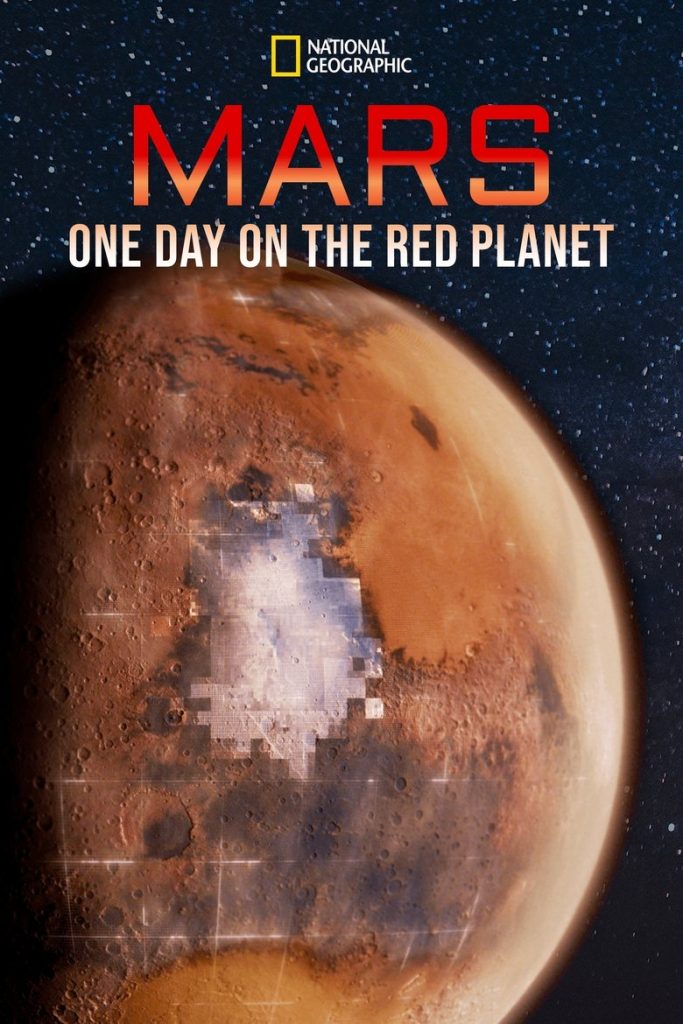
Mars: One Day on the Red Planet is a 2020 documentary that takes viewers on a visually stunning journey across Mars using real satellite and rover data. Narrated by Nigel Barber and directed by Martin Johnson, this TV-G rated film offers a scientifically accurate depiction of the Martian landscape, weather patterns, and geological features over a 24-hour period. It presents Mars as a dynamic world with canyons, volcanoes, dust storms, and polar ice caps, making complex planetary science accessible through immersive visuals and clear explanations.
Parent Guide
Educational documentary with no concerning content. Suitable for all ages with parental guidance for younger viewers to explain scientific concepts.
Content breakdown
No violence, conflict, or perilous situations. Includes scientific discussion of Mars' harsh environment but presented factually without dramatic tension.
No scary or disturbing content. Some visuals of vast Martian landscapes might feel awe-inspiring but not frightening. Dust storms are shown as natural phenomena.
No offensive language. Uses scientific and descriptive terminology appropriate for educational content.
No sexual content or nudity.
No substance use or references.
Mild sense of wonder and curiosity about space exploration. No intense emotional scenes.
Parent tips
This documentary is excellent for sparking interest in space science. Watch together and pause to discuss Mars facts or compare to Earth. The 88-minute runtime may be long for younger children; consider breaking into shorter segments. The scientific concepts are presented clearly but some terms might need explanation for kids under 8. No concerning content exists, making it safe for all ages during family viewing.
Parent chat guide
Parent follow-up questions
- Can you draw what Mars looks like?
- What colors did you see on Mars?
- Would you like to ride a rover on Mars?
- How is Mars different from Earth?
- Why do you think Mars is red?
- What job would you want if you worked on Mars?
- What challenges would humans face living on Mars?
- How do rovers send pictures back to Earth?
- Why is water important for finding life on Mars?
- What ethical considerations exist for Mars colonization?
- How does Martian geology help us understand Earth's history?
- What technological breakthroughs are needed for sustained Mars missions?
🎭 Story Kernel
The film is less a documentary about Mars and more a meditation on human projection. It expresses the tension between our scientific desire to know a world objectively and our psychological need to see ourselves reflected in it. The narrative drive isn't propelled by a traditional plot, but by the slow, deliberate accumulation of data points that gradually reveal Mars not as a dead rock, but as a complex system with its own 'personality'—a personality we are only beginning to decode. The characters—the scientists, engineers, and rovers—are driven by a quiet obsession to listen to a planet that speaks in whispers of radiation, dust storms, and ancient riverbeds, forcing us to confront the loneliness of being the only listeners in a potentially silent solar system.
🎬 Visual Aesthetics
The visual language masterfully employs a dual aesthetic: stark, high-resolution scientific imagery from orbiters and rovers contrasts with intimate, almost tactile close-ups of Martian soil and rock. The color palette is dominated by the relentless, oxidized reds and oranges of the surface, punctuated by the sterile blues and whites of human-made technology. This creates a constant visual dialogue between the alien and the familiar. The 'action' is in the slow pans across desolate landscapes and the precise, mechanical movements of robotic arms, cinematography that evokes both awe and profound isolation. Symbolism emerges in the recurring shots of rover tracks—fragile, temporary lines drawn in an ancient, indifferent desert.
🔍 Details & Easter Eggs
💡 Behind the Scenes
The film's most striking surface visuals are not CGI but processed composites from NASA's Mars Reconnaissance Orbiter HiRISE camera and Perseverance rover Mastcam-Z. Key 'flyover' sequences were created by painstakingly draping these high-resolution textures over detailed topographic models from laser altimeter data. The 'day' in the title is conceptual; it compresses events from multiple Martian solar days (sols) into a narrative 24-hour cycle. Several mission scientists from JPL appear as themselves, providing voiceover, with their scripted lines often based on real, unpublished commentary from mission logs.
Where to watch
Choose region:
- Disney Plus