
Mean Girls (2004)
Story overview
Mean Girls follows a teenage girl who moves from Africa to suburban Illinois and navigates the complex social hierarchy of her new high school. She befriends a group of popular but manipulative girls known as 'The Plastics' and gets caught up in their world of gossip, cliques, and social warfare. The film satirizes high school culture while exploring themes of friendship, identity, and the pressures of fitting in.
Parent Guide
PG-13 for mature thematic elements, sexual content, language, and some teen partying. Most appropriate for viewers 13+ due to social dynamics and mature humor.
Content breakdown
No physical violence, but includes social bullying, exclusion, and verbal conflicts among teens.
Some emotionally intense scenes involving social humiliation and peer pressure that could be upsetting to sensitive viewers.
Includes moderate profanity and sexual references typical of teen dialogue in a PG-13 film.
Contains sexual references, discussions about sexuality, and suggestive content without explicit scenes.
Brief references to teen partying and alcohol, but not depicted as positive or central to the plot.
Deals with themes of social anxiety, peer pressure, identity struggles, and friendship conflicts that may resonate strongly with teens.
Parent tips
Mean Girls is a comedy-drama that humorously portrays high school social dynamics, but contains mature themes that may require parental guidance. The film includes moderate language, discussions of sexuality, and social bullying that could be confusing or inappropriate for younger viewers. Parents should consider their child's maturity level and readiness to handle these topics before viewing.
This movie provides opportunities to discuss peer pressure, healthy friendships, and the importance of being true to oneself. The exaggerated portrayal of high school cliques can serve as a conversation starter about real-world social situations and empathy toward others.
Due to the PG-13 rating, the film is most appropriate for viewers aged 13 and up, though some mature 11-12 year olds might handle it with parental discussion. The social dynamics and humor will be most relatable to middle school and high school students.
Parent chat guide
Use the film's scenarios to discuss real-life situations your child might encounter at school or with friends. Talk about healthy ways to handle peer pressure, resolve conflicts, and maintain self-respect while being kind to others. Emphasize that while the movie exaggerates high school life for comedy, the emotional experiences of the characters can feel very real.
Consider watching together if possible, as this allows for natural conversation during and after the film. Pay attention to which scenes your child reacts to most strongly, as these may indicate areas where they need guidance or have personal experiences to share.
Parent follow-up questions
- What did you think about how the girls talked to each other in the movie?
- How did the characters show they were friends?
- What made you laugh during the movie?
- How do you think the characters felt when they were left out?
- What would you do if someone was being mean to your friend?
- Why do you think some characters wanted to be popular?
- How did the characters' actions affect their friendships?
- What does it mean to be a good friend, based on what you saw?
- How did the main character change from the beginning to the end?
- What would you do if you saw someone being treated unfairly at school?
- What pressures do you think the characters felt to fit in?
- How did gossip and rumors affect the characters' relationships?
- What are some healthy ways to handle social conflicts like those in the movie?
- How did the characters balance being themselves with wanting to be accepted?
- What lessons about friendship did you take from the movie?
- How realistically do you think the movie portrays high school social dynamics?
- What role does social media play in similar situations today compared to when the movie was made?
- How do the characters' motivations and insecurities drive their actions?
- What does the movie suggest about the consequences of conformity versus individuality?
- How can someone maintain their values while navigating complex social situations?
🎭 Story Kernel
At its core, 'Mean Girls' is a savage critique of social Darwinism in high school ecosystems, where survival depends on mastering unspoken social codes. The film exposes how teenage girls weaponize femininity as social currency—Cady's journey from naive observer to calculating participant reveals how easily moral boundaries dissolve in pursuit of acceptance. Regina George's reign demonstrates that power isn't about being liked, but about being feared and desired simultaneously. The Burn Book isn't just petty gossip; it's the institutional memory of social hierarchy, documenting who's valuable and who's disposable. Ultimately, the film argues that breaking these cycles requires conscious rebellion against the very social structures we're conditioned to crave.
🎬 Visual Aesthetics
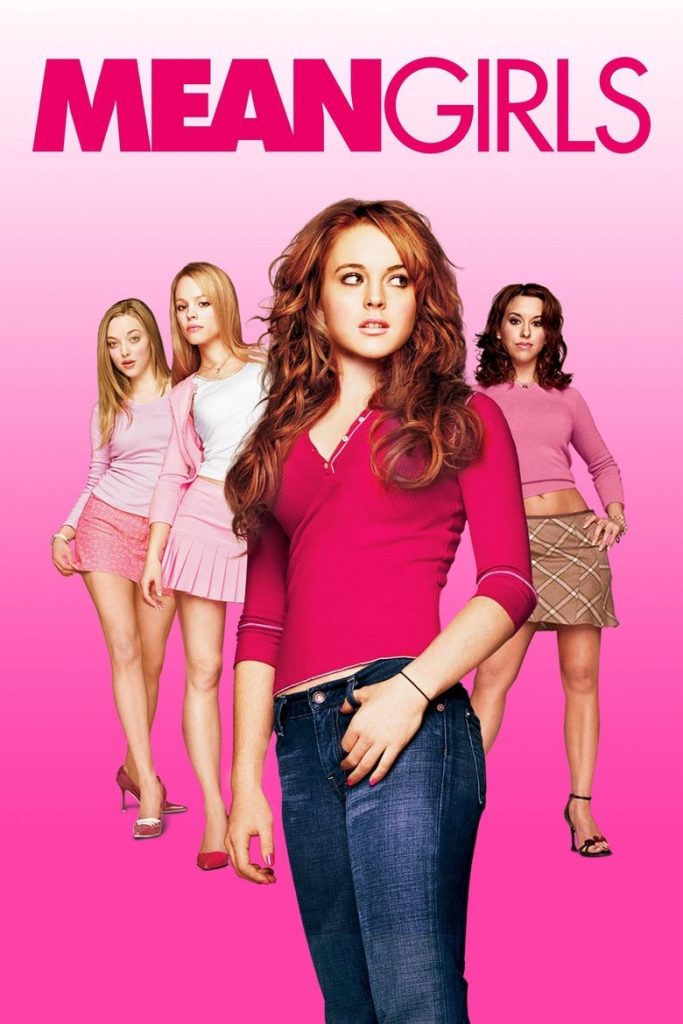
The visual language mirrors the social stratification it critiques. The Plastics' world is saturated with pinks and pastels—a deliberately artificial palette that contrasts with Cady's natural African memories. Camera angles shift dramatically: low-angle shots make Regina appear towering and dominant, while overhead shots during lunch scenes map the cafeteria's rigid social geography. Costuming serves as tribal markers: the Plastics' coordinated outfits versus the 'art freaks' bohemian layers. Notice how the camera lingers on reflective surfaces—mirrors, windows, glossy tables—constantly reminding us these characters are performing identities. The infamous 'Jingle Bell Rock' dance sequence uses synchronized movement to visualize conformity's seductive appeal.
🔍 Details & Easter Eggs
💡 Behind the Scenes
Tina Fey adapted the script from Rosalind Wiseman's nonfiction book 'Queen Bees and Wannabes,' drawing on her own high school experiences. Lindsay Lohan performed most of her own math equations on the blackboards. The 'Jingle Bell Rock' dance was choreographed in just two days. Regina's 'army of skanks' line was improvised by Rachel McAdams. The film was shot primarily in Toronto, with the school scenes at Etobicoke Collegiate Institute. Many of the background students were actual Toronto teens, giving authentic reactions to the Plastics' dramatic entrances.
Where to watch
Choose region:
- Netflix
- Paramount+ Amazon Channel
- Paramount+ Roku Premium Channel
- Netflix Standard with Ads
- Paramount Plus Essential
- Paramount Plus Premium
- Amazon Video
- Apple TV
- Google Play Movies
- YouTube
- Fandango At Home
- Plex
Trailer
Trailer playback is unavailable in your region.