
Mickey, Donald, Goofy: The Three Musketeers (2004)
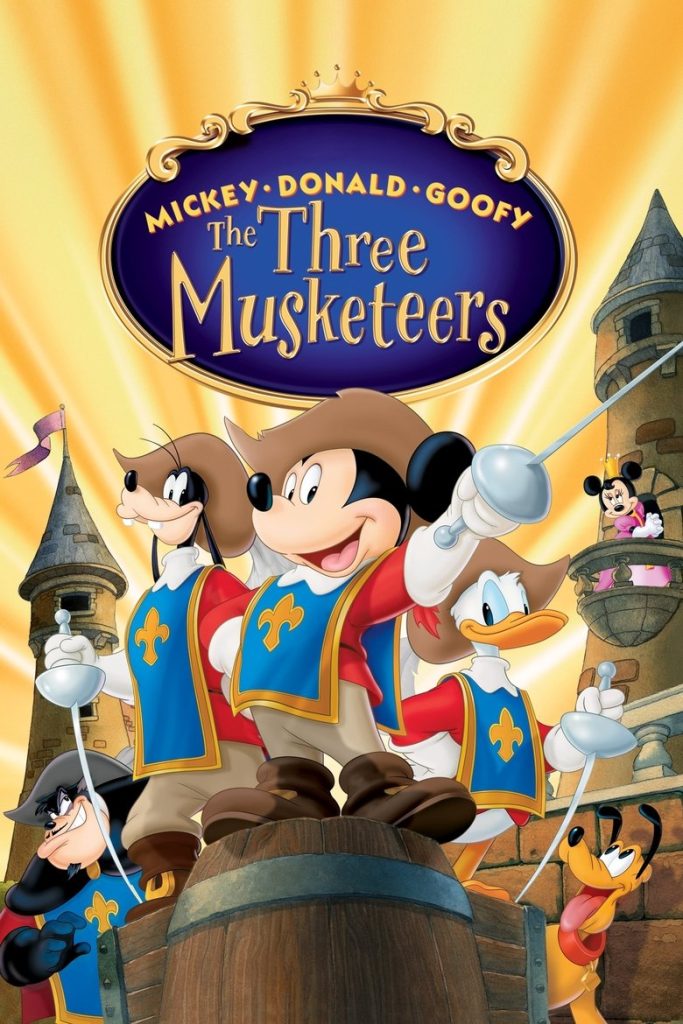
Story overview
Mickey, Donald, and Goofy dream of becoming Musketeers to serve Queen Minnie, but the villainous head Musketeer Pete assigns them as her guardians as part of his secret plot to overthrow her. This 2004 Disney animated adventure comedy adapts the classic Three Musketeers story with beloved characters, featuring musical numbers based on classical melodies. The film combines lighthearted humor with themes of friendship, loyalty, and perseverance.
Parent Guide
This G-rated Disney animated film is completely family-friendly with positive messages about friendship, loyalty, and perseverance. The cartoonish action and mild peril are appropriate for even the youngest viewers, with no concerning content in any category.
Content breakdown
Cartoon-style action with sword fights (no injuries shown), characters in mild peril situations (like being trapped or chased), and villainous schemes that are thwarted. All violence is slapstick and comedic in nature with no realistic danger.
No scary or disturbing content. The villain Pete is a typical Disney antagonist whose schemes are presented in a cartoonish, non-threatening manner. No dark themes or imagery.
No offensive language, profanity, or inappropriate dialogue. All language is family-appropriate with mild cartoon-style insults like 'you bumbling fools' that are comedic rather than mean-spirited.
No sexual content, innuendo, or nudity. Characters are fully clothed in typical Disney attire, with no romantic content beyond Mickey's chivalrous devotion to Minnie.
No depiction of alcohol, drugs, tobacco, or substance use of any kind. Characters drink non-alcoholic beverages in social settings.
Light emotional moments related to friendship and loyalty, with brief moments of concern when characters face obstacles. The overall tone is upbeat and comedic with happy resolution. No intense emotional scenes that would distress children.
Parent tips
This G-rated Disney film is appropriate for all ages. The cartoonish villainy and mild peril are balanced by positive messages about teamwork and doing what's right. The musical score uses familiar classical melodies that children might recognize. The 68-minute runtime makes it suitable for younger attention spans. No content concerns exist for language, substance use, or sexual content.
Parent chat guide
Parent follow-up questions
- Which character made you laugh the most?
- What was your favorite song in the movie?
- How did Mickey and his friends help the queen?
- What color was Minnie's dress?
- Why did Pete want to get rid of Queen Minnie?
- How did the friends work together as a team?
- What does it mean to be a Musketeer?
- Which part was the most exciting to watch?
- How does this version compare to other Three Musketeers stories you know?
- What qualities made Mickey, Donald, and Goofy good heroes despite their clumsiness?
- Why do you think the filmmakers chose these particular Disney characters for these roles?
- What lessons about friendship did the movie teach?
- How effectively does this adaptation translate the Three Musketeers themes to animated Disney characters?
- What commentary might the film be making about leadership and loyalty?
- How does the use of classical melodies in the score enhance or detract from the storytelling?
- In what ways does this film fit within Disney's tradition of adapting classic literature?
🎭 Story Kernel
Beneath its slapstick surface, 'The Three Musketeers' explores the anxiety of inadequacy and the performative nature of heroism. Mickey, Donald, and Goofy aren't born heroes—they're janitors thrust into roles they're spectacularly unqualified for, their incompetence weaponized by the villainous Peg-Leg Pete. The film's real conflict isn't about saving the princess but about three underdogs confronting their own perceived uselessness. Their eventual triumph isn't earned through skill but through chaotic persistence and friendship, suggesting that sometimes simply showing up and trying is its own form of valor. The cheese obsession becomes a metaphor for their lowly status—they're chasing literal scraps while others feast on glory.
🎬 Visual Aesthetics
The animation consciously evokes storybook illustrations with its warm, saturated palette of royal purples, golds, and deep blues, creating a fairy-tale aesthetic that contrasts with the characters' bumbling actions. Camera movements are theatrical—sweeping pans across ballrooms and dramatic zooms during musical numbers—mimicking stage productions. Action sequences employ rubber-hose physics reminiscent of 1930s cartoons, where characters stretch, squash, and defy anatomy for comedic effect. Symbolism appears in visual hierarchies: Pete is always framed from low angles to emphasize his dominance, while our trio is frequently shown from above or crowded in frames, visually reinforcing their underdog status.
🔍 Details & Easter Eggs
💡 Behind the Scenes
This direct-to-video film was Disney's first feature-length adaptation starring Mickey, Donald, and Goofy as the leads, released in 2004. Voice actor Wayne Allwine (Mickey) and Tony Anselmo (Donald) reprised their iconic roles, while Bill Farmer's Goofy performance required unique vocal gymnastics for the musical numbers. The animation blended traditional hand-drawn techniques with digital coloring, creating a hybrid look that honored classic Disney aesthetics while utilizing modern pipelines. Several deleted scenes showed more musical numbers that were cut for pacing, including a villain song for Peg-Leg Pete that was storyboarded but never animated due to budget constraints.
Where to watch
Choose region:
- Disney Plus
- Amazon Video
- Apple TV Store
- Google Play Movies
- YouTube
- Fandango At Home
Trailer
Trailer playback is unavailable in your region.