
Monty Python and the Holy Grail (1975)
Story overview
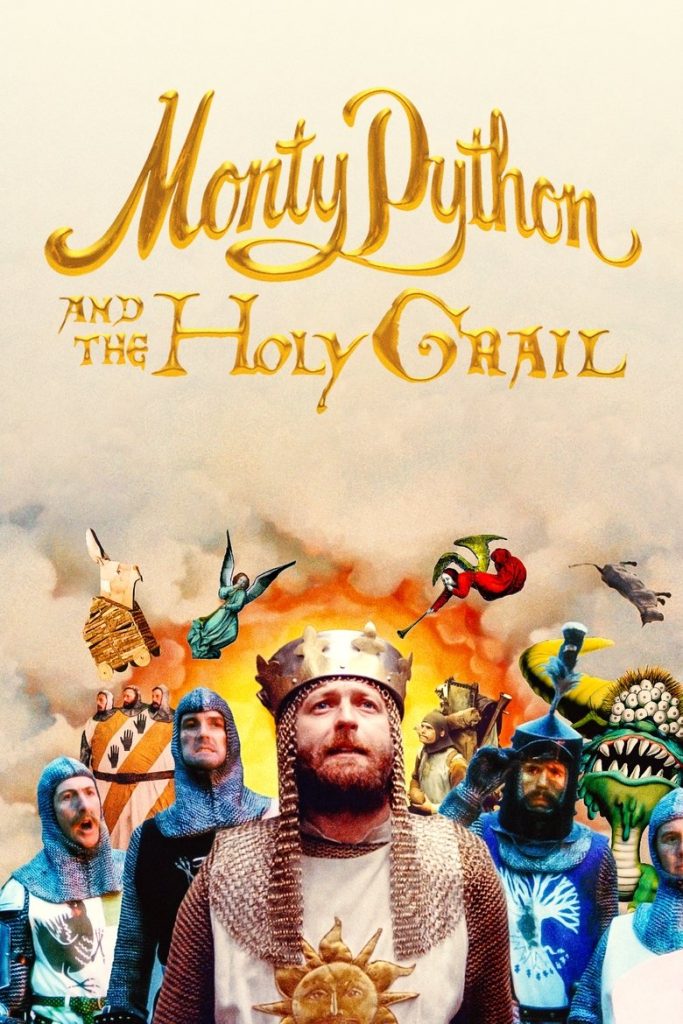
Monty Python and the Holy Grail is a British comedy film from 1975 that parodies the Arthurian legends. It follows King Arthur and his knights on a surreal quest for the Holy Grail, filled with absurd humor and satirical takes on medieval tales. The film features iconic comedic scenes and witty dialogue that have made it a cult classic, blending adventure with clever wordplay and visual gags.
Parent Guide
A classic comedy with absurd humor and mild cartoonish violence, best suited for older children who understand satire.
Content breakdown
Cartoonish swordplay and comedic peril without graphic consequences.
Some surreal or bizarre scenes might confuse younger viewers.
Occasional mild innuendo and British slang.
Brief suggestive dialogue and situations played for comedy.
No substance use depicted.
Lighthearted tone with occasional absurd tension.
Parent tips
This film contains mild cartoonish violence and absurd humor that may confuse younger children. The PG rating reflects some comedic peril and occasional suggestive dialogue, but overall it's a lighthearted parody. Parents should be aware that the humor relies heavily on British wit and satire, which might not resonate with all age groups.
Parent chat guide
Parent follow-up questions
- What was the funniest part for you?
- Did any parts seem silly or strange?
- What did you think about the knights?
- How did the music make you feel?
- Would you want to go on an adventure like that?
- Why do you think the characters acted so strangely?
- What made some scenes funny instead of scary?
- How is this story different from real knight tales?
- What was your favorite silly moment?
- How did the movie make serious things seem funny?
- What satirical elements did you notice in the film?
- How does the humor comment on traditional stories?
- What makes absurd comedy different from other types?
- Why do you think certain scenes became iconic?
- How does the film balance adventure with comedy?
- What social or historical commentary did you detect in the humor?
- How does the film use parody to critique traditional narratives?
- What makes British comedy distinct in its approach?
- How does the film's structure contribute to its comedic effect?
- What cultural references or satirical targets did you recognize?
🎭 Story Kernel
At its core, 'Monty Python and the Holy Grail' is a scathing satire of narrative structure, heroism, and the very concept of a quest. The characters are driven not by noble purpose, but by arbitrary, bureaucratic, and often nonsensical directives. King Arthur's 'divine right' is constantly questioned by peasants, his knights are incompetent, and every challenge—from the Knights Who Say 'Ni!' to the Bridge of Death—operates on absurd, self-contradicting rules. The film argues that the pursuit of a grand, mythical goal is often just a series of ridiculous obstacles and administrative hurdles, culminating not in glory, but in an abrupt, unsatisfying interruption (the modern police arrest). It's less about finding the Grail and more about exposing the folly of the search itself.
🎬 Visual Aesthetics
The film's visual language is a masterclass in low-budget ingenuity that becomes part of the joke. The handheld, documentary-style camerawork during 'serious' moments undercuts the epic fantasy genre. The color palette is deliberately drab and muddy—England looks perpetually damp and unglamorous. Key visual gags are built on absence and substitution: Arthur and Patsy's coconut-shell horse clopping, the invisible animated monsters described by Terry Gilliam's cut-out animations, and the blatantly fake castles and blood (the Black Knight scene uses bright red paint). This cheap, theatrical aesthetic constantly reminds the viewer this is a constructed fiction, breaking immersion to highlight the absurdity of the story being told.
🔍 Details & Easter Eggs
💡 Behind the Scenes
The iconic coconut shells used for horse hooves were a necessity born from an extremely low budget—the production couldn't afford real horses. The actors hated the muddy location shoots in Scotland, which contributed to the film's authentically grimy look. Terry Gilliam's cut-out animations were created using techniques from his work on 'Do Not Adjust Your Set' and 'Monty Python's Flying Circus,' often crafted from Victorian catalogues and religious artwork. The film was co-directed by Terry Gilliam and Terry Jones, with frequent creative clashes; Gilliam focused on the visual style and animations, while Jones directed the actors. The abrupt ending with the police was written because they literally ran out of money and had no funds for a large-scale battle scene.
Where to watch
Choose region:
- Amazon Prime Video
- fuboTV
- Peacock Premium
- Britbox Apple TV Channel
- BritBox
- BritBox Amazon Channel
- Amazon Prime Video with Ads
- Peacock Premium Plus
- Shout! Factory Amazon Channel
- Amazon Video
- Apple TV
- Google Play Movies
- YouTube
- The Roku Channel
- Pluto TV
- Shout! Factory TV
- Tubi TV
- The CW
- Kanopy
- Plex
- Plex Channel
Trailer
Trailer playback is unavailable in your region.