
Mrs. Doubtfire (1993)
Story overview
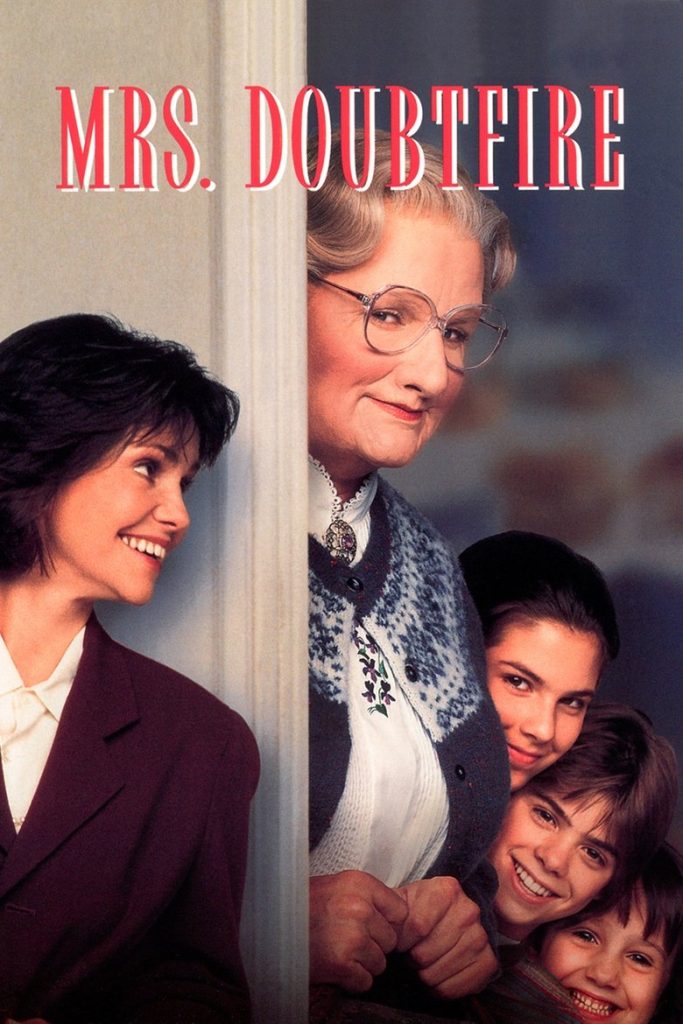
Mrs. Doubtfire is a 1993 family comedy-drama about a recently divorced father who disguises himself as an elderly British nanny to spend more time with his children. Through this elaborate charade, he navigates the challenges of co-parenting while trying to rebuild his relationship with his family. The film explores themes of family bonds, personal growth, and the lengths parents will go for their children, all wrapped in humorous situations.
Parent Guide
Family comedy with mature themes about divorce and parental deception. Best for older children who can understand the context.
Content breakdown
Some comedic physical humor and brief moments of tension, but no serious violence.
Emotional scenes related to family separation and parental conflict may be upsetting to sensitive children.
Some mild profanity and adult language consistent with PG-13 rating.
Brief sexual references and innuendo, but no explicit content.
Social drinking in adult settings, but not a focus of the film.
Strong emotional themes around family separation, parental love, and personal deception.
Parent tips
This PG-13 film contains some mature themes and language that may be unsuitable for younger children. The divorce storyline and parental conflict could be emotionally impactful for kids who have experienced family separation. Parents should be prepared to discuss healthy communication in relationships and the importance of honesty, as the main character's deception is central to the plot.
Parent chat guide
Parent follow-up questions
- What was your favorite funny part in the movie?
- How did the family show they loved each other?
- What did you think about the different voices the dad used?
- How did the children feel when their parents weren't together?
- What makes someone a good parent?
- Why do you think the dad dressed up as Mrs. Doubtfire?
- How did the children's feelings change during the movie?
- What were some of the challenges of keeping the secret?
- How did the family solve their problems at the end?
- What did you learn about telling the truth?
- What does the movie show about modern families and divorce?
- How did the parents handle their disagreements?
- What were the consequences of the father's deception?
- How does the film balance comedy with serious family issues?
- What messages does the movie give about gender and parenting roles?
- How does the film portray the legal and emotional complexities of divorce?
- What commentary does the movie make about societal expectations of parents?
- How effective is humor in addressing serious family issues?
- What does the film suggest about work-life balance and parental involvement?
- How do the characters demonstrate personal growth throughout the story?
🎭 Story Kernel
At its core, 'Mrs. Doubtfire' explores the performative nature of identity and the gendered expectations of parenting. Daniel Hillard doesn't just become a nanny to see his children—he becomes a better parent by adopting a feminine persona that society values for caregiving. The film exposes how the same behaviors that made him a 'failed husband' (spontaneity, playfulness, emotional availability) become celebrated when performed by 'Mrs. Doubtfire.' It's ultimately about a man discovering that to be the father his children need, he must first understand the invisible labor society assigns to mothers. The custody battle resolution—shared parenting with supervision—acknowledges his growth while recognizing his initial shortcomings.
🎬 Visual Aesthetics
The film employs a distinct visual language that separates Daniel's chaotic world from Mrs. Doubtfire's ordered one. Daniel's scenes feature handheld camerawork, warm golden tones, and cluttered frames reflecting his artistic but disorganized life. As Mrs. Doubtfire, the cinematography becomes more static and composed, with cooler blues and grays mirroring Miranda's corporate world. The transformation sequence uses practical effects and clever editing to maintain authenticity—notice how Robin Williams' actual facial expressions translate through the prosthetics. The restaurant climax employs wide shots to emphasize the physical comedy of Daniel's rapid costume changes, turning the space into a theatrical stage.
🔍 Details & Easter Eggs
💡 Behind the Scenes
Robin Williams improvised approximately 90% of his dialogue as Mrs. Doubtfire, with director Chris Columbus using multiple cameras to capture his spontaneous riffs. The prosthetic makeup took 4.5 hours to apply daily. Sally Field initially turned down the role of Miranda three times before accepting. The famous restaurant scene required 55 takes over 14 hours. Pierce Brosnan learned to actually cook for his scenes as Stu. The film's success directly influenced California's family court reforms regarding joint custody arrangements.
Where to watch
Choose region:
- Disney Plus
- fuboTV
- Amazon Video
- Apple TV
- Google Play Movies
- YouTube
- Fandango At Home
Trailer
Trailer playback is unavailable in your region.