Mujrim (1989)
Story overview
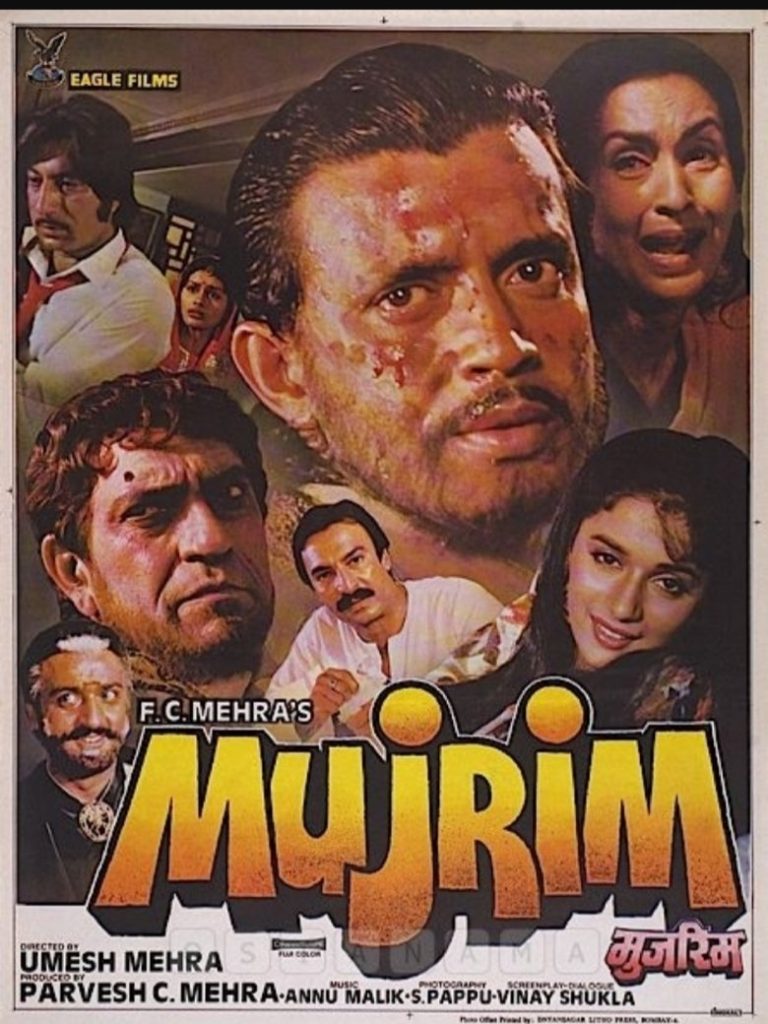
Mujrim (1989) is an Indian Hindi-language drama-action film directed by Umesh Mehra. The story centers on Shankar, a man who has spent ten years in prison since childhood and is labeled a criminal by society upon his release. As he navigates life outside, he faces societal prejudice and struggles for redemption, with themes of justice, identity, and social stigma. The film features a cast including Mithun Chakraborty, Madhuri Dixit, Nutan, Shakti Kapoor, and Amrish Puri, blending emotional drama with action sequences typical of Bollywood cinema of the era.
Parent Guide
Mujrim is a Bollywood drama-action film suitable for viewers aged 8 and above, with parental guidance recommended due to moderate action violence, emotional themes, and societal issues. It offers opportunities for discussions on justice, redemption, and empathy, but includes scenes that may be intense or stereotypical.
Content breakdown
Includes staged action sequences typical of 1980s Bollywood, such as fistfights, chases, and confrontations with villains. Violence is not graphic but involves physical altercations and perilous situations that could be intense for younger children. No gore or extreme brutality is depicted.
Some scenes may be mildly disturbing due to emotional intensity, such as Shankar's struggles with societal rejection and moments of conflict. No horror elements or jump scares; the distress comes from dramatic plot points rather than frightening imagery.
Dialogue is in Hindi with no strong profanity or offensive language. There may be mild insults or dramatic exchanges typical of the genre, but nothing explicit or vulgar. Subtitles or translation might be needed for non-Hindi speakers.
No sexual content or nudity. The film focuses on drama and action, with romantic subplots handled in a family-friendly manner common in classic Bollywood, involving song sequences and emotional connections without explicit scenes.
No depiction of substance use, smoking, drinking, or drug-related content. The film avoids such elements, keeping the focus on its central themes of crime and redemption.
Emotional themes include societal stigma, injustice, and personal redemption, which can be intense for sensitive viewers. Scenes of Shankar facing prejudice or emotional turmoil may evoke strong feelings, but they are balanced with hopeful moments and action sequences.
Parent tips
Mujrim is a Bollywood drama-action film from 1989 that deals with themes of crime, redemption, and societal judgment. It includes moderate action violence, such as fights and chases, and emotional scenes that may be intense for younger viewers. The film portrays negative stereotypes and criminal behavior, which could require discussion about justice and morality. Recommended for ages 8 and up, with parental guidance to address its mature themes and cultural context.
Parent chat guide
Parent follow-up questions
—
- What did you think about Shankar's story? Was it fair that people called him a criminal?
- How did the action scenes make you feel? Were they exciting or scary?
- What lessons can we learn about being kind to others, even if they've made mistakes?
- Why do you think society judged Shankar so harshly? How does the film show the impact of labels?
- Discuss the violence in the movie: was it necessary for the story, and how does it compare to real-life conflicts?
- What does redemption mean to you, and how does Shankar's journey illustrate this?
- Analyze the film's portrayal of crime and justice: does it challenge or reinforce stereotypes? How does it reflect 1980s Indian society?
- Explore the emotional intensity: how does the film handle themes of guilt, forgiveness, and social stigma? What cinematic techniques enhance this?
- Consider the role of action in Bollywood films: how does Mujrim use violence to drive its narrative, and what messages does it send about power and morality?
🎭 Story Kernel
At its core, 'Mujrim' is a psychological excavation of guilt as a self-imposed prison. The protagonist's journey isn't about evading external justice but confronting the internal tribunal of his own conscience. The film posits that the most severe punishment isn't legal consequence but the relentless, corrosive memory of one's own transgression. Characters are driven not by greed or ambition, but by the desperate need to either bury their past sins or have them acknowledged—a dynamic that turns every interaction into a tense negotiation of moral accountability. The plot's twists serve less as shocking reveals and more as gradual unveilings of how guilt distorts perception and reality.
🎬 Visual Aesthetics
The film employs a claustrophobic visual language, with tight close-ups that trap characters within the frame, mirroring their psychological confinement. A desaturated color palette, dominated by grays and muted blues, drains the world of vibrancy, reflecting the protagonist's moral decay. The camera often lingers on reflective surfaces—windows, mirrors, puddles—creating distorted doubles that visualize his fractured identity. Action sequences are brutal but brief, emphasizing consequence over spectacle; the shaky cam during key moments isn't for adrenaline but to convey visceral disorientation. Shadows are used not just for mood but as active entities, seeming to cling to characters as manifestations of their secrets.
🔍 Details & Easter Eggs
💡 Behind the Scenes
The lead actor reportedly isolated himself for weeks to embody the protagonist's paranoia, refusing to socialize with the cast off-set to maintain a palpable tension. Several key scenes were shot in a single take to preserve raw emotional continuity, requiring meticulous choreography. The film's muted color grade was achieved through practical lighting and minimal digital correction, with the director insisting on using period-specific fluorescent bulbs to cast the harsh, unflattering light that defines the film's aesthetic. A minor but notable detail: the recurring rain effects were all real, shot during an unseasonal monsoon, which added an authentic, relentless dampness to the atmosphere.
Where to watch
Choose region:
- Netflix
- Netflix Standard with Ads