My Hero Academia: You’re Next (2024)
Story overview
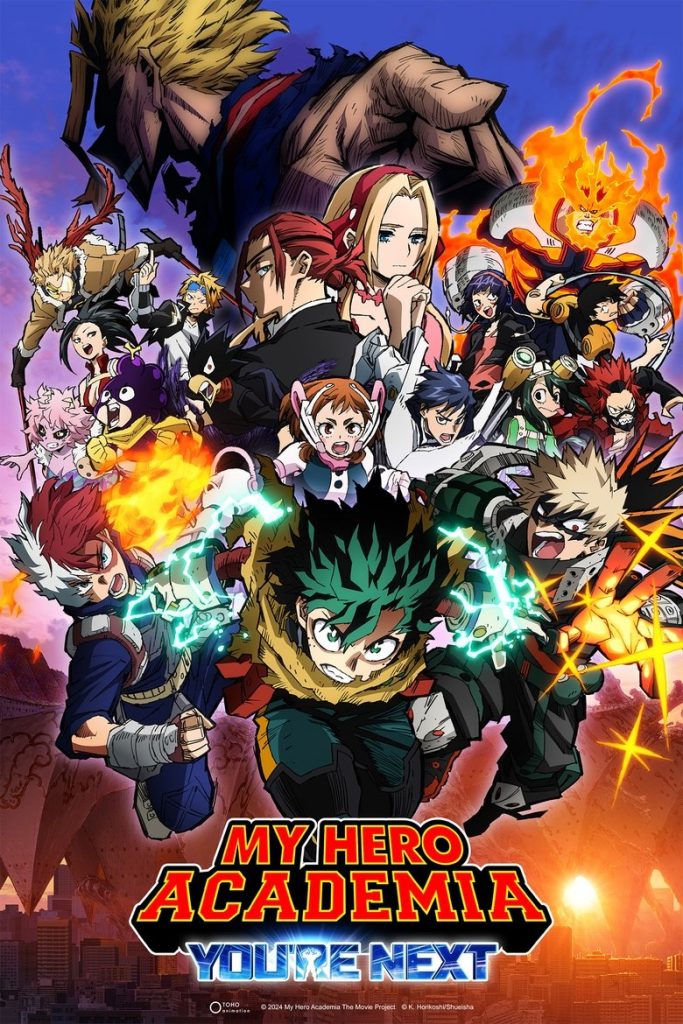
In a world recovering from a devastating war between heroes and villains, a mysterious giant fortress appears and begins engulfing towns and people. The story follows young hero-in-training Izuku Midoriya and his friends as they face this new threat. A man reminiscent of All Might, the legendary symbol of peace, emerges to confront the crisis. The film explores themes of heroism, sacrifice, and protecting society during times of great danger.
Parent Guide
Animated superhero action film with moderate fantasy violence and peril, suitable for older children and teens who enjoy action-packed stories with positive messages about heroism and teamwork.
Content breakdown
Stylized superhero combat with characters using superpowers against villains and threats. Towns and people are engulfed by a mysterious fortress, creating perilous situations. No graphic injuries shown, but intense action sequences throughout.
The giant fortress engulfing towns and people could be frightening for sensitive viewers. Scenes of societal devastation and high-stakes peril might be intense, though presented in animated format.
Typical superhero movie dialogue with occasional intense exclamations during action scenes. No strong profanity expected based on the PG-13 rating and genre conventions.
No sexual content or nudity present. Characters wear typical superhero costumes appropriate for the genre.
No depiction of substance use or references to alcohol, drugs, or smoking.
Themes of societal devastation, protecting others during crises, and the weight of heroism create emotional moments. Characters face high-stakes situations that could be intense for sensitive viewers.
Parent tips
This animated superhero film contains intense action sequences with characters using superpowers in combat against villains and a massive threat. Expect moderate peril as towns and people are engulfed by a mysterious fortress, creating high-stakes situations. The PG-13 rating reflects fantasy violence and some potentially frightening imagery, though it's presented in a stylized anime format.
While the film promotes positive messages about courage, teamwork, and protecting others, younger or sensitive viewers might find some scenes overwhelming. The story deals with societal devastation and the weight of heroism, which could be emotionally intense for some children. Parents should consider their child's comfort with animated action and peril before viewing.
Parent chat guide
After the movie, talk about the characters' choices and the film's themes. Ask what they learned about courage and helping others, even when facing overwhelming challenges. Discuss how the characters balanced using their powers with protecting innocent people, and explore real-world parallels about helping communities during crises.
Parent follow-up questions
- Which character did you like the most and why?
- What superpower would you want to have?
- How did the friends help each other in the movie?
- What was your favorite colorful part?
- Was there anything that made you feel worried?
- What makes someone a true hero in this story?
- How did the characters work together to solve problems?
- What would you do if you saw someone in trouble like in the movie?
- Which character showed the most courage and why?
- How did the movie show that helping others is important?
- What responsibilities come with having special powers or abilities?
- How did the characters balance using their powers with protecting innocent people?
- What does the movie suggest about recovering from difficult times as a community?
- How did different characters show leadership in their own ways?
- What real-world situations might require similar teamwork and courage?
- How does the film explore the concept of sacrifice for the greater good?
- What commentary might the movie be making about societal recovery after conflict?
- How do the characters' personal motivations influence their heroic actions?
- What ethical questions arise when using extraordinary abilities during crises?
- How does the animation style affect the presentation of intense action and peril?
🎭 Story Kernel
The film explores the vacuum left by All Might’s retirement and the dangerous misinterpretation of his final message, 'You’re next.' While Deku views this as a call to responsibility, the antagonist Dark Might perceives it as an invitation to seize absolute power. The narrative delves into the fragility of symbols and how a hero's image can be weaponized when divorced from their actual values. It serves as a bridge between the collapse of hero society and the desperate struggle to rebuild it, emphasizing that being a 'symbol' requires more than just overwhelming strength; it requires the empathy and self-sacrifice that Dark Might fundamentally lacks. The conflict is less about physical prowess and more about the ideological battle over what it truly means to inherit a legacy and the burden of being a successor.
🎬 Visual Aesthetics
Under Tensai Okamura’s direction, Studio Bones delivers a high-octane visual experience that leans into the 'Dark Might' aesthetic—a gaudy, over-saturated perversion of All Might’s classic Golden Age look. The cinematography utilizes sharp contrasts between the vibrant, almost blinding colors of Dark Might’s fortress and the grittier, war-torn reality of the world outside. Symbolism is heavy in the character designs; Dark Might’s exaggerated features serve as a visual uncanny valley for the audience. The action sequences maintain the series' signature fluid choreography but introduce a more cinematic scale, particularly in the aerial battles. The use of lighting during the climax highlights the 'inner light' of One For All versus the artificial, external brilliance projected by the antagonist, reinforcing the film's core thematic dichotomy through pure visual storytelling and kinetic energy.
🔍 Details & Easter Eggs
💡 Behind the Scenes
This is the fourth theatrical film in the franchise and the first to be directed by Tensai Okamura, known for Darker than Black and Wolf's Rain, taking over from Kenji Nagasaki. Original creator Kohei Horikoshi served as the general supervisor and character designer, ensuring the movie's 'Dark Might' concept aligned with the series' lore. The film's theme song, 'Homunculus,' was performed by Vaundy, who is a self-proclaimed fan of the series. Production focused on expanding the global scale of the MHA universe, introducing the Scervino family to provide a fresh perspective outside the central hero-villain conflict.
Where to watch
Choose region:
- Netflix
- Hulu
- Crunchyroll
- Crunchyroll Amazon Channel
- Netflix Standard with Ads
- Amazon Video
- Apple TV
- Google Play Movies
- YouTube
- Fandango At Home
Trailer
Trailer playback is unavailable in your region.