
My Octopus Teacher (2020)
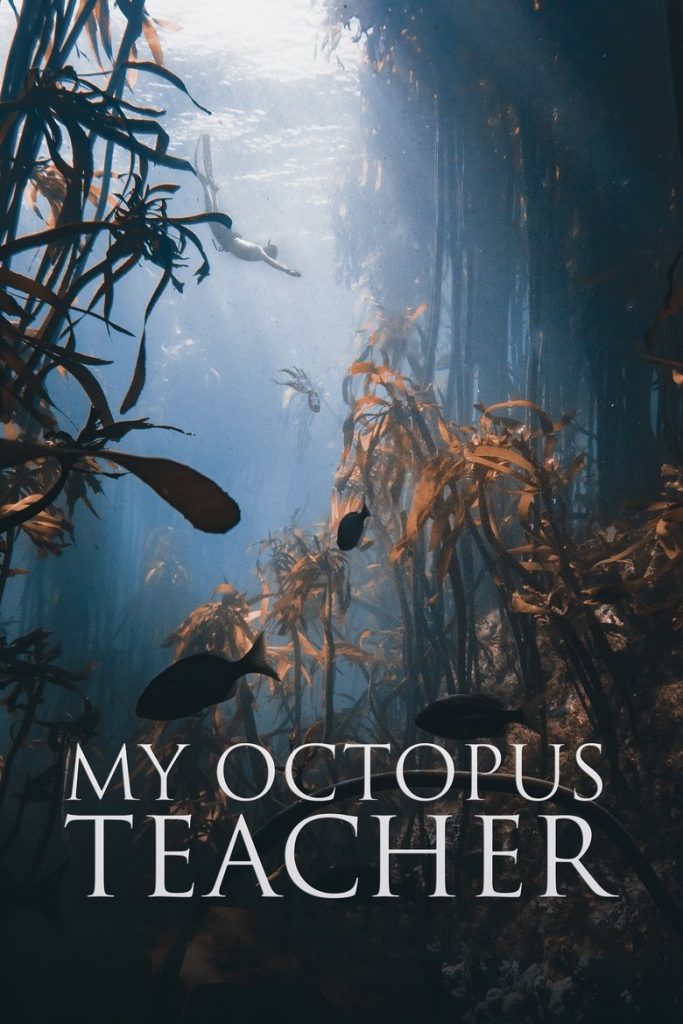
Story overview
This 2020 documentary follows filmmaker Craig Foster as he forms an extraordinary friendship with a wild octopus while free-diving daily in a South African kelp forest. Over nearly a year, he observes her remarkable intelligence, survival strategies, and life cycle, developing a profound interspecies connection that transforms his perspective on nature and humanity's place within it.
Parent Guide
A contemplative, visually stunning documentary about human connection with nature. While generally gentle, it includes realistic predator-prey sequences in the ocean ecosystem that may be intense for very young or sensitive children.
Content breakdown
Natural predator-prey scenes: octopus hunts crabs/lobsters, shark attacks octopus (non-graphic but tense). No human violence.
Predation scenes might be unsettling. The octopus's natural decline and death at the end is handled with sensitivity but may prompt questions about mortality.
No offensive language. Educational narration throughout.
No sexual content. Natural underwater footage shows marine life without human nudity.
No substance use depicted.
Strong emotional connection between human and octopus. The octopus's life cycle and death may evoke sadness. Uplifting themes of wonder and connection balance these moments.
Parent tips
This gentle documentary offers a beautiful opportunity to discuss marine biology, animal intelligence, and human-nature relationships. The octopus's natural life cycle includes predation scenes that might be intense for sensitive viewers. Consider watching together to answer questions about ocean ecosystems and conservation.
Parent chat guide
Parent follow-up questions
- What colors did the octopus change to?
- Did you see the octopus hiding in the kelp?
- What sea animals did you recognize?
- How did the octopus protect herself from predators?
- What made the octopus and Craig become friends?
- What did you learn about how octopuses live?
- Why do you think Craig felt so connected to the octopus?
- How did observing the octopus change Craig's life?
- What survival strategies did the octopus demonstrate?
- What does this documentary suggest about human-animal relationships?
- How does the film portray the balance between observation and intervention in nature?
- What ethical questions does this unusual friendship raise?
🎭 Story Kernel
The film is less about interspecies friendship and more about a profound meditation on presence, ego dissolution, and ecological consciousness. It expresses the radical idea that true connection requires complete surrender of human control and narrative. Driven by filmmaker Craig Foster's burnout and existential crisis, the story charts his transformation from an observer seeking solace to a participant in a wild, non-human drama. The octopus isn't a pet or a symbol; she is the active protagonist of her own life, allowing Foster temporary, privileged access. The core drive is Foster's need to reconnect with a primal, unmediated experience of life, which he achieves only by relinquishing his role as storyteller and becoming part of her story—a story of survival, curiosity, and inevitable mortality.
🎬 Visual Aesthetics
The visual language is intimate, observational, and deliberately unpolished. Cinematography relies on handheld cameras and Foster's own diving, creating a first-person, immersive perspective that makes the viewer feel like a fellow diver. The color palette is dominated by the cool blues and greens of the kelp forest, with sudden bursts of vibrant color from marine life, mirroring the emotional journey from melancholy to wonder. Slow-motion sequences of the octopus moving or hunting are not just beautiful; they force a deceleration of perception, mimicking Foster's own slowed-down, attentive state. The symbolism is direct and environmental: the kelp forest is a labyrinthine, breathing world that both conceals and reveals, representing the complex, interconnected web of life Foster is learning to see.
🔍 Details & Easter Eggs
💡 Behind the Scenes
Craig Foster spent a year free-diving in the freezing Atlantic waters off the coast of South Africa without a wetsuit, acclimating his body to better blend into the environment and minimize his disruptive presence. The entire film was shot over that year, with Foster often diving alone, acting as his own cameraman. The octopus was never named by the filmmakers to avoid anthropomorphism. The project grew from the Sea Change Project, an organization Foster co-founded, which uses storytelling to foster a deeper connection with the ocean. Much of the breathtaking macro photography was achieved with custom-built, waterproof camera housings.
Where to watch
Choose region:
- Netflix
- Netflix Standard with Ads
Trailer
Trailer playback is unavailable in your region.