
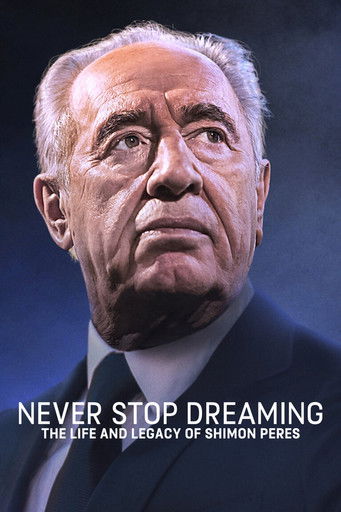
Never Stop Dreaming: The Life and Legacy of Shimon Peres (2022)
Story overview
This documentary chronicles the remarkable life of Shimon Peres, a Nobel Peace Prize laureate who served as Israel's prime minister twice and played a key role in the 1994 Israel-Jordan peace treaty. Through archival footage and interviews with global leaders like Bill Clinton, George W. Bush, and Barack Obama, the film explores his political career, peace efforts, and enduring legacy as a statesman dedicated to diplomacy and conflict resolution.
Parent Guide
A family-friendly documentary suitable for viewers aged 8 and older, offering an educational look at a historical figure's life and peace efforts without concerning content. It encourages discussions on politics, history, and diplomacy.
Content breakdown
No violent scenes or perilous situations depicted; the content focuses on political discussions and historical footage without graphic elements.
No scary or disturbing imagery; the documentary maintains a calm, informative tone throughout.
No offensive or strong language; dialogue is formal and respectful, typical of political discourse.
No sexual content or nudity present.
No depiction of substance use.
Mild emotional intensity may arise from discussions of political conflicts or historical events, but it is presented in a balanced, educational manner without heightened drama.
Parent tips
This documentary is suitable for families with children aged 8 and up, focusing on historical and political themes without graphic content. It provides an educational opportunity to discuss international relations, peacemaking, and leadership. Parents may want to watch with younger viewers to explain complex political contexts or historical events mentioned.
Parent chat guide
Parent follow-up questions
—
- Who was Shimon Peres?
- What is a peace treaty?
- Why is it important to help people get along?
- What were some of Shimon Peres's biggest achievements?
- How did he work with other countries?
- What can we learn from his life about solving problems?
- How did Shimon Peres's political views evolve over time?
- What were the key challenges in the Israel-Jordan peace process?
- How does this documentary portray leadership and legacy in international affairs?
🎭 Story Kernel
The film presents Shimon Peres not as a static icon but as a man whose core drive was a relentless, almost ruthless, belief in the possible. It argues his true legacy isn't a specific peace deal, but the ideological elasticity that allowed him to evolve from a hawkish defense architect to a Nobel-winning peace advocate. The narrative engine is this tension between his unwavering dream of a secure Israel and the constantly shifting, often morally ambiguous, tactics he employed to pursue it. We see a character motivated less by rigid dogma than by a futurist's conviction that tomorrow's reality can be engineered, making his compromises and reversals not contradictions, but calculated steps on a long game board only he could fully see.
🎬 Visual Aesthetics
The visual language is a deliberate blend of grandeur and intimacy, mirroring Peres's public and private selves. Archival footage is presented with crisp, stately composition, often using slow zooms on his face during key speeches to study the performer. In contrast, contemporary interviews and behind-the-scenes moments employ handheld, shallow-focus shots, creating a sense of privileged access. The color palette is significant: a desaturation of older conflict footage gives way to warmer, richer tones in scenes of diplomacy and later life, visually tracing his journey from the starkness of security concerns to the nuanced warmth of statecraft. Recreations are minimal but use stark lighting to highlight pivotal moments of decision.
🔍 Details & Easter Eggs
💡 Behind the Scenes
The documentary secured unprecedented access to Peres's personal archive and family, with several interviews conducted in his private study. Notably, it features the last major on-camera interview Peres gave before his death. Director Richard Trank collaborated closely with the Peres family, who provided home videos never before seen publicly. A significant challenge was condensing nearly seven decades of complex political history into a coherent narrative, requiring the team to sift through over 500 hours of archival footage from global news sources and Israeli state archives.
Where to watch
Choose region:
- Netflix
- Netflix Standard with Ads