
Night at the Museum (2006)
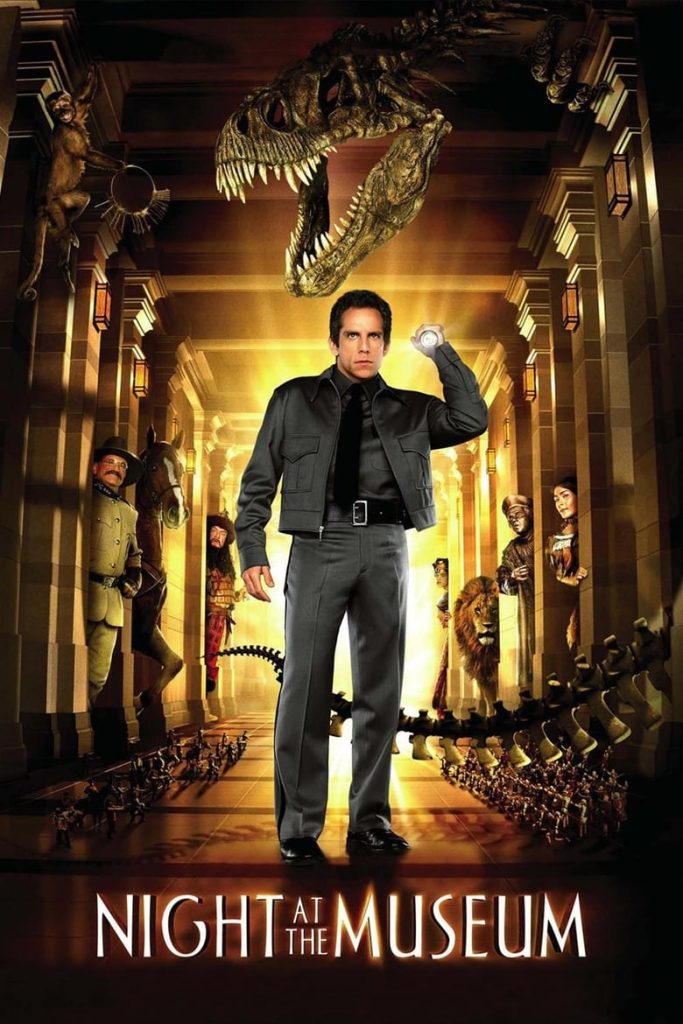
Story overview
Night at the Museum is a 2006 family adventure comedy where a struggling father, Larry Daley, takes a job as a night security guard at a natural history museum. He soon discovers that an ancient Egyptian artifact causes all the exhibits to come to life after sunset, leading to chaotic encounters with historical figures like Attila the Hun, Roman gladiators, and a mischievous T. rex skeleton. The film blends humor, mild action, and fantasy as Larry learns to manage the magical chaos while connecting with his son.
Parent Guide
A lighthearted, imaginative adventure suitable for most families, with minimal concerning content. The PG rating stems from mild action/peril and brief scary elements, but it's balanced by comedy and positive messages.
Content breakdown
Cartoonish, non-graphic action: exhibits play-fighting (e.g., gladiators sparring, Attila's army charging), a T. rex skeleton chases characters harmlessly, and Larry is briefly tied up. No injuries or blood; all resolved comically.
Some potentially frightening scenes for young children: dark museum settings, roaring dinosaurs (T. rex), and sudden movements of exhibits coming alive. Intensity is low due to humorous tone and bright lighting.
No profanity or strong language; occasional mild exclamations like 'oh my gosh' or 'heck'.
No sexual content, nudity, or romantic scenes beyond very mild flirting (e.g., Larry and a historical figure chatting).
No depiction of alcohol, drugs, or smoking.
Low emotional stakes: Larry's initial struggles with job insecurity and connecting with his son are gently portrayed. Scenes are upbeat, with tension relieved quickly by humor.
Parent tips
This PG-rated film is generally family-friendly with cartoonish action and humor. Best for ages 8 and up due to some mild peril and loud scenes. The museum setting offers educational elements about history. Watch for: 1) Mild comedic violence (e.g., exhibits play-fighting, a T. rex chasing characters). 2) Brief scary moments (dark museum, roaring dinosaurs). 3) Positive themes of responsibility and father-son bonding. 4) No strong language, sexual content, or substance use.
Parent chat guide
Parent follow-up questions
- Which exhibit was your favorite? The dinosaur or the monkey?
- Was the museum scary at night? Why or why not?
- How did Larry help the exhibits?
- Why did the exhibits come alive? What was the golden tablet?
- How did Larry change from the start to the end?
- What would you do if you were in charge of the museum at night?
- What historical facts did you notice about Attila or the Romans?
- How does the movie show Larry's relationship with his son improving?
- Is the magic in the movie realistic? Why might stories use magic?
- How does the film use humor to handle tense situations?
- What themes about adulthood or responsibility are shown?
- Compare the movie's portrayal of history to real facts—accurate or exaggerated?
🎭 Story Kernel
At its core, 'Night at the Museum' is a fable about finding purpose through responsibility. Larry Daley, a down-on-his-luck dreamer, initially sees the museum job as a dead end, but the magical tablet's animation of exhibits forces him into a role of protector and mediator. This external chaos mirrors his internal struggle to provide stability for his son, Nicky. The film expresses that true heroism isn't about grand adventures but about showing up, managing chaos, and earning respect through consistent care. The characters are driven by a need for connection—Larry to his family, the historical figures to be remembered and understood—making the museum a metaphor for a fractured family unit Larry must patiently reassemble.
🎬 Visual Aesthetics
The film employs a dynamic visual language that shifts from the sterile, blue-tinged realism of Larry's daytime struggles to the warm, golden-hued chaos of the museum at night. Cinematographer Guillermo Navarro uses sweeping crane shots to emphasize the scale of the animated exhibits, while tighter, handheld moments capture Larry's frantic attempts to control the bedlam. The action style is playful and physical, reminiscent of classic slapstick, with a color palette that brightens as Larry embraces his role—contrasting the dull greys of his initial failure with the vibrant life of the historical dioramas. Symbolism is straightforward: the Egyptian tablet represents unleashed potential, while the museum itself symbolizes a world of forgotten stories waiting for a curator.
🔍 Details & Easter Eggs
💡 Behind the Scenes
Robin Williams, who played Teddy Roosevelt, extensively researched the president's life and insisted on a portrayal that balanced warmth with historical accuracy, even ad-libbing some of Roosevelt's famous quotes. The film was shot primarily at the American Museum of Natural History in New York, with night shoots requiring special permits to avoid disrupting actual museum operations. Many of the animal animatronics, like the T-Rex skeleton, were custom-built and operated by puppeteers off-camera, blending practical effects with CGI for a more tactile feel. Director Shawn Levy aimed to create a family film that respected history, consulting with historians for the exhibit designs.
Where to watch
Choose region:
- Disney Plus
- fuboTV
- Amazon Video
- Apple TV Store
- Google Play Movies
- YouTube
- Fandango At Home
- Spectrum On Demand
Trailer
Trailer playback is unavailable in your region.