
Night Is Short, Walk On Girl (2017)
Story overview
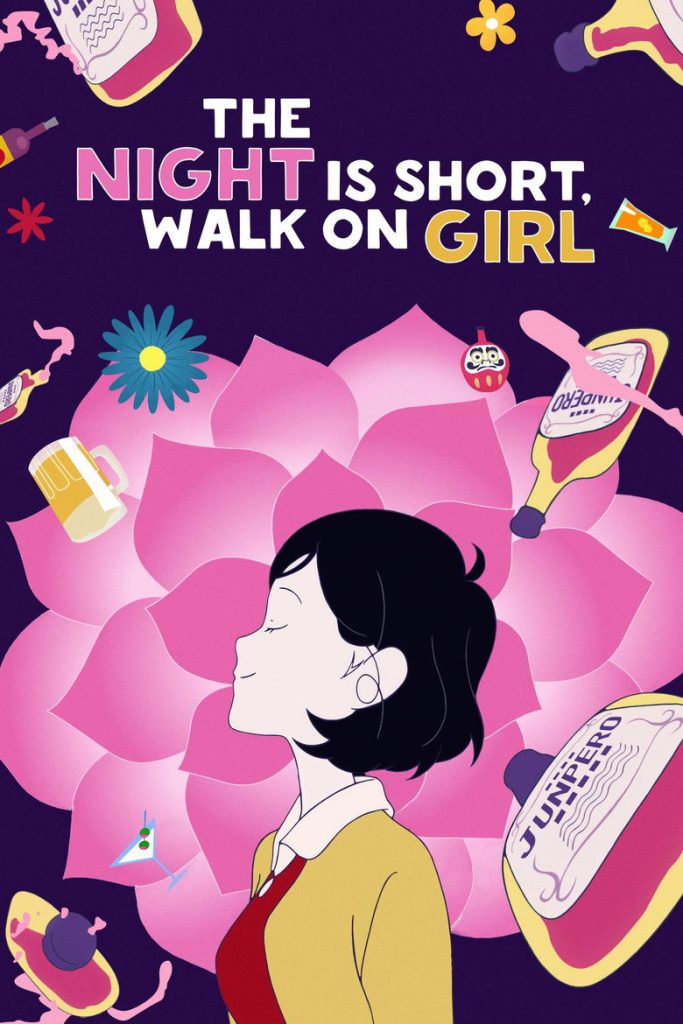
This animated Japanese film follows a group of university students during a magical night out in the city. The story centers on a sophomore girl who experiences increasingly surreal and fantastical encounters with the vibrant nightlife around her. Meanwhile, a senior student orchestrates elaborate coincidences to cross paths with her, hoping to express his romantic feelings. The film blends comedy, romance, and fantasy elements into a whimsical exploration of youth, connection, and the unexpected adventures that can unfold in a single night.
Parent Guide
A surreal animated romance with mature themes best suited for teens who can appreciate its artistic style and content.
Content breakdown
Some fantasy peril in surreal sequences, but no realistic violence or physical harm.
Surreal fantasy sequences with exaggerated transformations and abstract imagery that could be intense for sensitive viewers.
Occasional mild language typical of young adult social situations.
Some romantic situations and mild innuendo, but no explicit sexual content or nudity.
Depictions of alcohol consumption by young adults in social settings, including drinking scenes in bars and parties.
Themes of unrequited love, social anxiety, and the emotional intensity of young adulthood, portrayed through surreal and exaggerated scenarios.
Parent tips
This PG-13 animated film contains some mature themes and content that may require parental guidance for younger viewers. The story includes depictions of alcohol consumption by young adults in social settings, some mild romantic situations, and surreal fantasy sequences that could be confusing or intense for children. The film's nonlinear storytelling and abstract visual style might be challenging for viewers who prefer straightforward narratives.
Parents should be aware that while the animation is colorful and imaginative, the content is aimed at older teens and adults who can appreciate its artistic style and thematic depth. The film explores themes of young adulthood, romantic pursuit, and the boundary between reality and fantasy in ways that younger children may not fully grasp. The runtime of 93 minutes and fast-paced editing could also make it difficult for some children to follow.
Parent chat guide
During viewing, you could pause occasionally to check if they're following the story or if any scenes are confusing them. The film's abstract sequences might prompt questions about what's "real" versus what's imagined or exaggerated for artistic effect. This could lead to conversations about how different types of storytelling work.
After watching, discuss how the film portrays friendship, romantic feelings, and the excitement of new experiences. Ask what they thought about the main characters' actions and whether they understood why the senior student went to such lengths to meet the girl. This could lead to conversations about healthy relationships, communication, and how people express their feelings.
Parent follow-up questions
- What was your favorite colorful part in the movie?
- Did you see any funny characters?
- What sounds did you hear in the city?
- Was there any music you liked?
- What would you do if you had a magical night out?
- What was the most surprising thing that happened in the story?
- How did the characters show they cared about each other?
- What made some parts of the movie feel like a dream?
- Why do you think the senior student kept trying to meet the girl?
- What would you do if you had one special night in the city?
- What did you think about how the film mixed reality and fantasy?
- How did the characters' actions show their feelings without always saying them?
- What messages did you get about friendship and romance?
- Why do you think the filmmakers chose such an imaginative visual style?
- How might this story be different if it wasn't animated?
- How does the film use surreal elements to explore themes of connection and young adulthood?
- What did you think about the portrayal of social interactions and romantic pursuit among university students?
- How did the animation style contribute to the film's overall mood and message?
- What commentary might the film be making about the experiences of youth?
- How does this compare to other coming-of-age stories you've seen?
🎭 Story Kernel
At its core, 'Night Is Short, Walk On Girl' is a surreal exploration of life's interconnectedness and the pursuit of meaning through serendipity. The film posits that existence is a chaotic, beautiful web where every action ripples outward, connecting strangers and shaping destinies. The unnamed Girl with Black Hair is driven by a simple, joyful curiosity to experience everything the night offers, from rare books to strange drinks. Her journey is passive yet magnetic, drawing the world to her. Conversely, Senpai is driven by a desperate, comically futile desire to orchestrate 'fateful encounters' with her, believing he must engineer their connection. The movie argues that genuine connection and meaning emerge not from forced plans, but from surrendering to life's unpredictable flow, as symbolized by the ever-circulating, shared cup of alcohol that ties all characters together.
🎬 Visual Aesthetics
The film's visual language is a masterclass in controlled chaos, mirroring its thematic density. Director Masaaki Yuasa employs a wildly fluid, rubber-hose animation style where characters and backgrounds morph and stretch, visually representing the intoxicated, dreamlike logic of the night. The color palette is a vibrant, almost psychedelic assault of saturated reds, purples, and yellows during the chaotic street festival, contrasting with the warmer, more intimate tones of the underground book market. This isn't just aesthetic; it's psychological mapping. The camera (or its animated equivalent) is relentlessly dynamic, often adopting a first-person perspective during Senpai's frantic chases or swooping through impossible spaces, making the viewer an active participant in the night's dizziness. Symbolism is direct yet profound: the ever-present alcohol represents the shared experience of life, while the literal 'God of Used Book Markets' and 'God of Festivals' manifest the idea that meaning and community are forces to be worshipped in the mundane.
🔍 Details & Easter Eggs
💡 Behind the Scenes
The film is based on a novel by Tomihiko Morimi, who also wrote 'The Tatami Galaxy,' which shares the same 'universe' and characters (the Girl and Senpai). Director Masaaki Yuasa and Science SARU studio are known for their distinctive, expressionistic animation style, which rejects conventional anime aesthetics for more painterly, dynamic movement. The film's soundtrack, composed by Michiru Oshima, blends big band jazz, classical, and eclectic sounds to match the night's shifting moods. A notable production challenge was animating the massively complex, continuously moving crowd scenes during the festival sequence, requiring meticulous planning to maintain both chaos and visual coherence.
Where to watch
Choose region:
- HBO Max
- HBO Max Amazon Channel
- Amazon Video
- Apple TV
- Fandango At Home
- Hoopla
Trailer
Trailer playback is unavailable in your region.