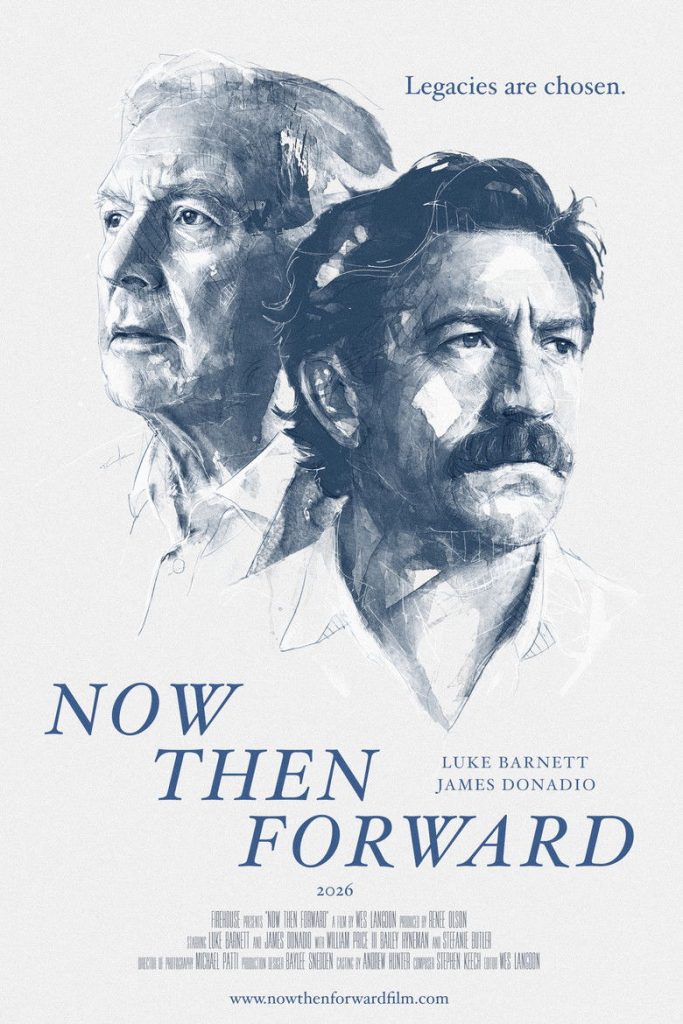
Now Then Forward (2026)

Released: 2026-02-01 Recommended age: 10+ No IMDb rating yet
Now Then Forward

Movie details

  • Genres: Drama
  • Director: Wes Langdon
  • Main cast: Luke Barnett, James Donadio, William Gene Price III, Bailey Hyneman, Stefanie Butler
  • Country / region: United States of America
  • Original language: en
  • Premiere: 2026-02-01

Story overview

Now Then Forward is a 2026 American drama directed by Wes Langdon, starring Luke Barnett, James Donadio, William Gene Price III, Bailey Hyneman, and Stefanie Butler. The film explores the emotional journey of George Bellamy Jr. and his ailing veteran father, George Sr., as they grapple with grief, unresolved family tensions, and the need for honesty after the death of matriarch Rhea. Set against a backdrop of familial expectations and personal hurt, the story delves into themes of loss, reconciliation, and the complexities of father-son relationships, aiming for a poignant and introspective narrative.

Parent Guide

Now Then Forward is a short drama that deals with mature emotional themes, including grief, family tension, and reconciliation. It is suitable for older children and teens who can handle discussions of loss and complex relationships, but may be too intense for very young viewers due to its serious subject matter.

Content breakdown

Violence & peril
None

No physical violence, action scenes, or perilous situations are present. The conflict is entirely emotional and relational.

Scary / disturbing
Mild

Themes of death and family strife may be unsettling for sensitive viewers, but there are no jump scares, horror elements, or graphic content.

Language
None

No profanity, offensive language, or harsh dialogue is expected, based on the dramatic and introspective nature of the film.

Sexual content & nudity
None

No sexual content, nudity, or romantic scenes are present; the focus is solely on familial and emotional dynamics.

Substance use
None

No depiction of alcohol, drugs, tobacco, or substance use is indicated in the overview or genre context.

Emotional intensity
Moderate

High emotional intensity due to themes of loss, grief, and strained family relationships. Scenes may evoke sadness or reflection, but are handled in a dramatic rather than overwhelming manner.

Parent tips

This drama focuses on emotional themes like grief, family conflict, and aging, which may be heavy for young children. It contains no explicit violence, language, or sexual content, but the mature subject matter and emotional intensity make it best suited for older children and teens. Parents should consider their child's sensitivity to discussions of death and family strife before viewing. The short runtime (15 minutes) allows for manageable viewing, but follow-up conversations may be needed to process the themes.

Parent chat guide

After watching 'Now Then Forward,' use this guide to discuss the film with your child. Start by asking what they understood about the story and characters. For younger viewers (ages 8-12), focus on emotions: 'How did George Jr. and George Sr. feel after Rhea died?' or 'What does it mean to be honest with family?' For teens (ages 13-18), delve deeper: 'How do past hurts affect relationships?' or 'What does the film say about communication in families?' Emphasize that it's okay to talk about difficult feelings and that movies can help us understand real-life challenges. Keep the conversation open-ended and supportive.

Parent follow-up questions

  • What did you think about George Jr. and his dad?
  • How do you think they felt when Rhea was gone?
  • What does it mean to be a family?
  • Why do you think George Jr. and George Sr. had trouble talking to each other?
  • How does grief change people in the movie?
  • What can we learn about honesty from this story?
  • How does the film portray the impact of unresolved family conflicts?
  • What themes about aging and veteran experiences are explored?
  • In what ways does the film challenge traditional expectations in father-son relationships?
⚠️ Deep Film Analysis (Contains Spoilers) · Click to Expand
A time-travel puzzle where the real journey is through emotional baggage.

🎭 Story Kernel

At its core, 'Now Then Forward' is less about the mechanics of temporal displacement and more a poignant exploration of regret and the illusion of control. The protagonist's desperate leaps through time aren't driven by a desire to change the world, but to fix a single, personal fracture—a lost relationship. The film argues that even with the power to rewrite moments, we remain prisoners to our emotional patterns. Each 'correction' creates new unintended consequences, revealing that the problem was never the specific events, but the protagonist's own inability to process loss and move forward. The narrative engine is the haunting question: if you could go back, would you fix the moment, or fix yourself?

🎬 Visual Aesthetics

The film employs a distinct visual language to demarcate timelines. The 'present' is rendered in a stark, desaturated palette with static, composed shots, reflecting the protagonist's emotional stagnation. In contrast, the past sequences burst with warmer, golden-hour hues and utilize more handheld, fluid camera movement, visually romanticizing memory. Crucially, the 'future' (or altered present) scenes are tinged with a subtle, unnatural cyan, a digital coldness hinting at the artificiality of these manufactured outcomes. This color-coded system allows the audience to intuitively track the narrative's complex jumps without explicit exposition, making the temporal chaos emotionally legible.

🔍 Details & Easter Eggs

1
The protagonist's wristwatch is permanently stuck at the exact time of the initial traumatic incident, a detail only visible in close-ups, symbolizing how that moment has halted their internal sense of time.
2
In every altered timeline, a specific brand of coffee mug appears in the background of key scenes, a subtle production design cue that this reality is a constructed 'off-brand' version of the true past.
3
During the final 'leap,' the sound of the time-travel mechanism audibly glitches and distorts, foreshadowing that this jump will be the one that breaks the cycle permanently, rather than continuing it.

💡 Behind the Scenes

The film was shot almost entirely on location in a single neighborhood of Berlin, with different streets and slightly altered set dressings used to represent the different timelines, creating a palpable sense of familiar-yet-wrong geography. The lead actor reportedly performed all scenes in chronological order of the character's emotional journey, not the film's edited sequence, to maintain a consistent arc through the fractured narrative. The distinctive, minimalist score was created using manipulated sounds recorded from old railway clocks, tying the music directly to the theme of time and machinery.

Where to watch

Streaming availability has not been announced yet.

SkyMe App
SkyMe Guide Download on the App Store
VIEW