
Om Shanti Om (2007)
Story overview
Om Shanti Om is a 2007 Indian film that blends comedy, thriller, and drama elements. The story follows a junior film actor who becomes entangled in a mysterious past-life connection with a famous actress. It explores themes of reincarnation, love, and justice through a Bollywood-style narrative with musical numbers and dramatic twists.
Parent Guide
A Bollywood-style film mixing comedy, thriller, and drama elements with musical sequences and themes of reincarnation.
Content breakdown
Some suspenseful situations and dramatic confrontations typical of thriller elements.
Themes of past lives and mysterious connections might be confusing or slightly unsettling for very young viewers.
No concerning language issues noted.
No sexual content or nudity concerns.
No substance use depicted.
Dramatic plot twists and themes of love, betrayal, and justice create emotional moments.
Parent tips
This film contains typical Bollywood elements including dramatic plot twists, musical sequences, and some suspenseful moments that might be intense for younger viewers. Parents should be aware that while categorized as a comedy-thriller-drama, it deals with themes of past lives, betrayal, and revenge that could be confusing or emotionally challenging for children under 8. The film's runtime and musical nature make it suitable for family viewing with older children who can follow complex narratives.
Parent chat guide
Parent follow-up questions
- What was your favorite song in the movie?
- Did you like the dancing parts?
- Which character made you laugh the most?
- What did you think about the idea of someone remembering a past life?
- How did the music help tell the story?
- What made this movie funny and exciting at the same time?
- How does the film balance comedy with more serious thriller elements?
- What do you think about the concept of justice in the story?
- How do the musical sequences contribute to character development?
- How effectively does the film blend multiple genres (comedy, thriller, drama)?
- What commentary does the film make about the film industry through its story?
- How does the reincarnation theme serve the narrative structure?
🎭 Story Kernel
At its core, 'Om Shanti Om' is less a ghost story and more a scathing critique of Bollywood's star-making machinery and its brutal disposability. The driving force isn't just revenge for murder; it's the desperate, almost pathological, yearning for cinematic validation. Om Prakash Makhija's obsession with Shanti isn't purely romantic—it's the obsession of a background artist for the ultimate leading lady, the embodiment of the glamour he's denied. His reincarnation as Om Kapoor allows him to rewrite his narrative, not just as a wronged lover, but as the superstar he always dreamed of being. The film argues that in Bollywood, rebirth is the ultimate career comeback.
🎬 Visual Aesthetics
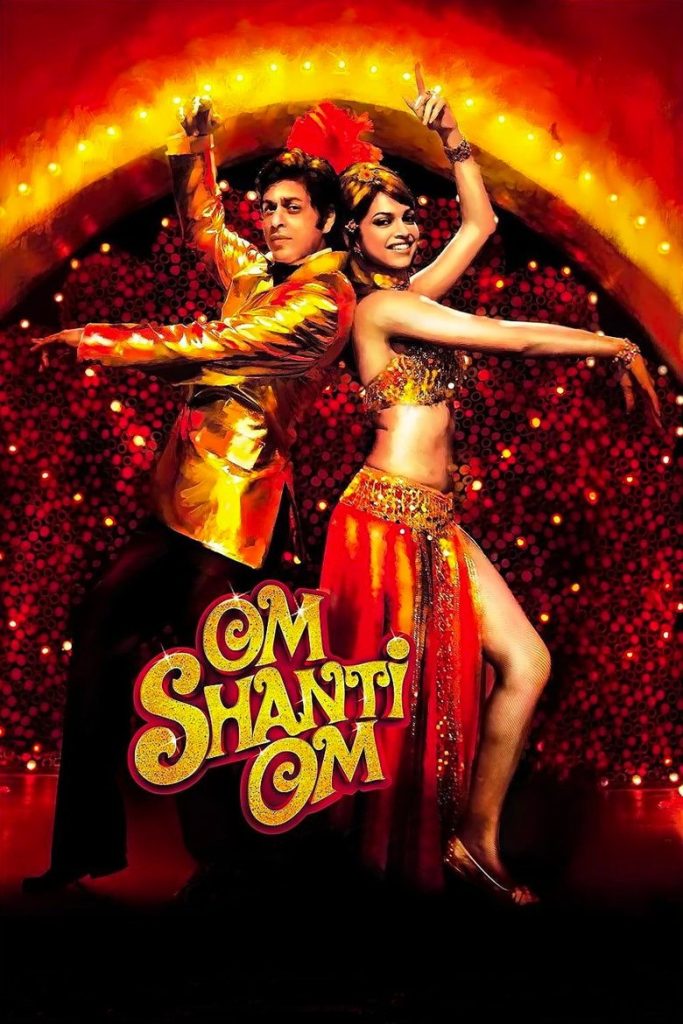
The film's visual language is a deliberate, flamboyant pastiche of 1970s and 2000s Bollywood. The '70s sequences are drenched in warm, saturated amber and red tones, with softer focus and theatrical, stage-like lighting, mimicking the melodramatic Technicolor era. The 2000s segments shift to cooler, sharper digital clarity and frenetic, MTV-style editing, especially in the song sequences. This stark visual divide isn't just about time periods; it visually codes the past as emotionally 'real' (if stylized) and the present as a performative, media-saturated playground where Om enacts his revenge.
🔍 Details & Easter Eggs
💡 Behind the Scenes
The legendary 'Dard-e-Disco' number was filmed with Shah Rukh Khan performing despite severe shoulder pain from a previous injury, which was written into the choreography. The film features over 30 celebrity cameos in the finale song 'Deewangi Deewangi,' a record at the time, orchestrated as a meta-tribute to Bollywood's own self-referential culture. Director Farah Khan intentionally cast Arjun Rampal, then primarily a model, as the villain to subvert his 'pretty boy' image. The 1970s sets were meticulously researched to replicate the iconic R.K. Studios aesthetic.
Where to watch
Choose region:
- Netflix
- Netflix Standard with Ads
- Amazon Video
- Apple TV
- Google Play Movies
- YouTube