
Oppenheimer (2023)
Story overview
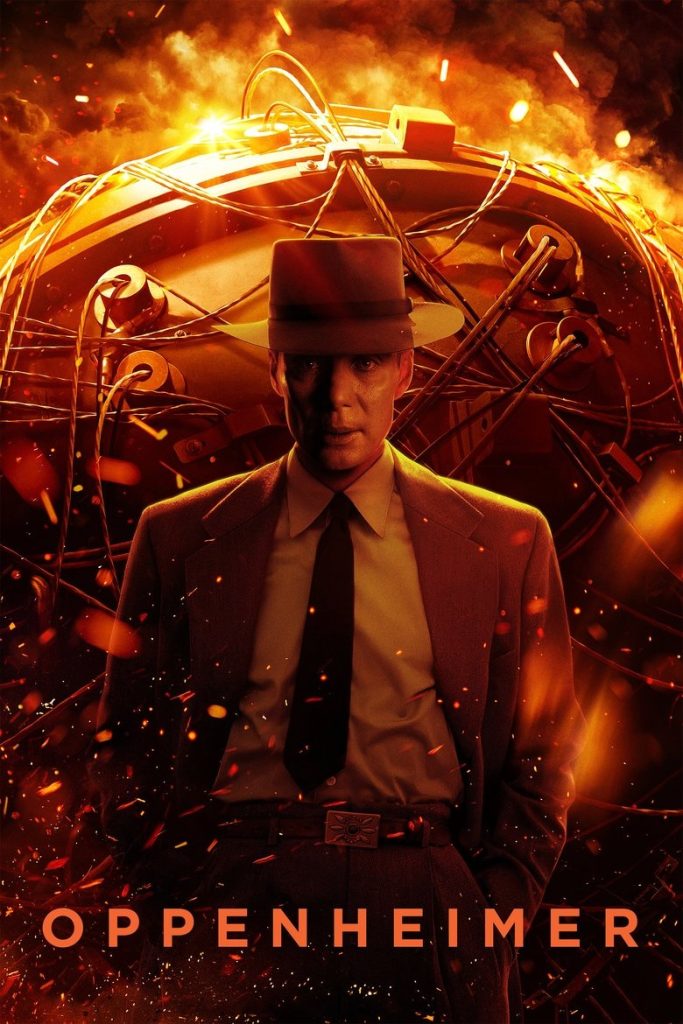
Oppenheimer is a historical drama about J. Robert Oppenheimer, the physicist who led the Manhattan Project to develop the first atomic bomb during World War II. The film explores his scientific work, personal life, and the moral dilemmas surrounding the creation of this powerful weapon. It depicts the intense pressure of the wartime race against Nazi Germany and the profound consequences of scientific discovery.
Parent Guide
A mature historical drama exploring complex ethical questions about scientific responsibility during wartime.
Content breakdown
Historical depictions of war context and implied destruction, though not graphically shown.
Intense themes about nuclear weapons and their devastating potential, with tense sequences.
Occasional strong language consistent with adult drama.
Brief romantic scenes and implied relationships.
Social drinking and smoking depicted in historical context.
High-stakes decision-making, moral dilemmas, and intense dramatic scenes throughout.
Parent tips
This R-rated film deals with mature themes including war, moral responsibility, and the devastating power of nuclear weapons. The 3-hour runtime and complex historical narrative may challenge younger viewers' attention spans. Parents should be prepared to discuss the historical context of World War II and the ethical questions raised by scientific advancement.
Parent chat guide
Parent follow-up questions
- What did you notice about the scientists in the movie?
- How did the music make you feel during different parts?
- What colors or pictures do you remember most?
- What was the main job the scientists were trying to do?
- Why do you think they were working so hard on their project?
- How did the characters show they were worried or stressed?
- What ethical questions did the scientists face about their work?
- How did the wartime setting affect their decisions?
- What responsibilities do scientists have when creating new technology?
- How does the film portray the relationship between scientific progress and moral responsibility?
- What historical factors influenced the decisions made about the atomic bomb?
- How might the story be different if told from other perspectives?
🎭 Story Kernel
At its heart, Oppenheimer is less a biopic and more a high-stakes psychological thriller exploring the burden of genius and the terrifying consequences of scientific discovery. Nolan delves into the moral ambiguity of J. Robert Oppenheimer, framing the creation of the atomic bomb not as a triumph, but as a Faustian bargain. The narrative oscillates between the feverish race of the Manhattan Project and the claustrophobic 1954 security hearing, illustrating how political machinations can dismantle a man’s legacy. It examines the Promethean myth—the idea that bringing fire to humanity inevitably leads to eternal torment. The film suggests that while the bomb ended one war, it ignited a chain reaction of global anxiety and personal guilt that Oppenheimer could never outrun, effectively turning his greatest achievement into his ultimate haunting.
🎬 Visual Aesthetics
Hoyte van Hoytema’s cinematography is a masterclass in scale, juxtaposing the vast, desolate landscapes of Los Alamos with extreme, pores-and-all close-ups of Cillian Murphy’s face. The film’s dual timelines are distinguished by a striking visual shorthand: the Fission sequences are in vibrant, high-contrast color, representing Oppenheimer’s subjective experience, while the Fusion sequences are shot in stark, 65mm black-and-white IMAX film to denote Lewis Strauss’s objective, political perspective. The use of practical effects to simulate subatomic particles and the Trinity test—avoiding CGI entirely—lends the imagery a tactile, terrifying realism. Light is used as a weapon, particularly in the blinding flash of the explosion and the rhythmic, flickering shadows during the interrogation scenes, mirroring the protagonist’s internal fragmentation and the volatile nature of the atoms he sought to split.
🔍 Details & Easter Eggs
💡 Behind the Scenes
To maintain historical authenticity, the production filmed at several real-life locations, including the actual house where the Oppenheimer family lived in Los Alamos and the campus of the Institute for Advanced Study in Princeton. Cillian Murphy underwent a rigorous physical transformation to match Oppenheimer’s gaunt silhouette, reportedly subsisting on a very minimal diet. Furthermore, the film marks the first time IMAX black-and-white film stock was ever created, as Kodak had to manufacture it specifically for this production. The cast even features several real scientists as extras to provide an authentic atmosphere during the laboratory and lecture scenes.
Where to watch
Choose region:
- Amazon Video
- Apple TV
- Google Play Movies
- YouTube
- Fandango At Home
- Spectrum On Demand
Trailer
Trailer playback is unavailable in your region.