
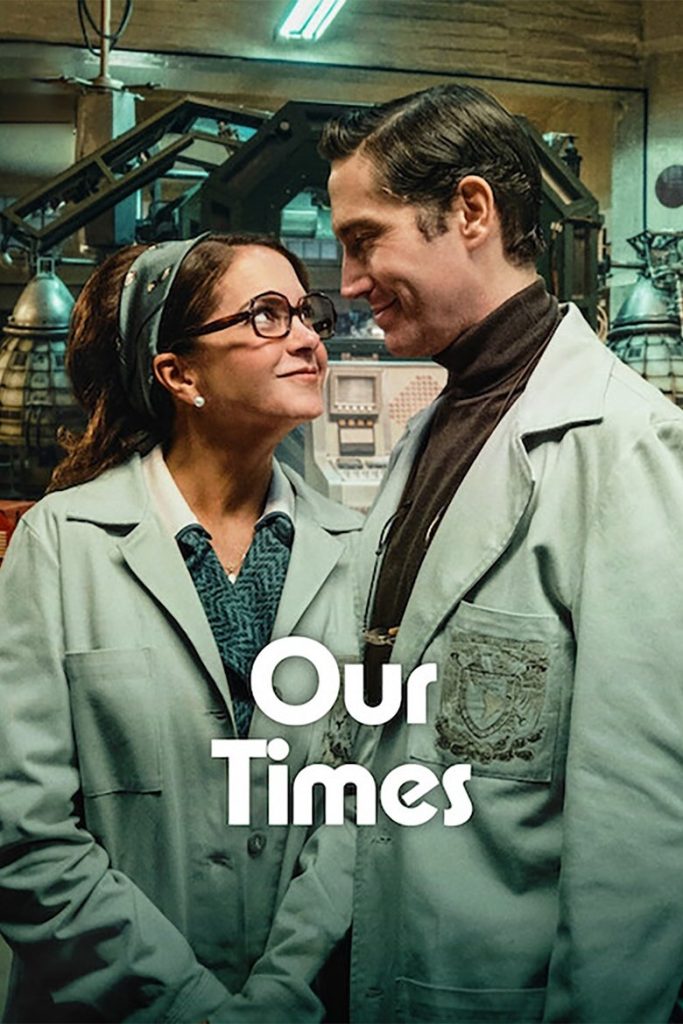
Our Times (2025)

Released: 2025-06-09 Recommended age: 8+ IMDb 5.3
Our Times

Movie details

  • Genres: Science Fiction, Romance, Comedy
  • Director: Chava Cartas
  • Main cast: Lucero, Benny Ibarra, Renata Vaca, Ofelia Medina, Alejandro Ávila
  • Country / region: Mexico
  • Original language: es
  • Premiere: 2025-06-09

Story overview

In this Mexican sci-fi romantic comedy, married scientists Nora and Héctor invent a time machine that transports them from 1966 to 2025. While Héctor struggles to adapt to the futuristic world, Nora embraces the opportunities it offers, but their journey raises questions about the personal costs of progress and change.

Parent Guide

A family-friendly sci-fi romance with mild thematic complexity. Suitable for most children with parental guidance for discussion.

Content breakdown

Violence & peril
Mild

No physical violence. Mild peril includes comedic scenes of time-travel disorientation and cultural shock. Some light tension as characters navigate unfamiliar future environments.

Scary / disturbing
Mild

Minimal scary content. Some mildly unsettling scenes of time-travel effects and disorientation. No horror elements or disturbing imagery.

Language
None

No offensive language expected in this family-oriented film. May include mild exclamations appropriate for general audiences.

Sexual content & nudity
None

No sexual content or nudity. The film focuses on marital relationship dynamics in a wholesome manner, with affectionate moments appropriate for family viewing.

Substance use
None

No depiction of substance use. Characters may drink socially in period-appropriate settings (1966 scenes) but nothing excessive or glorified.

Emotional intensity
Mild

Moderate emotional themes about change, adaptation, and marital dynamics. Some scenes may evoke mild empathy or concern as characters face challenges, but nothing overwhelming for children.

Parent tips

This film explores themes of adaptation, marriage dynamics, and technological ethics through a lighthearted sci-fi lens. Parents should be prepared to discuss how technology impacts relationships and personal growth. The time-travel premise may confuse younger viewers, but it serves as a metaphor for navigating change. The Mexican cultural context provides opportunities to discuss different perspectives on progress.

Parent chat guide

After watching, ask: 'How would you feel if you traveled to the future like Nora and Héctor?' For older kids: 'What do you think Nora sacrificed to thrive in 2025?' Discuss the balance between embracing new opportunities and preserving what matters from the past. Talk about how technology in the film compares to real-life advancements and their effects on families.

Parent follow-up questions

  • What was your favorite part of the movie?
  • Did you like the time machine?
  • Would you want to visit the future?
  • How was 2025 different from 1966 in the movie?
  • Why do you think Héctor had trouble in the future?
  • What would you miss most if you time traveled?
  • What sacrifices do you think Nora made to succeed in 2025?
  • How does the film show technology affecting relationships?
  • What would be hardest about adapting to a different time period?
  • Analyze the film's commentary on technological progress versus personal cost.
  • How does the time travel metaphor reflect real-life adaptation to rapid change?
  • Discuss the gender dynamics in Nora and Héctor's different responses to the future.
⚠️ Deep Film Analysis (Contains Spoilers) · Click to Expand
A nostalgic time capsule that proves first loves shape us more than we admit.

🎭 Story Kernel

At its core, 'Our Times' explores how youthful infatuation serves as a catalyst for self-discovery, not through idealized romance but through the messy, awkward process of becoming. The film's true subject isn't just teenage love—it's the formation of identity through shared vulnerability. Truly Lin and Hsu Tai-yu aren't chasing each other as much as they're escaping their own insecurities, using their 'contract' relationship as a safe laboratory for emotional growth. The adult framing device reveals how these formative experiences create the people we become, suggesting our teenage selves never fully disappear but integrate into our adult personas.

🎬 Visual Aesthetics

The film employs a distinct visual dichotomy between past and present sequences. The 1990s scenes feature warm, saturated colors with soft lighting that creates a nostalgic haze, while present-day scenes use cooler, more muted tones. Director Frankie Chen utilizes handheld camera work during emotional teenage moments to create intimacy, contrasting with stable shots in adult scenes. The visual storytelling cleverly mirrors the narrative—when Truly rediscovers her cassette tapes, the color palette subtly warms, visually representing her reconnection with her past self. The school environment feels authentically lived-in rather than idealized.

🔍 Details & Easter Eggs

1
The cassette tape Truly finds as an adult contains not just songs but her teenage voice—this physical artifact becomes a time machine, foreshadowing how objects carry emotional weight beyond their material function.
2
When Hsu Tai-yu practices his confession in the mirror, his reflection shows both his nervous present self and the confident person he's trying to become—a subtle visual metaphor for adolescence as performance.
3
The recurring motif of folded paper stars represents not just teenage craft but how small moments accumulate into significant memories, mirroring how the film itself constructs meaning from seemingly minor interactions.

💡 Behind the Scenes

Actress Vivian Sung gained 15 kilograms for her role as teenage Truly Lin, then lost it again for the adult sequences—a physical transformation that mirrored her character's journey. Many school scenes were filmed at Neiwan Junior High School in Hsinchu County, which maintained its 1990s appearance. Director Frankie Chen intentionally cast actors who weren't typical idol drama stars to create more authentic teenage portrayals. The film's soundtrack features actual 1990s Mandopop hits that triggered widespread nostalgia among Taiwanese audiences upon release.

Where to watch

Choose region:

  • Netflix
  • Netflix Standard with Ads
SkyMe App
SkyMe Guide Download on the App Store
VIEW