Out of My Mind (2024)
Story overview
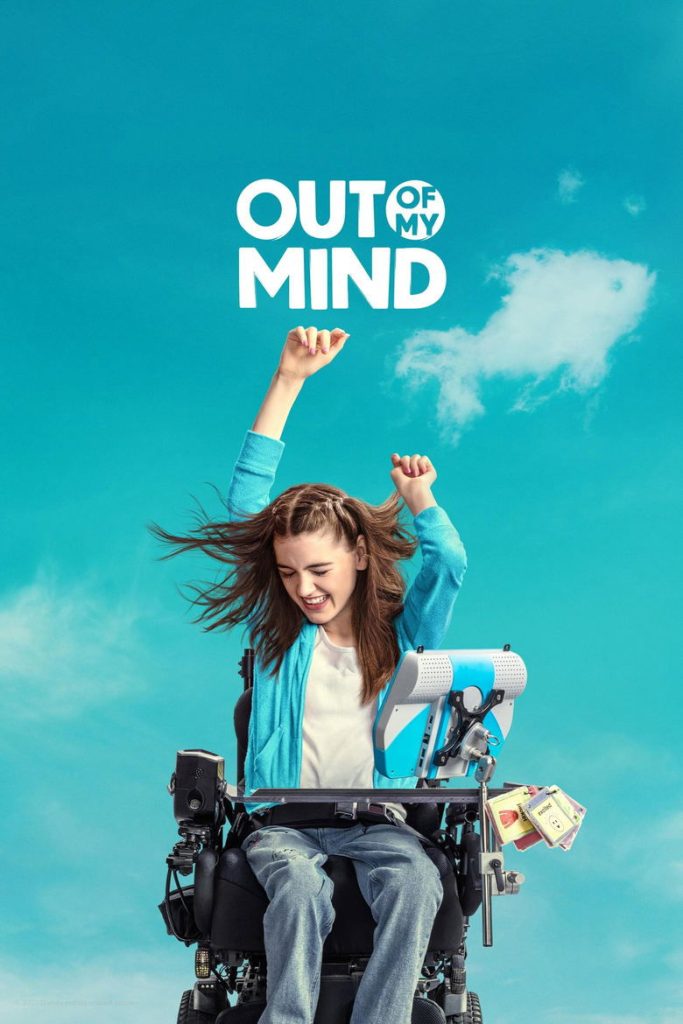
Out of My Mind is a heartfelt family drama about Melody Brooks, a bright sixth grader with cerebral palsy who uses a wheelchair and communicates non-verbally. The film follows her journey as she faces underestimation from others but finds an educator who recognizes her intelligence and helps her access mainstream education. Through her determination, Melody demonstrates that her thoughts and contributions matter far more than her physical limitations, offering an inspiring story about inclusion and human potential.
Parent Guide
A family-friendly drama with positive messages about inclusion and overcoming challenges, suitable for most children with parental guidance.
Content breakdown
No violence or physical peril depicted.
Some emotional scenes showing frustration and exclusion that might be upsetting to sensitive viewers.
No offensive language noted.
No sexual content or nudity.
No substance use depicted.
Emotional themes of exclusion, frustration, and triumph may be intense for younger viewers.
Parent tips
This film provides an excellent opportunity to discuss disability awareness, empathy, and inclusion with children. The story portrays the challenges faced by someone with cerebral palsy in an accessible way, showing both frustrations and triumphs. Parents should be prepared for emotional moments as Melody faces exclusion and works to prove herself, but the overall message is uplifting and educational about valuing people for their abilities rather than their limitations.
Parent chat guide
Parent follow-up questions
- How did Melody talk to people?
- What was special about Melody's wheelchair?
- How did Melody's friends help her?
- What made Melody happy in the movie?
- How can we be kind to people who are different?
- Why do you think some people didn't understand Melody at first?
- How did Melody show she was smart even though she couldn't speak?
- What challenges did Melody face at school?
- How did the teacher help Melody?
- What did you learn about cerebral palsy from this movie?
- How does the movie show the difference between physical ability and intelligence?
- What stereotypes about disability does the film challenge?
- How did Melody's communication device change how others saw her?
- What does the film teach about inclusion in education?
- How can schools better support students with different abilities?
- How does the film portray the social and educational barriers faced by people with disabilities?
- What does Melody's journey reveal about assumptions we make based on appearance?
- How does the film balance emotional impact with educational value?
- What systemic changes would help create more inclusive environments?
- How does the movie challenge traditional definitions of intelligence and capability?
🎭 Story Kernel
Based on Sharon M. Draper’s novel, the film follows Melody Brooks, a sixth-grader with non-verbal cerebral palsy who possesses a photographic memory and a sharp intellect. The narrative is not a standard tale of pity but a rigorous examination of intellectual isolation. It centers on Melody’s struggle to communicate in a world that equates physical limitation with mental incapacity. When she acquires a cutting-edge assistive device, the 'Medi-Talker,' her world expands, allowing her to participate in a competitive academic quiz team. The story explores the systemic failures of the education system and the social friction that arises when a marginalized voice suddenly demands to be heard. It is a profound study of self-advocacy, the nuances of family support, and the fundamental human need to connect and be understood on one's own terms.
🎬 Visual Aesthetics
Director Amber Sealey employs a vibrant and empathetic visual palette that contrasts Melody’s rich internal life with her often stagnant external environment. The cinematography frequently utilizes close-ups on Phoebe-Rae Taylor’s expressive face, capturing nuanced emotions that her character cannot verbally articulate. This creates an intimate bond between the viewer and Melody’s perspective. The film avoids the drab, clinical aesthetic often associated with disability dramas, instead using bright colors and dynamic camera movements during Melody’s moments of intellectual triumph. The visual language effectively mirrors the sensory experience of a girl who notices everything but is rarely noticed herself. By keeping the camera at Melody’s eye level, the film grounds the audience in her physical reality while the sophisticated voiceover provides a bridge to her complex, colorful consciousness.
🔍 Details & Easter Eggs
💡 Behind the Scenes
The film premiered at the 2024 Sundance Film Festival to critical acclaim. A landmark decision in production was the casting of Phoebe-Rae Taylor, a young actress who actually has cerebral palsy, ensuring authentic representation and lived experience in the lead role. Jennifer Aniston provides the internal voice of Melody, a creative choice intended to reflect how Melody perceives her own thoughts—sophisticated, clear, and adult-like—rather than how the world hears her. The project was developed by Big Beach and Disney Branded Television, aiming to modernize the beloved source material for a new generation of viewers while maintaining its emotional core.
Where to watch
Choose region:
- Disney Plus
Trailer
Trailer playback is unavailable in your region.