
Out of Scale (1951)
Story overview
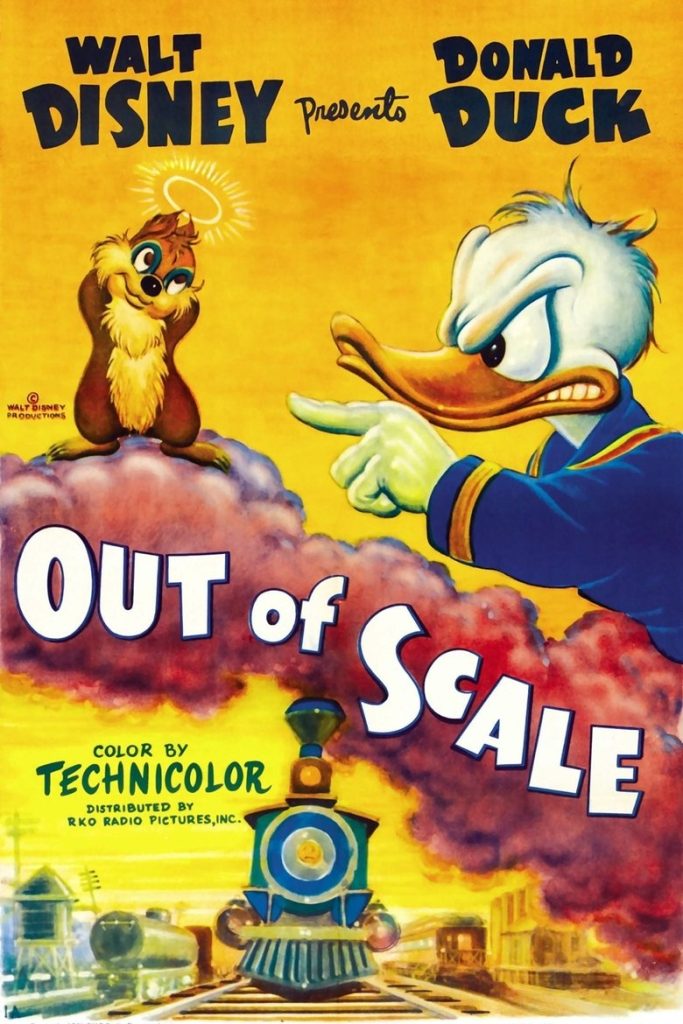
Donald Duck has a backyard train layout that includes a large tree home to Chip 'n Dale. When Donald moves the tree because it's out of scale with his model train setup, the chipmunks return to find their home displaced. They discover one of Donald's model houses is perfectly sized for them and decide to make it their new home, leading to playful interactions.
Parent Guide
A gentle animated short with mild cartoon mischief suitable for most children.
Content breakdown
Cartoon-style antics with characters being startled or inconvenienced, but no actual violence or danger.
No frightening or disturbing content; all situations are playful and resolved positively.
No inappropriate language; typical Disney character sounds and expressions.
No sexual content or nudity.
No substance use depicted.
Brief moments of frustration or surprise, but quickly resolved with humor.
Parent tips
This 7-minute animated short from 1951 features classic Disney slapstick humor with Donald Duck and Chip 'n Dale. The conflict centers around Donald moving the chipmunks' tree home without their permission, which could prompt discussions about respecting others' property and finding creative solutions to problems. The mild cartoon mischief includes characters being startled or inconvenienced but no real danger or harm.
Parent chat guide
Parent follow-up questions
- How did Chip 'n Dale feel when they saw their tree moving?
- What was your favorite part of the train?
- What would you do if someone moved your favorite toy?
- How big do you think the model house was compared to the chipmunks?
- What sounds did the train make?
- Why do you think Donald wanted to move the tree?
- How did Chip 'n Dale solve their problem?
- What does 'out of scale' mean in this story?
- Have you ever built something that didn't fit right?
- What would you have done if you were Donald?
- What does this story show about problem-solving?
- How might this situation be different if it happened with real people?
- What are some ways the characters showed creativity?
- Why is considering others' perspectives important?
- What other solutions could Donald have tried?
- How does this film use scale and perspective for comedic effect?
- What does the conflict reveal about property rights and consideration?
- How does this 1950s animation reflect attitudes of its time?
- What storytelling techniques make this short film effective?
- How might this situation be handled differently today?
🎭 Story Kernel
At its core, 'Out of Scale' is a chilling parable about control and the arrogance of imposing one's own sense of order onto a complex, living system. The protagonist, a model train enthusiast, is driven by a desire for aesthetic perfection and total dominion over his miniature world. His meticulous landscaping and forced narratives for the tiny inhabitants aren't about creation, but about curation—removing the unpredictable 'flaws' of nature and independent will. The film's real tension stems from this conflict between his sterile, scaled-down utopia and the messy, uncontrollable reality that inevitably bleeds in, questioning whether true harmony can ever be achieved through domination rather than coexistence.
🎬 Visual Aesthetics
The film's visual language masterfully employs extreme close-ups and shallow depth of field to create a disorienting sense of scale. The lush, hyper-realistic miniatures are shot with the grandeur of epic landscape cinematography, making a backyard garden feel like an impassable wilderness. A desaturated, slightly cool color palette dominates the human world, contrasting sharply with the warm, vibrant greens and browns of the miniature diorama, visually coding the 'real' world as sterile and the fabricated one as paradoxically more alive. The camera often adopts a low-angle, god-like perspective when viewing the miniatures, literally embodying the protagonist's controlling gaze.
🔍 Details & Easter Eggs
💡 Behind the Scenes
The film's astonishingly detailed miniatures were crafted by a team led by award-winning model maker Eleanor Vance, who previously worked on stop-motion features. To achieve the seamless integration of live-action and miniature elements, the production used forced perspective techniques on a custom-built soundstage, with many 'outdoor' garden scenes actually filmed indoors under controlled lighting. The lead actor, Julian Finch, reportedly spent weeks practicing with model trains and landscaping tools to make his hobbyist movements look authentically effortless and second-nature.
Where to watch
Choose region:
- Disney Plus