
Out on a Limb (1950)
Story overview
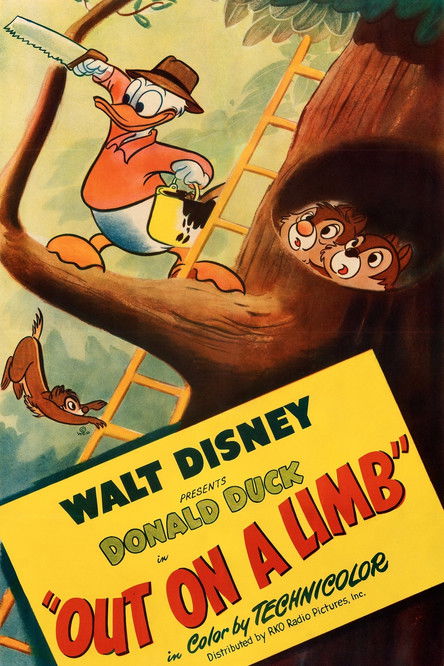
This 1950 animated short features Donald Duck performing tree maintenance when he encounters Chip 'n' Dale gathering nuts. Donald engages in playful mischief by sawing off a branch near their home and applying tar, which causes one of the chipmunks to become stuck. The cartoon depicts lighthearted pranks and slapstick interactions between the characters in a woodland setting.
Parent Guide
A classic Disney short with mild cartoon mischief suitable for most children.
Content breakdown
Cartoon slapstick with characters getting stuck in tar and playful pranks involving saws and shears, but no real danger or harm depicted.
No frightening elements; all conflict is presented as lighthearted cartoon mischief.
No dialogue beyond character sounds and typical cartoon expressions.
No sexual content or nudity present.
No substance use depicted.
Brief moments of frustration between characters, but resolved quickly with cartoon humor.
Parent tips
This classic Disney short contains mild cartoon mischief and slapstick humor typical of its era. Donald Duck's pranks involve non-threatening actions like sawing branches and using tar, with no real danger portrayed. The 7-minute runtime makes it suitable for brief viewing, and the simple conflict resolution provides opportunities to discuss playful behavior versus unkind teasing.
Parent chat guide
Parent follow-up questions
- What was your favorite part of the cartoon?
- How did the chipmunks feel when Donald played tricks on them?
- What sounds did the characters make?
- Was Donald being funny or mean?
- Would you want to play with Donald or the chipmunks?
- Why do you think Donald wanted to play tricks on the chipmunks?
- How did the characters solve their problem at the end?
- What would you do if someone played a trick on you like that?
- Was it fair for Donald to cut the branch near their home?
- What lesson could Donald learn from this experience?
- How does the animation style compare to modern cartoons you watch?
- What does this short tell us about conflict resolution without dialogue?
- Do you think the pranks went too far or stayed within playful boundaries?
- How might the story be different if told from the chipmunks' perspective?
- What historical context might explain why this cartoon was made in 1950?
- How does this cartoon reflect mid-20th century animation techniques and storytelling?
- What commentary might be present about human-animal interactions in this short?
- How does the physical comedy compare to modern slapstick humor?
- What values about conflict and resolution does this cartoon implicitly promote?
- How might different audiences interpret Donald's behavior toward the chipmunks?
🎭 Story Kernel
At its core, 'Out on a Limb' is a satirical exploration of modern corporate culture and masculinity through the lens of absurdist survival. The film follows Matthew Broderick's Bill Campbell, a yuppie investment banker who, while trying to sabotage a business rival's deal in a small logging town, literally gets stuck high in a giant redwood tree. The driving force isn't just physical survival, but the unraveling of his carefully constructed corporate persona. As hours turn to days, his materialistic values and cutthroat business tactics become useless, forcing a raw confrontation with his own emptiness. The movie cleverly uses this extreme situation to ask what happens when the trappings of modern success are stripped away, revealing the fragile ego beneath.
🎬 Visual Aesthetics
The film employs a stark visual dichotomy to mirror Bill's psychological journey. The early corporate scenes are shot with sterile, steady compositions and a cool color palette of grays and blues, reflecting his controlled, artificial life. Once in the tree, the cinematography shifts dramatically. The camera adopts unsettling Dutch angles and tight close-ups of Broderick's increasingly panicked face, emphasizing his disorientation and vulnerability. The majestic, towering redwoods are filmed with wide, awe-inspiring shots that dwarf the human figure, visually reinforcing nature's indifference to his corporate crisis. The transition from sleek office lighting to the harsh, natural light of the forest underscores the theme of being thrust back into a primal reality.
🔍 Details & Easter Eggs
💡 Behind the Scenes
The film's production faced significant logistical challenges filming in the actual redwood forests of Northern California. Matthew Broderick performed many of his own stunts in the tree, spending long hours harnessed on a platform built among the branches. The production had to be meticulously planned around weather and the protected status of the trees, using special rigging to avoid damage. Interestingly, the small town scenes were shot in the historic logging community of Fort Bragg, California, adding authentic local flavor. Director Francis Veber, known for French comedies, brought a distinctly European farcical sensibility to this American corporate satire.
Where to watch
Choose region:
- Disney Plus