
Pagglait (2021)
Story overview
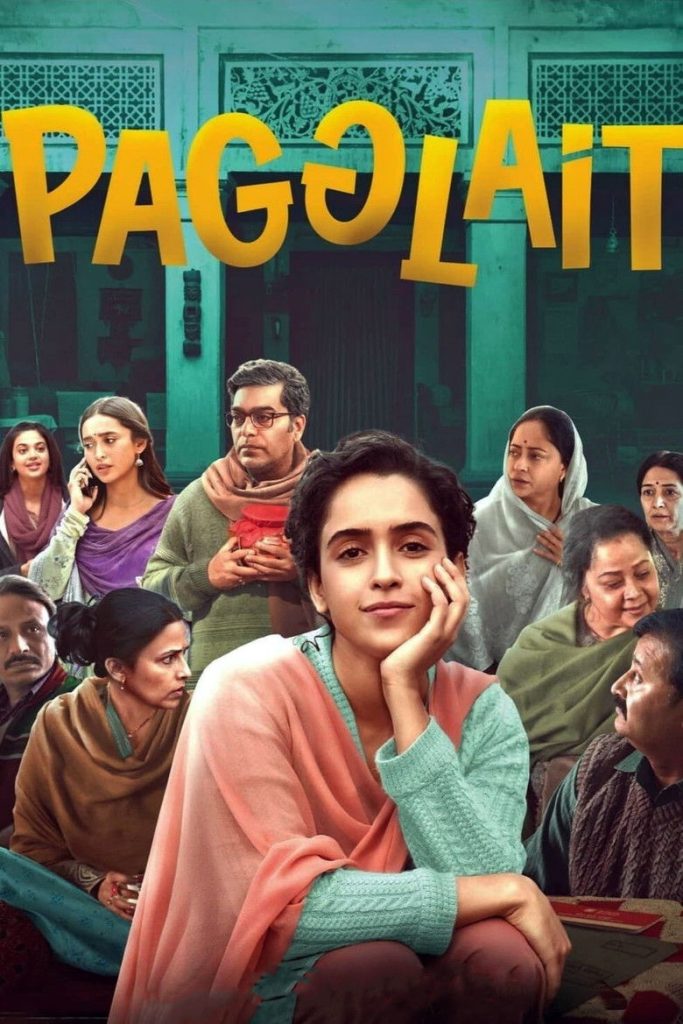
Pagglait is a 2021 Indian Hindi-language drama-comedy film directed by Umesh Bist. The story follows Sandhya, a young woman who becomes a widow just five months after her arranged marriage. As her family and in-laws gather for the traditional 13-day mourning period, Sandhya finds herself unable to grieve her husband's sudden death. Instead, she navigates the absurdities of family dynamics, societal expectations, and quirky relatives while making a startling discovery about her late husband that challenges her understanding of their relationship and her own identity.
Parent Guide
A thoughtful drama-comedy about grief, family dynamics, and self-discovery in contemporary India. While not graphically intense, it deals with emotionally mature themes that require some life experience to fully appreciate.
Content breakdown
No physical violence or peril. The central conflict is emotional rather than physical.
Themes of sudden death and grief might be emotionally heavy for younger viewers. Some family conflicts and emotional revelations could be intense but are handled with sensitivity and humor.
Occasional mild Hindi language that translates to equivalent of 'damn' or similar in context. No strong profanity.
Implied sexual relationships discussed but not shown. Some kissing and romantic moments. The discovery of the husband's secret involves emotional rather than explicit sexual content.
Social drinking in family gatherings and mourning rituals. No excessive or glorified substance use.
Significant emotional themes including grief, betrayal, family pressure, and self-discovery. The protagonist's emotional journey from confusion to empowerment is central to the plot. Some tense family confrontations and emotional revelations.
Parent tips
This film deals with mature themes of grief, marriage, and self-discovery in a thoughtful but sometimes emotionally complex way. Best for mature tweens and teens who can handle discussions about death and relationships. The comedic elements provide relief but don't overshadow the serious subject matter. Parents should be prepared to discuss arranged marriage customs, widowhood in Indian society, and emotional honesty.
Parent chat guide
Parent follow-up questions
—
—
- What did you think about how the family members treated Sandhya?
- Why do you think Sandhya felt confused about her feelings?
- What was your favorite funny moment in the movie?
- How does the film critique traditional gender roles and expectations in marriage?
- What does Sandhya's emotional journey say about authentic grieving versus performative mourning?
- How does the film use humor to address serious topics like death and betrayal?
- What commentary does the film make about arranged marriages and personal agency?
- How does Sandhya's financial independence contribute to her emotional liberation?
🎭 Story Kernel
At its core, 'Pagglait' explores performative grief versus authentic self-discovery. The film dissects how societal expectations around widowhood—especially in Indian middle-class families—can become a cage, while actual loss might paradoxically unlock freedom. Sandhya's journey isn't about missing her husband but realizing she never truly knew him or herself. Her emotional detachment isn't coldness; it's the quiet rebellion of a woman who refuses to cry on cue. The film cleverly uses the 13-day mourning ritual as a countdown to her emancipation, questioning whether marriage itself was her first confinement.
🎬 Visual Aesthetics
Director Umesh Bist employs a muted, naturalistic color palette dominated by whites and earthy tones during mourning scenes, visually emphasizing emotional sterility. The camera often lingers on Sandhya's face in tight close-ups, capturing micro-expressions of boredom and detachment amidst the chaotic family drama. Notice how her vibrant red dupatta appears only after she starts reclaiming her agency—a subtle visual rebellion. The framing frequently traps characters within doorways and windows, mirroring their social constraints. The funeral scenes are shot with handheld realism, avoiding melodramatic angles to underscore the mundane reality of grief.
🔍 Details & Easter Eggs
💡 Behind the Scenes
Sanya Malhotra prepared for her role by observing real widows in Varanasi and Lucknow, noting their body language and social isolation. The film was shot chronologically over 35 days to maintain emotional continuity. Director Umesh Bist insisted on authentic Lucknow locations rather than sets, capturing the specific architecture that influences family dynamics. The title 'Pagglait'—a colloquial term for 'crazy'—was chosen to challenge how society labels women who defy mourning expectations. Composer Arijit Singh recorded the melancholic 'Dil Udd Ja Re' in one take to preserve raw emotion.
Where to watch
Choose region:
- Netflix
- Netflix Standard with Ads