
Pinocchio (1940)
Story overview
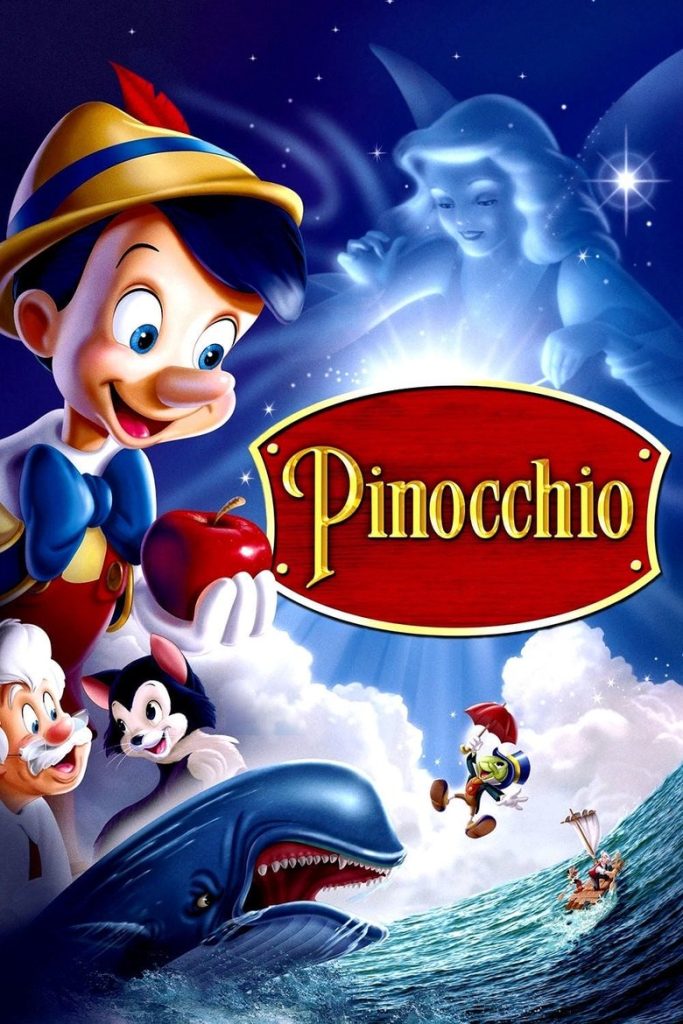
Pinocchio is a classic animated fantasy about a wooden puppet brought to life by a fairy. To become a real boy, Pinocchio must demonstrate bravery, honesty, and selflessness through various adventures and challenges. The story follows his journey with his conscience, Jiminy Cricket, as he learns important life lessons about truth and responsibility.
Parent Guide
A classic moral tale with some intense moments that may require parental guidance for younger viewers.
Content breakdown
Characters face perilous situations including kidnapping, imprisonment, and threats. Some scenes show characters in danger from villains.
Some scenes may be frightening for young children, including transformations and moments where characters are in serious danger. Villains can be intimidating.
No offensive language present.
No sexual content or nudity.
Brief scenes show adult characters smoking cigars or pipes in social settings.
Themes of separation, danger, and moral consequences create emotional tension. Some scenes may be upsetting for sensitive viewers.
Parent tips
This Disney classic contains some intense scenes that might be frightening for very young children, including moments of peril and transformation sequences. The themes of lying and its consequences are central to the story, providing good discussion points about honesty. While generally family-friendly, parents should be aware that some scenes involve characters in dangerous situations that could be unsettling for sensitive viewers.
Parent chat guide
Parent follow-up questions
- What was your favorite part of the movie?
- How did you feel when Pinocchio was in trouble?
- What does it mean to tell the truth?
- Who helped Pinocchio the most?
- What makes someone a real friend?
- Why was it important for Pinocchio to tell the truth?
- What lessons did Pinocchio learn on his journey?
- How did Jiminy Cricket help Pinocchio?
- What does it mean to be brave?
- How did Pinocchio change from beginning to end?
- What are the consequences of lying in the story?
- How does the movie show the difference between right and wrong?
- What does it mean to prove yourself worthy?
- How do the characters' choices affect their outcomes?
- What makes someone truly 'real' beyond just being alive?
- How does the film explore the concept of morality and conscience?
- What commentary does the story make about personal growth and redemption?
- How are the themes of truth and deception presented in different contexts?
- What does the transformation from puppet to boy symbolize?
- How does the film balance fantasy elements with real-world lessons?
🎭 Story Kernel
At its core, 'Pinocchio' explores the painful gap between the desire for transformation and the reality of what transformation demands. Geppetto's loneliness creates Pinocchio as a wish-fulfillment object, but the film argues that sentience emerges through suffering consequences, not magic. Pinocchio's repeated failures—lying, skipping school, pursuing fame—aren't moral lessons but necessary experiments in cause-and-effect. His ultimate sacrifice for Geppetto isn't rewarded with humanity; it's the act itself that completes him. The Blue Fairy doesn't grant reality; she merely recognizes it has been earned through lived experience.
🎬 Visual Aesthetics
The film's visual language oscillates between cozy, warm interiors and threatening, exaggerated exteriors. Geppetto's workshop glows with amber lantern light and intricate wood textures, creating a womb-like safety. Outside, scenes shift to cold blues and grays, with Pleasure Island's garish neon highlighting artificial joy. The whale sequence uses claustrophobic low angles and murky greens to visualize entrapment. Pinocchio's design subtly evolves—his joints become less rigid, his movements more fluid—mirroring his internal growth long before the physical transformation occurs.
🔍 Details & Easter Eggs
💡 Behind the Scenes
Disney's animators studied marionette mechanics for months, even visiting puppet theaters to capture Pinocchio's stiff-yet-expressive movement. Cliff Edwards (Jiminy Cricket) was a popular jazz singer whose scat-style delivery influenced the character's musicality. The underwater sequences required revolutionary multiplane camera techniques, with some shots using seven layered glass panels to create depth. Voice actor Dickie Jones recorded Pinocchio's lines while standing on a box to reach the microphone, giving his delivery an authentically childlike perspective.
Where to watch
Choose region:
- Disney Plus
- Amazon Video
- Apple TV
- Google Play Movies
- YouTube
- Fandango At Home
Trailer
Trailer playback is unavailable in your region.