
Piper (2016)
Story overview
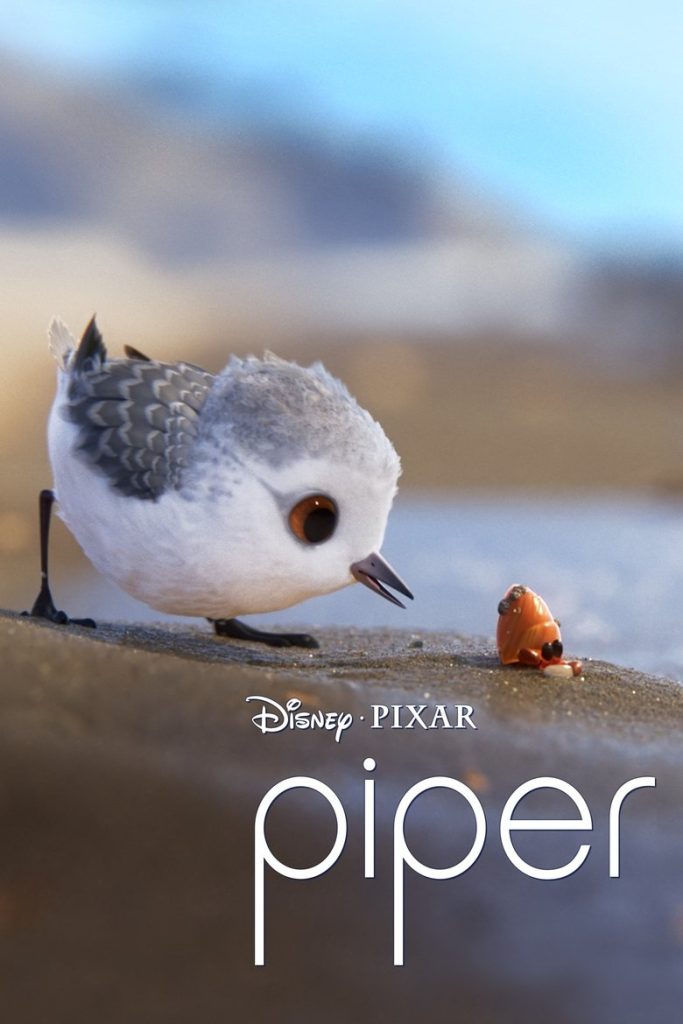
Piper is a short animated film about a young sandpiper learning to find food on her own under her mother's guidance. The little bird faces a challenging experience that initially frightens her but ultimately helps her grow. Through perseverance and adaptation, she discovers new ways to overcome her fears and thrive in her coastal environment. This charming story celebrates resilience, independence, and the natural learning process between parent and child.
Parent Guide
A gentle, wordless animated short about a young bird learning independence, suitable for all ages with mild emotional moments.
Content breakdown
Brief natural peril when the young bird encounters waves, but no harm occurs.
Momentary startling when waves approach the bird, resolved quickly.
No dialogue in this wordless film.
No sexual content or nudity.
No substance use depicted.
Mild anxiety as the bird faces challenges, followed by positive resolution.
Parent tips
Piper is a gentle, wordless short film that beautifully illustrates a young bird's journey toward independence. The story contains a brief moment where the main character experiences a startling natural event, but it's handled sensitively without any graphic content. This film offers excellent opportunities to discuss overcoming fears, trying new things, and learning from challenges in a safe, age-appropriate way.
Parent chat guide
Parent follow-up questions
- How did the little bird feel when she was learning?
- What did the mother bird do to help her baby?
- What was your favorite part of the bird's adventure?
- Have you ever tried something new like the little bird?
- What do you think the little bird learned?
- Why do you think the little bird was afraid at first?
- How did the bird's experience help her find food differently?
- What does this story teach us about trying new things?
- How did the mother bird support her baby's learning?
- Can you think of a time you overcame a fear like the little bird did?
- What does this story show about the relationship between learning and fear?
- How did the bird's perspective change after her challenging experience?
- What real-life situations might be similar to the bird's journey?
- How does the film show growth and adaptation without using words?
- What message about resilience does this story convey?
- How does this short film use visual storytelling to convey emotional growth?
- What metaphors for personal development can you find in the bird's journey?
- How does the film balance the challenges of learning with the rewards of perseverance?
- What does this story suggest about the role of parental guidance in independence?
- How might different viewers interpret the bird's transformative experience?
🎭 Story Kernel
At its core, 'Piper' explores the universal journey from sheltered dependence to confident independence through experiential learning. The titular sandpiper chick's initial terror of the crashing waves represents the paralyzing fear that prevents growth. The film's brilliance lies in showing that true courage isn't born from mere encouragement but from discovering one's own capabilities through trial and error. When Piper learns to observe the hermit crab's technique and adapts it to his own advantage, he transforms from a victim of his environment to its master. This isn't just about finding food—it's about developing resilience, problem-solving skills, and the confidence that comes from overcoming obstacles through personal discovery rather than parental protection.
🎬 Visual Aesthetics
The animation's hyper-realistic textures create a tactile world where every grain of sand feels distinct and every water droplet carries weight. The camera frequently adopts Piper's low-angle perspective, making ordinary beach elements appear monumental and threatening. Color plays a crucial psychological role: the initial scenes use muted blues and grays to convey danger, while the underwater sequences explode with warm golds and ambers as Piper discovers safety and abundance. The water animation deserves particular praise—its physics feel authentic, with waves that don't just look real but behave with convincing mass and force. The shift from chaotic surface turbulence to serene underwater clarity visually mirrors Piper's emotional journey from panic to understanding.
🔍 Details & Easter Eggs
💡 Behind the Scenes
Director Alan Barillaro spent months observing real sandpipers at Monterey Bay, California, to capture their distinctive 'run-stop-peck' feeding rhythm. The six-minute short took three years to complete due to unprecedented technical challenges in animating realistic sand and water interactions. Pixar developed new software specifically for the granular simulation of millions of individual sand grains that move independently. The film's protagonist was originally going to be a different bird species until animators became fascinated with sandpipers' unique feeding behavior. Barillaro insisted on minimal dialogue to tell the story purely through visual storytelling and sound design, resulting in one of Pixar's most universally accessible shorts.
Where to watch
Choose region:
- Disney Plus
- Apple TV
- Google Play Movies
- YouTube
- Fandango At Home
Trailer
Trailer playback is unavailable in your region.