
Red’s Dream (1987)
Story overview
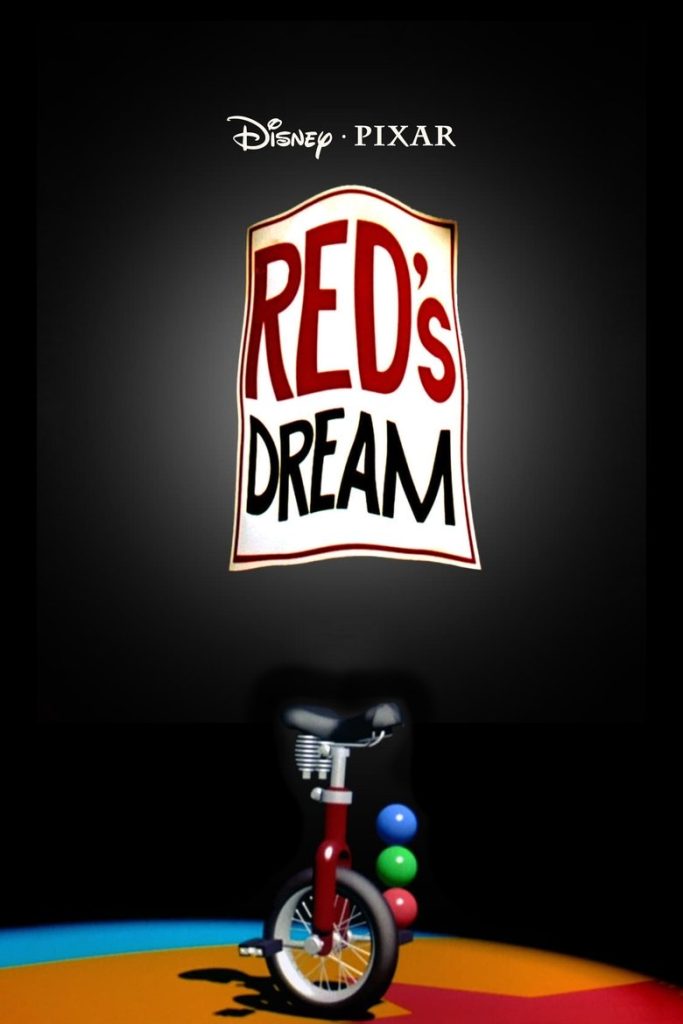
Red's Dream is a 4-minute Pixar animated short from 1987 that tells the poignant story of Red, a unicycle languishing in the clearance corner of a bicycle shop. Through a beautifully animated dream sequence, Red imagines being owned by a clown and performing a spectacular juggling act to thunderous applause. The film explores themes of loneliness, unfulfilled dreams, and the contrast between fantasy and reality in a gentle, visually expressive way.
Parent Guide
A gentle, artistic animated short with no concerning content. Suitable for all ages. The brief emotional themes are handled with subtlety and poetic beauty.
Content breakdown
No violence, danger, or peril of any kind. The film is completely peaceful throughout.
Nothing scary or disturbing. The dream sequence is joyful, and the return to reality is handled gently with rain imagery rather than anything frightening.
No dialogue at all in the film. The story is told entirely through visuals and music.
No sexual content or nudity of any kind.
No substance use, references to substances, or smoking.
Mild emotional themes of loneliness and unfulfilled dreams, handled with poetic subtlety. The brief moment of disappointment when the dream ends is gentle and not distressing.
Parent tips
This short film is completely appropriate for all ages with no concerning content. The emotional themes are handled subtly and poetically. For younger viewers, you might explain that Red is feeling lonely and using imagination to feel better. The brief moment of disappointment when the dream ends is mild and resolved peacefully. The film's artistic quality makes it worthwhile viewing despite its simplicity.
Parent chat guide
Parent follow-up questions
- What color was the unicycle?
- What did Red dream about?
- Was the clown nice to Red?
- How did Red feel at the end?
- Why was Red in the clearance corner?
- What was special about Red's dream?
- How did the dream make Red feel?
- What happened when the dream ended?
- What does this film say about dreams versus reality?
- How does the animation show Red's emotions?
- Why do you think the filmmaker chose a unicycle as the main character?
- What might happen to Red after the story ends?
- How does this early Pixar short demonstrate themes the studio would explore in later films?
- What commentary might be made about consumerism and discarded items?
- How effective is the visual storytelling without dialogue?
- What emotional resonance does the rain symbolism create?
🎭 Story Kernel
Pixar's 1987 short 'Red's Dream' is a poignant allegory for the quiet despair of obsolescence and unfulfilled potential within a system that values utility over individuality. The narrative follows Red, a lonely unicycle in a bicycle shop, who dreams of a vibrant circus performance. This isn't merely a tale of anthropomorphism; it's an expression of the universal longing for purpose and recognition. The dream sequence represents an escape from the crushing reality of being a forgotten commodity on a clearance rack. The film's true driver is the contrast between Red's internal, expressive world and his external, static existence, asking what happens to identity when one's function is deemed irrelevant by the market.
🎬 Visual Aesthetics
The visual language masterfully employs a stark, desaturated color palette in the real-world bicycle shop, emphasizing gloom and neglect through cold blues and grays. This contrasts violently with the warm, saturated reds, yellows, and spotlight golds of the circus dream, visually coding the dream as emotionally 'true' and vibrant. The camera work is equally telling: static, wide shots in the shop make Red seem small and trapped, while dynamic, swirling pans and close-ups during the circus act convey freedom and exhilaration. The clunky, early CGI rendering of the bicycles and unicycles themselves adds a layer of poignant symbolism—they are literally rigid, mechanical objects yearning for fluid, organic expression.
🔍 Details & Easter Eggs
💡 Behind the Scenes
'Red's Dream' was Pixar's third short film following 'Luxo Jr.' and marked a significant technical ambition as their first film to feature a complex, non-geometric background (the detailed bicycle shop). It was also one of the earliest CGI narratives to attempt a nuanced, emotional story rather than pure technical demonstration. The film's director, John Lasseter, has noted the challenge of making an inanimate object—a unicycle—emote without a face, relying entirely on posing, lighting, and the context of the story. The melancholic score by John Debney was crucial in establishing the short's unique, somber tone distinct from Pixar's more playful early works.
Where to watch
Choose region:
- Disney Plus
- Apple TV Store
- Google Play Movies
- YouTube
- Fandango At Home
Trailer
Trailer playback is unavailable in your region.