
Rustin (2023)
Story overview
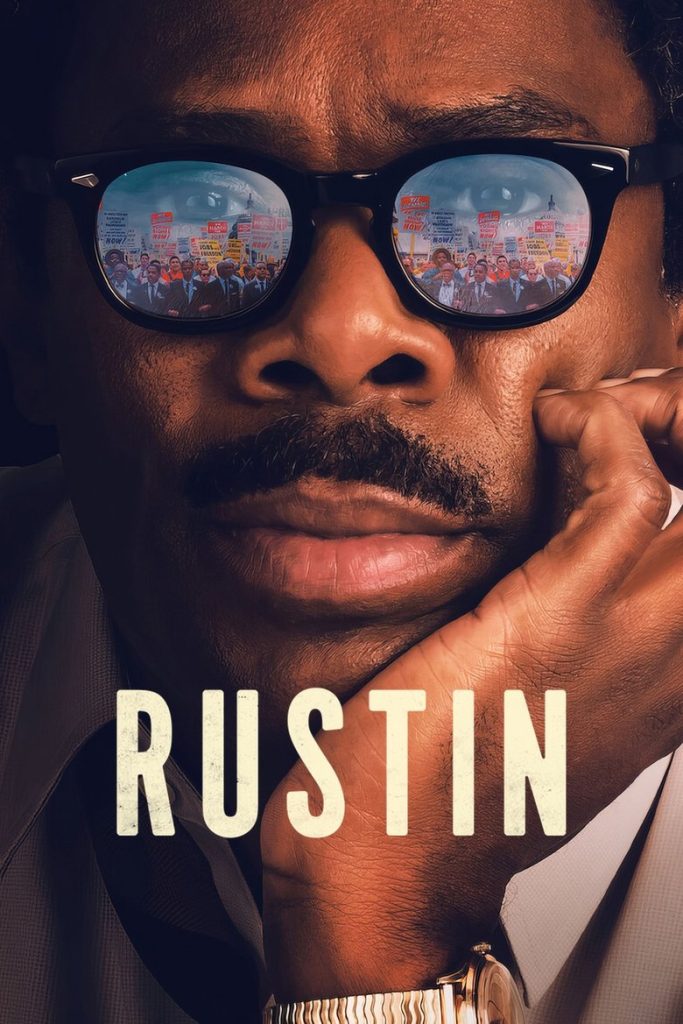
Rustin (2023) is a historical drama directed by George C. Wolfe, starring Colman Domingo as Bayard Rustin, a key but often overlooked civil rights activist. The film focuses on Rustin's pivotal role in organizing the 1963 March on Washington, highlighting his struggles against racism and homophobia within the movement. Set in the United States, it portrays the political and personal challenges of the era, emphasizing themes of perseverance, equality, and social justice. With a PG-13 rating and a runtime of 108 minutes, it offers an educational and inspiring look at a significant moment in American history.
Parent Guide
Rustin is a thought-provoking historical drama that provides valuable insights into the civil rights movement, suitable for teens and adults with parental guidance for younger viewers due to mature themes.
Content breakdown
The film includes non-graphic depictions of racial tension and protest scenes, such as verbal confrontations and mild peril during civil rights activities, but no physical violence or gore.
Some scenes may be emotionally intense, portraying racism, discrimination, and social injustice, which could be disturbing for sensitive viewers, but there are no horror or jump-scare elements.
Occasional mild language, such as insults or derogatory terms related to race and sexuality, consistent with the historical context, but no strong profanity.
No sexual content or nudity; the film focuses on historical and political themes, with any references to relationships being implied or discussed in a non-explicit manner.
No depiction of substance use; the film centers on activism and historical events without involving drugs, alcohol, or smoking.
High emotional intensity due to themes of racism, homophobia, and social struggle, which may evoke strong feelings of empathy, anger, or inspiration, particularly in scenes depicting discrimination and activism.
Parent tips
This film is suitable for mature children and teens due to its historical and thematic depth. Parents should note that it deals with racism, homophobia, and social injustice, which may require explanation for younger viewers. It includes mild language and emotional intensity but no graphic violence, sexual content, or substance use. Recommended for ages 13 and up, with parental guidance to discuss the civil rights movement and issues of discrimination. Use it as a springboard for conversations about activism, equality, and historical context.
Parent chat guide
Parent follow-up questions
—
—
- What is the March on Washington, and why was it important?
- How did Bayard Rustin help organize the event?
- What does 'civil rights' mean to you?
- How does the film address both racism and homophobia in the civil rights movement?
- What leadership qualities did Bayard Rustin demonstrate?
- How can historical events like this inspire activism today?
- Discuss the challenges Rustin faced and how he overcame them.
🎭 Story Kernel
Rustin is a focused biographical drama that centers on the frantic eight-week period leading up to the 1963 March on Washington. It explores the life of Bayard Rustin, a brilliant strategist and civil rights activist who faced erasure from history due to his identity as a gay man and his former ties to the Communist Party. The film portrays the internal friction within the Civil Rights Movement, specifically the tension between Rustin’s radical grassroots approach and the more conservative institutionalism of NAACP leader Roy Wilkins. Ultimately, it is a study of political logistics as a form of protest, illustrating how Rustin’s unwavering commitment to non-violence and organizational genius provided the platform for Martin Luther King Jr.’s iconic 'I Have a Dream' speech while navigating the personal cost of being an outsider among outsiders.
🎬 Visual Aesthetics
Director George C. Wolfe and cinematographer Tobias A. Schliessler employ a visual style that balances the intimacy of a stage play with the kinetic energy of a political thriller. The film utilizes a warm, saturated color palette that evokes the early 1960s without feeling like a dusty museum piece. The 'March HQ' in Harlem is depicted as a cramped, bustling hive of activity, where the visual clutter of mimeograph machines and rotary phones symbolizes the manual labor of revolution. This claustrophobia is intentionally contrasted with the final act's expansive, wide-angle shots of the National Mall. These sweeping views emphasize the sheer scale of the achievement, transforming the individual struggle into a collective historical moment. The camera often lingers on Rustin’s expressive face, capturing the exhaustion and exhilaration of a man finally seeing his vision manifest.
🔍 Details & Easter Eggs
💡 Behind the Scenes
Produced by Barack and Michelle Obama’s Higher Ground Productions, the film was a passion project intended to restore Bayard Rustin’s legacy to public consciousness. Colman Domingo underwent extensive preparation for the role, mastering Rustin’s unique mid-Atlantic accent and his distinct physical gait. The film’s score was composed by jazz legend Branford Marsalis, who infused the soundtrack with a rhythmic energy that mirrors the ticking clock of the march's organization. Filming took place largely in Pittsburgh and Washington D.C., and the production earned Colman Domingo his first Academy Award nomination for Best Actor.
Where to watch
Choose region:
- Netflix
- Netflix Standard with Ads
Trailer
Trailer playback is unavailable in your region.