Se7en (1995)
Story overview
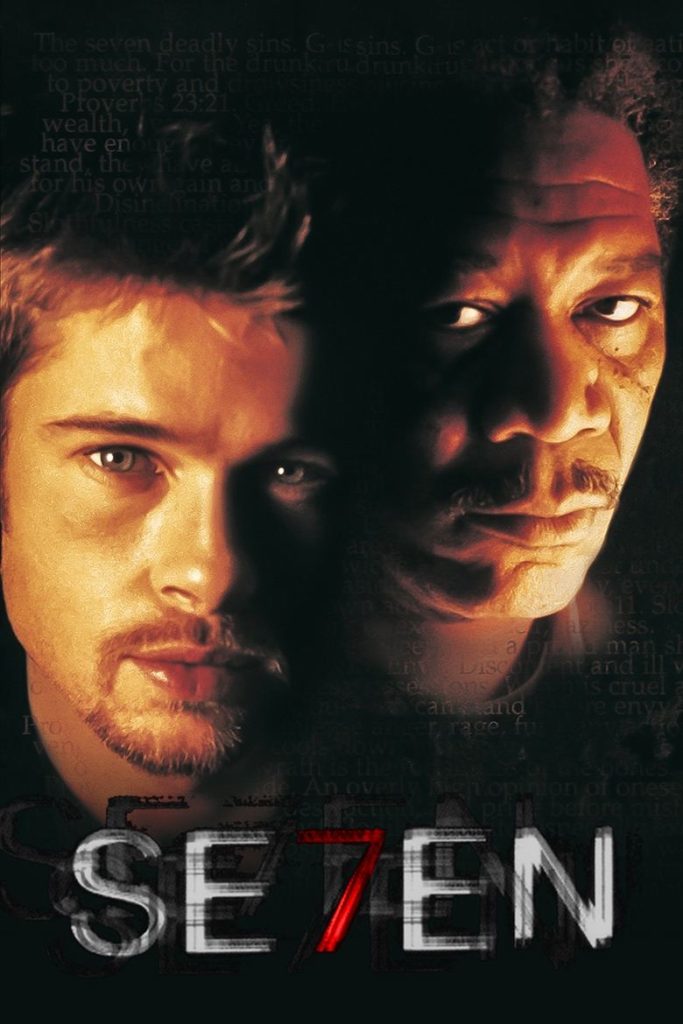
Se7en is a dark crime thriller about two detectives hunting a serial killer who bases murders on the seven deadly sins. The film follows their desperate investigation through disturbing crime scenes as they try to understand the killer's twisted motivations. It's a psychological exploration of evil and morality that builds intense suspense toward a shocking conclusion.
Parent Guide
Extremely intense psychological thriller with graphic violence and disturbing themes, suitable only for mature older teens and adults.
Content breakdown
Graphic depictions of murder victims, crime scenes shown in detail, intense peril throughout investigation
Extremely disturbing images and themes, psychological horror, bleak atmosphere, shocking twists
Strong language including profanity, used in tense situations
Brief sexual references and situations, no explicit nudity shown
Characters drink alcohol in social and stressful situations
High tension throughout, psychological distress, traumatic events, bleak worldview
Parent tips
This film is rated R for strong graphic violence, disturbing images, language, and thematic elements. The content is extremely intense and not suitable for children or younger teens. Parents should be aware that the film depicts gruesome crime scenes, psychological torment, and a deeply unsettling atmosphere throughout.
The movie's central theme involves brutal murders based on religious concepts of sin, which could be particularly disturbing for viewers sensitive to religious or moral themes. The violence is graphic and often shown in detail, with the film's tone being consistently dark and hopeless.
Even mature teens should watch with caution, as the film's disturbing content and bleak worldview can be emotionally overwhelming. The shocking ending leaves a lasting impact that many viewers find difficult to process.
Parent chat guide
During viewing, be available to pause if needed, as some scenes are particularly shocking. Check in periodically about how they're processing the content, especially during the most intense sequences.
After watching, create space for discussion about the film's themes without pressure. The ending is particularly traumatic, so allow time for processing before diving into analysis. Focus on how the film made them feel and what questions it raised about justice, morality, and human nature.
Parent follow-up questions
- What makes you feel safe when you see something scary?
- Who are the helpers in stories you watch?
- What happy things can we think about after watching something serious?
- How do detectives help keep people safe?
- What does it mean to solve a mystery?
- Why do you think some stories are only for grown-ups?
- How do movies create suspense without showing everything?
- What's the difference between scary entertainment and real violence?
- Why might filmmakers choose dark themes for stories?
- How does the film explore the concept of justice versus revenge?
- What commentary does the movie make about society and human nature?
- How do the detectives' different approaches reflect their worldviews?
- What makes psychological thrillers different from action movies?
- How does the film's atmosphere contribute to its impact?
🎭 Story Kernel
At its core, 'Se7en' is less a detective story and more a philosophical treatise on the seductive power of despair. The film argues that in a world saturated with sin, the most terrifying villain isn't the one who commits atrocities, but the one who makes you *agree* with his worldview. John Doe doesn't just kill; he constructs a perverse, airtight sermon. His 'work' is a meticulously staged argument that evil is not an aberration but the baseline human condition. Somerset's weary cynicism and Mills's naive fury are both proven inadequate defenses. The film's true horror lies in the chilling moment Mills completes Doe's masterpiece, proving that righteous anger can be the final, most destructive sin of all.
🎬 Visual Aesthetics
The film's visual language is a character in itself, a relentless assault of grime and shadow. Director David Fincher bathes the unnamed city in a perpetual, sickly yellow-green pallor, as if the air itself is toxic with moral decay. The camera is rarely static, employing unsettling, almost imperceptible movements and jarring close-ups of evidence and violence, forcing complicity in the gruesome details. Rain is a constant, not cleansing but oppressive, turning streets into reflective rivers of filth. The action is brutal and functional—there are no heroic gunfights, only the clumsy, desperate violence of reality. This aesthetic isn't just mood; it's the physical manifestation of Doe's thesis: the world is a festering, inescapable crime scene.
🔍 Details & Easter Eggs
💡 Behind the Scenes
Brad Pitt, who played Detective Mills, had a clause in his contract stipulating that his character could not die, which famously created tension during the filming of the grim original ending. The film's relentlessly rainy, anonymous city was primarily a composite of Los Angeles and New York, with the final desert showdown shot in the Mojave. The now-iconic title sequence, designed by Kyle Cooper, was created using practical effects—filming scribbled notebooks, dipping fingers in glue, and manipulating film stock with needles—to achieve its visceral, handmade feel of madness.
Where to watch
Choose region:
- Amazon Video
- Apple TV
- Google Play Movies
- YouTube
- Fandango At Home
Trailer
Trailer playback is unavailable in your region.