Spirited Away (2001)
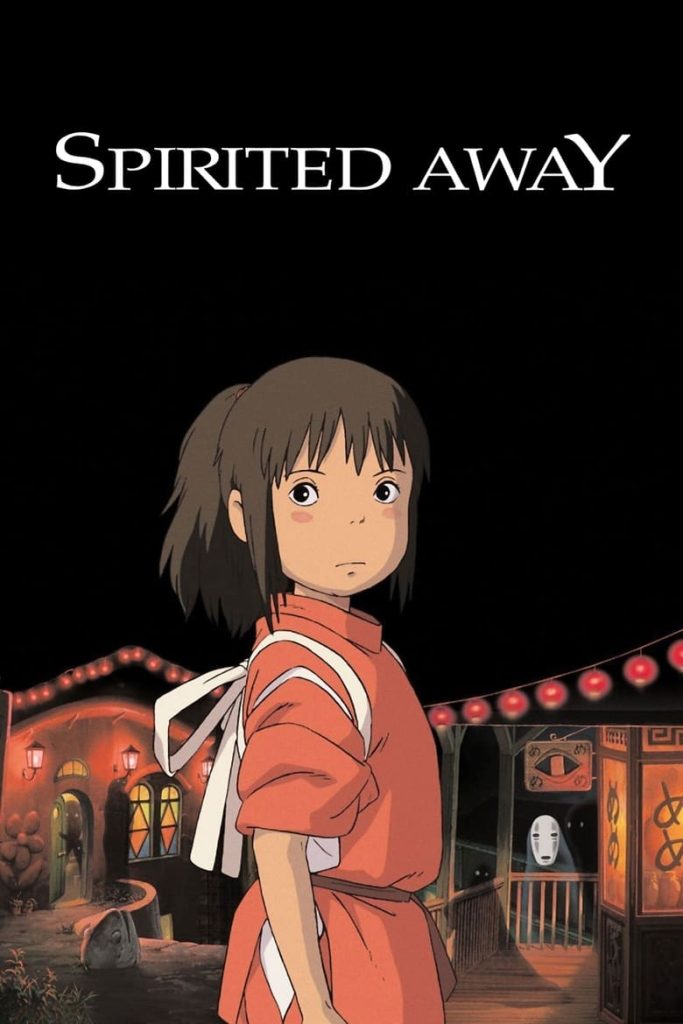
Story overview
Spirited Away follows Chihiro, a young girl who accidentally enters a mysterious spirit world after her parents are transformed. To survive and rescue her family, she must work in a bathhouse for spirits, facing various challenges and strange creatures. Through her journey, she discovers inner strength, resilience, and the importance of kindness and identity in a fantastical, sometimes unsettling environment.
Parent Guide
A beautifully animated fantasy with some intense moments that may be too frightening for very young children, but offers valuable themes about courage and resilience for older kids.
Content breakdown
Some perilous situations and tense moments as characters face challenges in a strange world, but no graphic violence.
Surreal spirit creatures, transformed characters, and atmospheric tension in an unfamiliar setting could be disturbing to sensitive viewers.
No concerning language present.
No sexual content or nudity.
No substance use depicted.
Themes of separation, transformation, and facing fears create emotional moments that may be intense for younger children.
Parent tips
This animated fantasy contains some intense and potentially frightening moments for younger viewers, including scenes with transformed characters, large spirit creatures, and atmospheric tension. While the film has a PG rating and ultimately conveys positive messages about courage and perseverance, parents should be aware that the surreal setting and some character designs might be disturbing to sensitive children. The 125-minute runtime is also quite long for younger audiences, so consider watching in segments or ensuring children are well-rested.
Parent chat guide
Parent follow-up questions
- How did you feel when Chihiro went to the new place?
- What was your favorite creature in the movie?
- What did Chihiro do that was brave?
- How did she help other characters?
- What would you do if you felt scared like Chihiro?
- Why do you think Chihiro had to be brave in the spirit world?
- How did she change from the beginning to the end of the movie?
- What lessons did she learn about helping others?
- Which parts felt exciting or scary to you?
- How would you describe the world Chihiro visited?
- What does the movie show about facing fears and challenges?
- How did Chihiro's relationships with other characters help her grow?
- What themes about identity and responsibility did you notice?
- Why might the spirit world be both fascinating and unsettling?
- How does the animation style contribute to the story's mood?
- How does the film explore themes of transformation and personal growth?
- What cultural elements might be present in this Japanese fantasy?
- How does Chihiro's journey reflect coming-of-age experiences?
- What makes the spirit world both magical and ominous?
- How do the film's visuals and storytelling create emotional impact?
🎭 Story Kernel
At its core, 'Spirited Away' is a coming-of-age allegory about the loss of innocence through the crucible of labor. Chihiro's journey isn't about defeating a villain, but about earning her identity back through work, humility, and empathy in a world of transactional spirits. Her parents' transformation into pigs represents the adult world's consumptive greed, a fate she avoids by learning responsibility. The film critiques capitalist excess—the bathhouse is a grotesque service economy—while affirming that genuine connection, like her bond with Haku and No-Face, transcends mere exchange. Chihiro's triumph is not escape, but maturation; she leaves not as a rescued child, but as a person who has proven her worth.
🎬 Visual Aesthetics
Miyazaki's visual language masterfully contrasts the mundane with the fantastical. The initial car ride uses drab, realistic colors that bleed into the lush, saturated hues of the spirit world, marking Chihiro's entry into the unknown. The bathhouse itself is a vertical labyrinth, its Escher-like stairs and cluttered spaces visually conveying overwhelming bureaucracy and social hierarchy. Key transformations—Chihiro's fading, Haku as a dragon, No-Face's bloating—are rendered with fluid, almost biological horror, grounding the magic in tangible, bodily anxiety. The color palette shifts with emotion: warm golds for safety with Lin and Zeniba, cold blues and greys for Yubaba's office, and the serene green of the train sequence, which uses static, contemplative shots to evoke profound melancholy and transition.
🔍 Details & Easter Eggs
💡 Behind the Scenes
The film's setting was inspired by the real-life Edo-Tokyo Open Air Architectural Museum, with the bathhouse design influenced by the historic Dogo Onsen. Voice actor Daveigh Chase, who played Chihiro in the English dub, also voiced Lilo in 'Lilo & Stitch' the same year. Miyazaki initially struggled with the story, taking a break where he visited a mountain hut with young girls, whose resilience inspired Chihiro's character. The iconic train scene over water was based on a real train line in Miyazaki's hometown. Composer Joe Hisaishi wrote the main theme, 'One Summer's Day,' before seeing any animation, and Miyazaki adjusted storyboards to match its emotional flow.
Where to watch
Choose region:
- HBO Max
- HBO Max Amazon Channel
- Amazon Video
- Apple TV
- Google Play Movies
- YouTube
- Fandango At Home
- Plex
Trailer
Trailer playback is unavailable in your region.