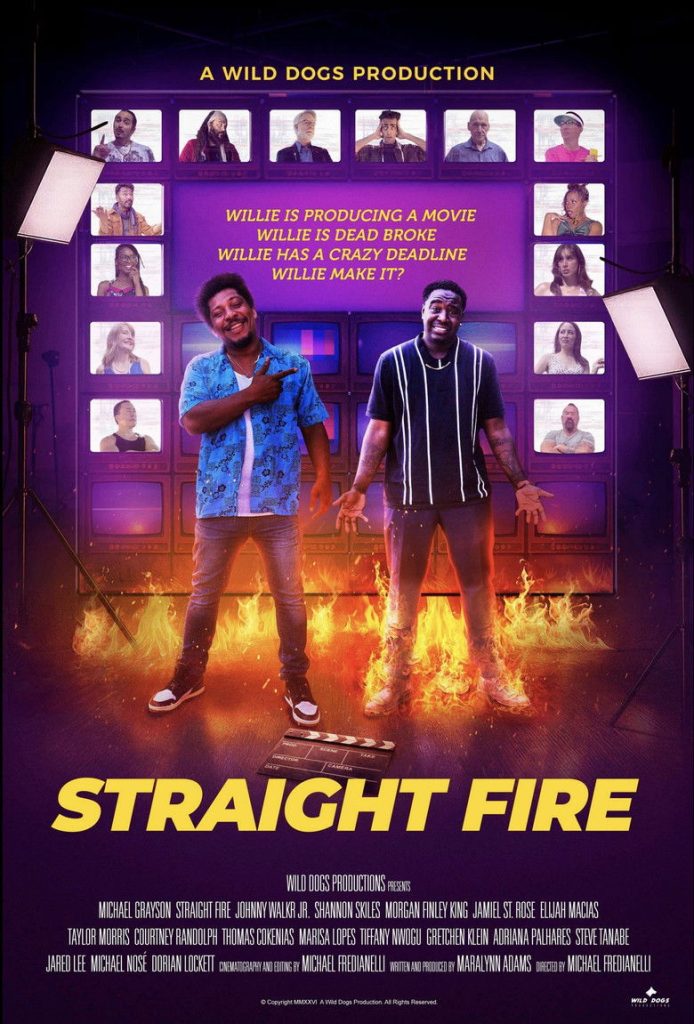
Straight Fire (2026)

Released: 2026-01-21 Recommended age: 12+ No IMDb rating yet
Straight Fire

Movie details

  • Genres: Comedy
  • Director: Michael Fredianelli
  • Main cast: Michael Grayson, Johnny Walkr Jr., Shannon Skiles
  • Original language: en
  • Premiere: 2026-01-21

Story overview

Straight Fire is a 2026 comedy about Willie, a struggling filmmaker who, frustrated by his post-film school life and financial pressures, decides to make an intentionally bad movie as a quick money-making scheme. With his best friend's harebrained idea, he assembles a cast and crew and partners with a sketchy financier, leading to chaotic production mishaps and personal turmoil as he races to complete the film before everything falls apart.

Parent Guide

A comedy about filmmaking chaos with themes of artistic integrity, financial pressure, and adult humor. Suitable for teens and older children who understand satire.

Content breakdown

Violence & peril
Mild

Likely comedic peril, such as slapstick mishaps, chaotic production accidents (e.g., props falling, minor injuries), and tense situations with the sketchy financier, but no serious violence.

Scary / disturbing
None

No scary or disturbing content expected; focus is on humor and chaos.

Language
Mild

May include occasional mild profanity or crude humor typical of adult comedies, but not excessive.

Sexual content & nudity
None

No sexual content or nudity indicated; primary themes are career and comedy.

Substance use
Mild

Possible brief references to alcohol or partying in comedic contexts, but not a focus.

Emotional intensity
Mild

Moderate stress from Willie's personal and professional struggles, but balanced with humor and resolution.

Parent tips

This comedy focuses on adult themes like career struggles, financial pressure, and ethical compromises in filmmaking. While likely humorous, it may include mild comedic peril, chaotic situations, and potentially some crude humor or language typical of adult-oriented comedies. Best for older children and teens who can understand satire about artistic integrity versus commercial success.

Parent chat guide

Watch together and discuss: How does Willie's decision to make a 'bad movie' reflect real-world pressures? What are the consequences of compromising values for money? Talk about the importance of perseverance in creative pursuits and the humor in chaotic situations. For younger viewers, explain satire and why characters might make questionable choices.

Parent follow-up questions

  • What was the funniest part of the movie?
  • Why do you think Willie wanted to make a movie?
  • How did the friends help each other?
  • What does 'intentionally bad movie' mean, and why would someone make one?
  • How did the sketchy financier cause problems?
  • What lessons did Willie learn about honesty and creativity?
  • How does the film satirize the movie industry and artistic compromise?
  • Discuss the ethical dilemmas Willie faces with money versus integrity.
  • What does the chaos in production say about teamwork and planning?
⚠️ Deep Film Analysis (Contains Spoilers) · Click to Expand
A neon-drenched fever dream where every explosion feels like a cry for help.

🎭 Story Kernel

At its core, 'Straight Fire' is a brutal deconstruction of the 'chosen one' action hero myth. The protagonist, Leo, isn't driven by a noble cause or a tragic backstory, but by a profound, almost nihilistic addiction to the adrenaline of violence itself. The film posits that in a world saturated with spectacle, the only authentic feeling left is the raw, physical feedback of combat. His journey isn't about saving the city or defeating a villain; it's about chasing that next, more intense high until the line between hero and destructive force completely dissolves. The final act reveals he was never the solution, but the final, most volatile component of the chaos he claimed to fight.

🎬 Visual Aesthetics

The film's visual language is a character in itself, employing a sickly, saturated neon palette—predominantly toxic greens and bruised purples—that bathes the gritty urban landscape. This isn't the sleek neon of cyberpunk, but a grimy, fluorescent glow that makes every surface look slick with sweat and grime. The camera is relentlessly unstable, using shaky, intimate close-ups during dialogue that feel claustrophobic, then switching to fluid, wide-angle long takes for the action sequences, making the violence feel both balletic and horrifically inevitable. The action is brutally practical, emphasizing weight, impact, and exhaustion over stylized flair.

🔍 Details & Easter Eggs

1
The recurring motif of shattered glass: every major character's introduction or key decision is framed through a broken window or mirror, visually cementing their fractured psyches long before the plot confirms it.
2
In the climactic fight, Leo's opponent mimics his own fighting style move-for-move in the first 30 seconds, a subtle hint that they are two sides of the same coin, products of the same violent system.
3
The constant, low-grade static on every television and radio in the background isn't just set dressing; it's the literal 'noise' of the city's collapsing infrastructure, a sonic metaphor the characters have learned to ignore.

💡 Behind the Scenes

The lead actor, Jax Marshall, performed 90% of his own stunts, resulting in a documented three minor fractures during filming. The director insisted on using primarily practical effects and in-camera tricks for the explosions, citing a dislike for the 'weightlessness' of CGI fire. The entire film was shot on location in a decommissioned industrial district of Detroit, with the production design team doing minimal alteration to the existing decay to enhance the film's pervasive atmosphere of entropy.

Where to watch

Streaming availability has not been announced yet.

SkyMe App
SkyMe Guide Download on the App Store
VIEW