
Strange Voices (1987)
Story overview
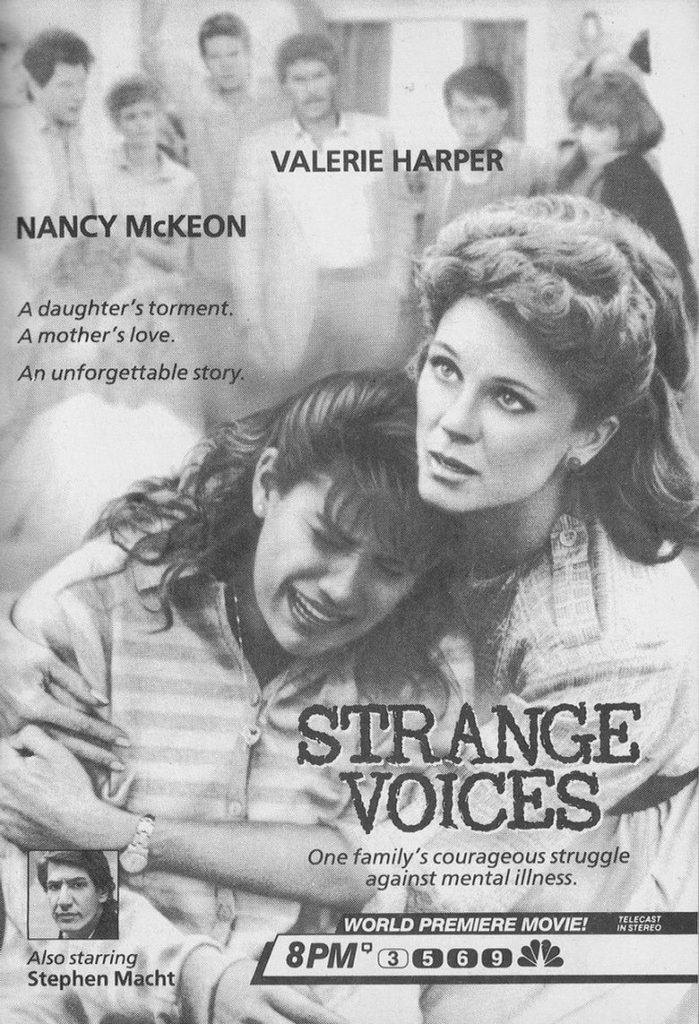
Strange Voices (1987) is a TV drama that sensitively portrays a family's emotional journey when their teenage daughter is diagnosed with schizophrenia. The film follows the family's struggles to understand and cope with the mental illness, showing both the daughter's perspective and the impact on her parents and siblings. It explores themes of family bonds, mental health stigma, medical treatment, and the challenges of supporting a loved one through a serious psychological condition.
Parent Guide
A thoughtful drama about mental illness suitable for mature teens with parental guidance. The film handles serious themes with sensitivity but contains emotionally intense scenes that may disturb younger viewers.
Content breakdown
No physical violence, but there are tense scenes where the daughter experiences psychological distress and the family argues. One scene shows the daughter in a psychiatric hospital, which might be unsettling.
The portrayal of schizophrenia symptoms (hearing voices, paranoia, disorganized thinking) could be disturbing to sensitive viewers. Scenes in psychiatric settings and emotional family conflicts may be intense.
Occasional mild language typical of family dramas from the 1980s. Nothing stronger than 'hell' or 'damn' in emotional moments.
No sexual content or nudity. The focus is entirely on family relationships and mental health.
No substance use depicted. The film focuses on psychiatric medication as part of treatment.
High emotional intensity throughout as the family grapples with diagnosis, treatment decisions, and changing relationships. Scenes of confusion, fear, and family conflict are central to the narrative.
Parent tips
This film provides an opportunity to discuss mental health with older children. Watch together and pause to talk about what's happening. Emphasize that schizophrenia is a medical condition, not a character flaw. Discuss how families can support each other during difficult times. Be prepared to answer questions about psychiatric hospitals and medication. The emotional content may be heavy for younger viewers.
Parent chat guide
Parent follow-up questions
—
—
- What did you notice about how the sister's behavior changed?
- How did the family show they cared about each other?
- What do you think 'hearing voices' means in this movie?
- How does this film portray the stigma around mental illness?
- What did you think about the medical treatment shown in the film?
- How might this family's experience be different today with modern mental health awareness?
- What responsibilities do family members have when someone is seriously ill?
🎭 Story Kernel
At its core, 'Strange Voices' is a harrowing examination of schizophrenia's devastating impact on family dynamics, disguised as a supernatural thriller. The film's true horror isn't the titular voices but the gradual disintegration of familial trust and understanding. Nicole's descent into psychosis becomes a mirror reflecting her family's own fears and failures in communication. The driving force isn't a ghost or demon but the terrifying reality of a mind turning against itself, and society's inability to distinguish mental illness from possession. The film's power lies in its refusal to provide easy answers, leaving viewers to question whether Nicole's experiences are supernatural or symptomatic.
🎬 Visual Aesthetics
The cinematography masterfully mirrors Nicole's deteriorating mental state through increasingly disorienting camera work. Early scenes feature stable, symmetrical compositions that gradually give way to Dutch angles and shaky handheld shots as her psychosis intensifies. The color palette shifts from warm domestic tones to cold, clinical blues during hospital sequences, visually separating Nicole from her family's reality. Clever use of sound design makes voices emerge from environmental noise before becoming distinct entities. Mirror shots repeatedly fracture Nicole's reflection, symbolizing her fragmented identity. The film's most effective visual trick is making ordinary spaces—a bedroom, a kitchen—feel threatening through subtle lighting changes and off-kilter framing.
🔍 Details & Easter Eggs
💡 Behind the Scenes
Lori Loughlin prepared for her role by spending weeks at a psychiatric facility observing patients with schizophrenia, though the film faced criticism from mental health advocates for potentially stigmatizing portrayals. Director Arthur Allan Seidelman intentionally used practical effects for the 'voice' sequences rather than digital manipulation to maintain realism. The suburban house location was chosen specifically for its 'too perfect' aesthetic that contrasts with the family's internal chaos. Several scenes were improvised based on the actors' reactions to unexpectedly hearing the actual sound design playback during filming.
Where to watch
Choose region:
- Netflix
- Netflix Standard with Ads
- Amazon Video