
Summer Wars (2009)
Story overview
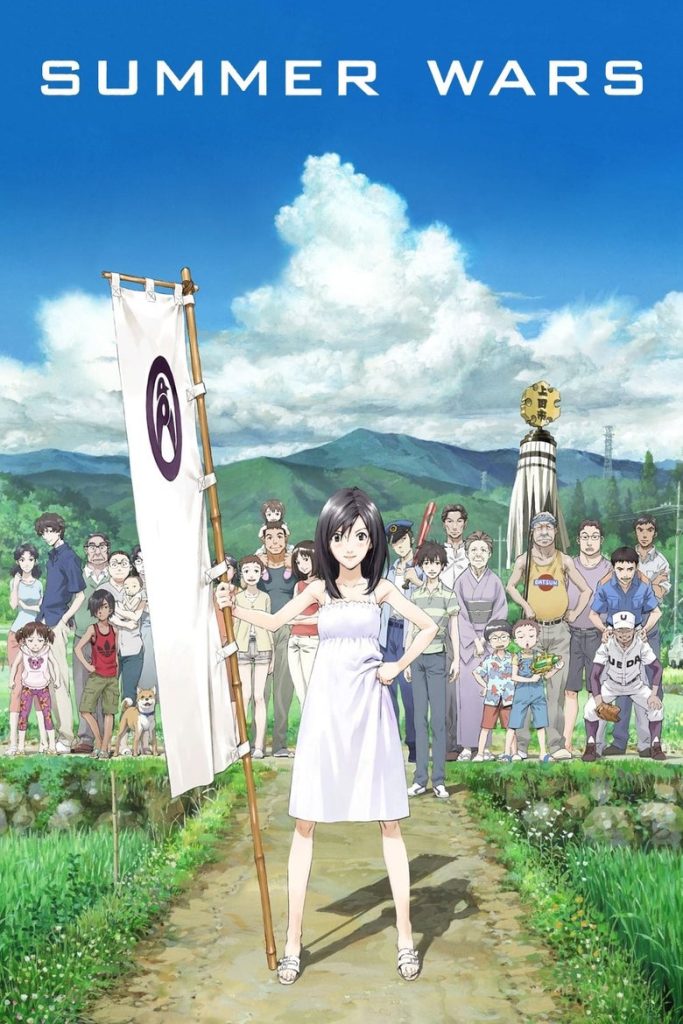
Summer Wars is a 2009 Japanese animated sci-fi film about a teenage math genius named Kenji who visits his crush Natsuki's family in Nagano for the summer. He pretends to be her fiancé while her large extended family gathers to celebrate their grandmother's 90th birthday. Meanwhile, Kenji accidentally triggers a crisis when his mathematical work causes a collision between Earth and a parallel virtual world, putting both the real and digital worlds at risk. The story blends family drama with high-stakes technological adventure.
Parent Guide
A family-friendly animated sci-fi film with positive themes about teamwork and responsibility, featuring some intense but non-graphic virtual world action.
Content breakdown
Virtual world destruction and peril with no real-world physical violence. Animated action sequences show digital entities being attacked or destroyed.
Some tense moments during the virtual world crisis, but nothing graphic or overly frightening. The animated style keeps it accessible.
No offensive language noted in the English version. Some mild expressions appropriate for family viewing.
No sexual content or nudity. There's a pretend engagement as part of the plot.
No substance use shown. Family gatherings include food and celebration without alcohol focus.
Family dynamics and high-stakes virtual crisis create emotional moments. Themes of responsibility and unity are emotionally engaging.
Parent tips
Summer Wars is rated PG and is generally appropriate for most children, but parents should be aware of some elements. The film features intense sequences involving a virtual world crisis with some peril and destruction, though it's animated and not graphic. There are themes of family responsibility, technology dependence, and teamwork that provide good discussion opportunities.
The movie's runtime is nearly two hours, which might be long for younger viewers. The Japanese cultural context and large cast of characters could be confusing at times, but the core themes of family unity and problem-solving are universal. The blend of slice-of-life family scenes with sci-fi action creates an engaging mix that appeals to both emotional and adventurous storytelling.
Parent chat guide
After the movie, ask about favorite characters and moments. Discuss how the film shows both the benefits and risks of advanced technology. Explore how different family members contributed to solving the crisis and what that teaches about teamwork and responsibility.
Parent follow-up questions
- What was your favorite colorful part?
- Did you like the family in the movie?
- How did the characters help each other?
- What made you happy in the story?
- Was there anything that surprised you?
- What did you think about the virtual world in the movie?
- How did the family work together to solve problems?
- What did you learn about being part of a team?
- Which character did you relate to most and why?
- What would you do if you faced a big challenge like in the movie?
- How does the movie show the relationship between technology and real life?
- What responsibilities do the characters have to their family and community?
- How does the film balance family drama with sci-fi adventure?
- What messages does the story give about problem-solving and cooperation?
- How might the virtual world crisis relate to real-world technology issues?
- How does the film explore themes of identity and belonging within a family?
- What commentary does the movie make about our dependence on digital systems?
- How are traditional family values presented alongside futuristic technology?
- What ethical questions does the story raise about technology and responsibility?
- How does the film use both emotional and action elements to tell its story?
🎭 Story Kernel
At its core, 'Summer Wars' explores how traditional family structures adapt to digital modernity. The Jinnouchi clan's matriarchal hierarchy isn't threatened by the AI Love Machine—it's challenged by their own inability to communicate across generations. Kenji's mathematical genius becomes irrelevant until he learns to navigate family politics. The film argues that our most powerful encryption isn't digital but emotional—the unspoken bonds that allow this sprawling family to coordinate against a global threat using fax machines and landlines while the world relies on failing technology.
🎬 Visual Aesthetics
Mamoru Hosoda creates visual duality through contrasting palettes: OZ's sterile blues and whites versus the Jinnouchi estate's warm earth tones. The digital world uses clean vector lines, while reality features textured, imperfect brushwork. During action sequences, OZ employs video game-style UI overlays, making the virtual conflict feel like a playable experience. Most tellingly, family scenes use low-angle shots looking upward, emphasizing the weight of tradition, while Kenji's mathematical visions appear as floating, weightless equations—his escape from social gravity.
🔍 Details & Easter Eggs
💡 Behind the Scenes
Director Mamoru Hosoda originally conceived this as a sequel to 'Digimon: Our War Game!' but expanded it into original IP. The Jinnouchi family home was modeled after traditional Japanese estates in Ueda, Nagano. Voice actor Ryunosuke Kamiki (Kenji) recorded his mathematical mumbling scenes by actually learning to recite complex equations. The film's OZ interface inspired real Japanese emergency response systems, with officials consulting the production team about believable crisis visualization.
Where to watch
Choose region:
- HBO Max
- HBO Max Amazon Channel
- Amazon Video
- Apple TV
- Google Play Movies
- YouTube
- Fandango At Home
Trailer
Trailer playback is unavailable in your region.