The Colors Within (2024)
Story overview
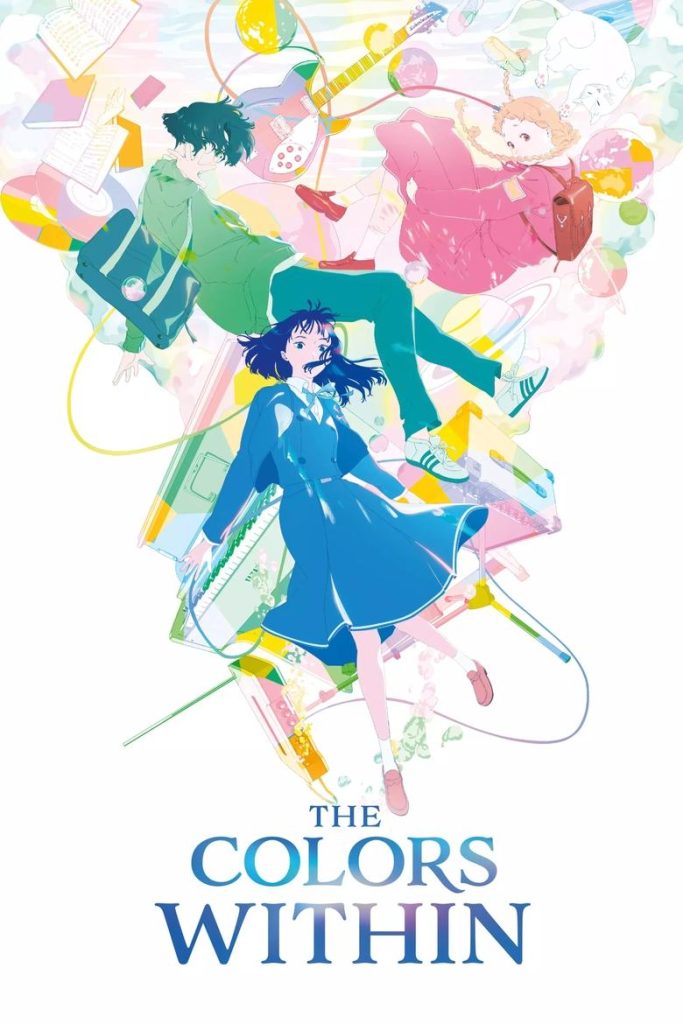
The Colors Within is a 2024 Japanese animated drama about Totsuko, a high school student who can perceive the emotional 'colors' of people around her. She forms a band with Kimi, whose color she finds exceptionally beautiful, and Rui, a quiet music lover they meet at a bookstore. The trio practices at an old church on a remote island, where music helps them build friendships and explore budding affections. The film explores themes of connection, creativity, and emotional awareness through its gentle narrative and musical elements.
Parent Guide
A gentle animated drama about friendship, music, and emotional awareness with no concerning content. Suitable for most children with parental guidance for emotional themes.
Content breakdown
No violence, fighting, or perilous situations. The story is entirely peaceful and focuses on character relationships.
Nothing scary or disturbing. The film has a calm, contemplative tone throughout.
No strong language or offensive dialogue. Characters speak politely and respectfully.
No sexual content or nudity. There are subtle romantic feelings portrayed through emotional connections and brief, chaste moments of affection.
No substance use, smoking, or drinking depicted.
Contains mild emotional themes including friendship dynamics, subtle romantic feelings, and moments of self-discovery. Some children might feel emotional during musical or bonding scenes, but nothing intense or distressing.
Parent tips
This PG-rated animated film is suitable for most children but deals with emotional themes that may require discussion. The story focuses on friendship, artistic expression, and subtle romantic feelings among teenagers. There's no violence, strong language, or mature content, but younger viewers might need help understanding the metaphorical 'colors' representing emotions. The 101-minute runtime and contemplative pacing could challenge very young children's attention spans. Consider watching together to discuss the film's themes of empathy and creative collaboration.
Parent chat guide
Parent follow-up questions
- What colors did you see in the movie?
- Did you like the music?
- Which friend was your favorite?
- What do you think the colors meant?
- How did music help the characters become friends?
- What was your favorite part of their adventure?
- How did Totsuko's ability affect her relationships?
- What did the film show about how friendships develop?
- How did the island setting contribute to the story?
- How did the film portray emotional awareness and empathy?
- What did you think about the subtle romantic elements?
- How did music serve as a metaphor for connection in the story?
🎭 Story Kernel
The film explores the concept of color not as a visual gimmick, but as a profound metaphor for the internal states and hidden burdens of its protagonists. Totsuko, a girl who perceives the emotional colors of others, navigates a world where she struggles to find her own hue. By forming a band with Kimi, who has dropped out of school to preserve her own integrity, and Rui, who pursues music in secret, the narrative delves into the courage required to be authentic. It is a story about the delicate transition from childhood to adulthood, emphasizing that one’s identity is not a static shade but a shifting, vibrant spectrum that only finds its true resonance when shared with others through creative expression and mutual vulnerability.
🎬 Visual Aesthetics
Naoko Yamada’s aesthetic is defined by a soft, painterly palette that mirrors the protagonist’s synesthetic worldview. The cinematography utilizes shallow depth of field and intimate framing—often focusing on legs or hands—to convey unspoken emotions through body language. The use of light is particularly sophisticated, with lens flares and chromatic aberration creating a dreamlike, ethereal atmosphere. Symbolism is woven into the environment, particularly through the architecture of the Christian school and the coastal landscape of Nagasaki. The colors themselves are rendered with a fluid, watercolor-like quality, distinguishing them from the more solid reality of the physical world, effectively illustrating the boundary between internal perception and external reality, making the invisible emotional landscape tangible to the audience.
🔍 Details & Easter Eggs
💡 Behind the Scenes
The Colors Within marks another high-profile collaboration between director Naoko Yamada, screenwriter Reiko Yoshida, and composer Kensuke Ushio, the powerhouse trio behind A Silent Voice and Liz and the Blue Bird. Produced by Science SARU, the film won the Golden Goblet Award for Best Animation Film at the Shanghai International Film Festival. The film's emphasis on music is bolstered by Ushio’s score, which incorporates diegetic sounds and electronic elements to mirror the characters' internal colors. The production team conducted extensive location scouting in Nagasaki to capture the specific quality of light and the unique coastal atmosphere.
Where to watch
Choose region:
- HBO Max
- HBO Max Amazon Channel
- Amazon Video
- Apple TV Store
- Google Play Movies
- YouTube
- Fandango At Home
- Plex
Trailer
Trailer playback is unavailable in your region.