
The Jungle Book (2016)
Story overview
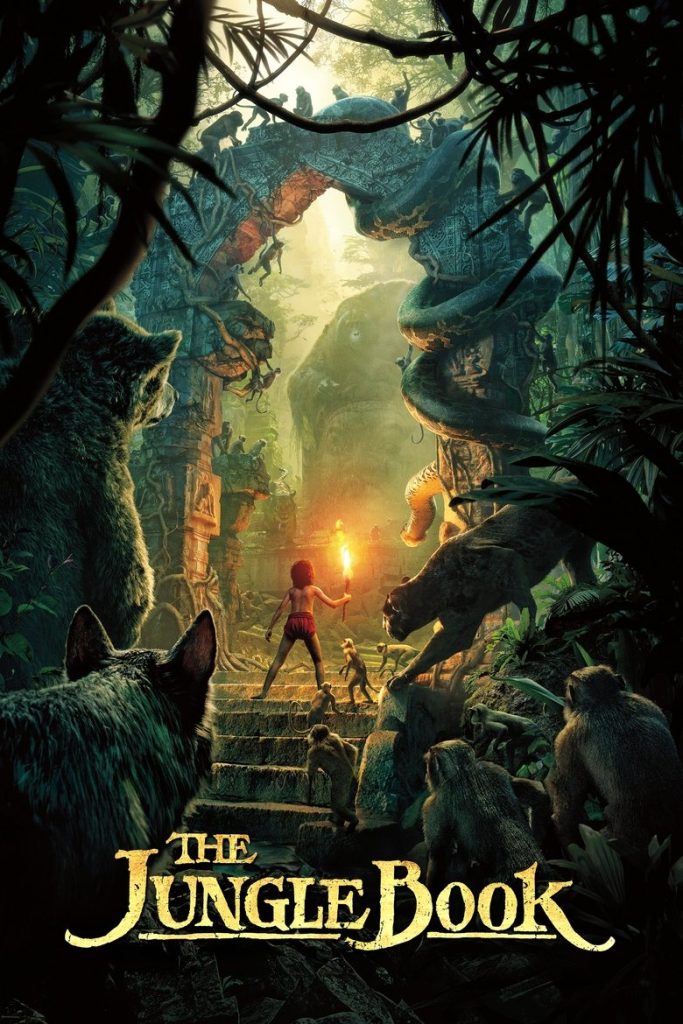
The Jungle Book (2016) is a visually stunning live-action adaptation of Rudyard Kipling's classic stories, directed by Jon Favreau. It follows Mowgli, a young boy raised by wolves in the jungle, who must flee his home when threatened by the fearsome tiger Shere Khan. With the help of his mentors—the wise panther Bagheera and the carefree bear Baloo—Mowgli embarks on a journey of self-discovery, learning about his unique place between the animal world and human civilization.
Parent Guide
A beautifully crafted adventure with positive messages about courage and identity, but contains realistic animal threats and peril that may be intense for sensitive or younger viewers.
Content breakdown
Multiple scenes of animal threats and peril: Shere Khan attacks other animals, threatens Mowgli repeatedly, and causes destruction. A buffalo stampede endangers characters. Animals fight each other. No graphic violence, but the realistic CGI makes threats feel immediate and dangerous.
Shere Khan is an intimidating, realistic tiger who stalks and threatens Mowgli throughout. The python Kaa has a hypnotic, unsettling sequence. Some tense chase scenes. The death of a parent figure is referenced. Dark atmospheric scenes in parts of the jungle.
No offensive language. Some mild insults between animals ('coward,' 'traitor').
No sexual content. Mowgli wears only a loincloth, consistent with the story.
No substance use depicted.
Themes of abandonment, identity crisis, and facing mortality. Mowgli experiences separation from his wolf family and must confront his differences. Some sad moments when characters are in danger or relationships are strained. Ultimately uplifting resolution.
Parent tips
This PG-rated film is generally family-friendly but contains intense sequences that may frighten younger children. Key considerations: 1) Several scenes feature realistic animal threats and peril, particularly involving Shere Khan the tiger. 2) The film explores themes of identity, belonging, and facing fears. 3) Some emotional moments involve separation from family and confronting mortality. 4) The visual effects are impressive but may make dangerous situations feel more realistic. 5) Positive messages about friendship, courage, and finding one's path are prominent.
Parent chat guide
Parent follow-up questions
- Which animal was your favorite?
- What sounds did the animals make?
- Was Mowgli brave?
- Did you like the singing bear?
- What color was Shere Khan?
- Why was Shere Khan afraid of fire?
- How did Mowgli help his animal friends?
- What made Baloo and Bagheera different as friends?
- Why did Mowgli have to leave the wolf pack?
- What human things could Mowgli do that animals couldn't?
- How does the film show the balance between nature and human civilization?
- What does Mowgli's journey teach about identity?
- Why do you think Shere Khan hated humans so much?
- How did the film handle the concept of 'the law of the jungle'?
- What differences did you notice between this version and other Jungle Book adaptations?
- How does the film explore themes of prejudice and fear of the 'other'?
- What commentary does the film make about human impact on nature?
- How does Mowgli's hybrid identity reflect real-world experiences of cultural belonging?
- In what ways does the film update Kipling's colonial-era stories for modern audiences?
- How do the visual effects enhance or detract from the storytelling?
🎭 Story Kernel
The film is a profound exploration of identity and belonging, framed as a coming-of-age story. It's not just about Mowgli finding his place, but about the jungle itself grappling with the concept of 'man.' Shere Khan's vendetta isn't merely personal hatred; it's a primal, ecological fear of the destructive potential humanity represents. Mowgli's journey forces every character to confront their own nature: Bagheera's protective guilt, Baloo's conflicted loyalty, and the wolves' tribal honor. The climax isn't about defeating a villain, but about Mowgli choosing to define his own humanity not by fire (destruction), but by ingenuity and connection to his jungle family.
🎬 Visual Aesthetics
Jon Favreau's direction crafts a hyper-real, yet mythic, digital ecosystem. The camera often adopts animal perspectives—low angles through dense foliage, sweeping tracking shots that mimic a predator's pursuit—immersing us in the jungle's point-of-view. The color palette is a character itself: the warm, golden hues of the Peace Rock and wolf den contrast with the cool, ominous blues and greys of Shere Khan's territory and the monsoon. The 'red flower' (fire) is the only unnatural color, a violent visual rupture. The action is grounded in the physics and biology of the animals, making Baloo's wrestling and the stampede feel terrifyingly authentic.
🔍 Details & Easter Eggs
💡 Behind the Scenes
The entire jungle was created using cutting-edge CGI, filmed on a soundstage in Los Angeles. Young actor Neel Sethi (Mowgli) performed almost entirely against blue screens and rudimentary props, with the legendary voice cast recording separately. Bill Murray ad-libbed many of Baloo's lines, including the iconic 'Just try and relax, kid.' The film's technical achievement lies in its seamless blend of photorealistic animals (down to individual wet hairs in the rain) with a stylized, storybook lighting and color grade, aiming for emotional truth over pure realism.
Where to watch
Choose region:
- Disney Plus
- Amazon Video
- Apple TV Store
- Google Play Movies
- YouTube
- Fandango At Home
Trailer
Trailer playback is unavailable in your region.