
The Lion King II: Simba’s Pride (1998)
Story overview
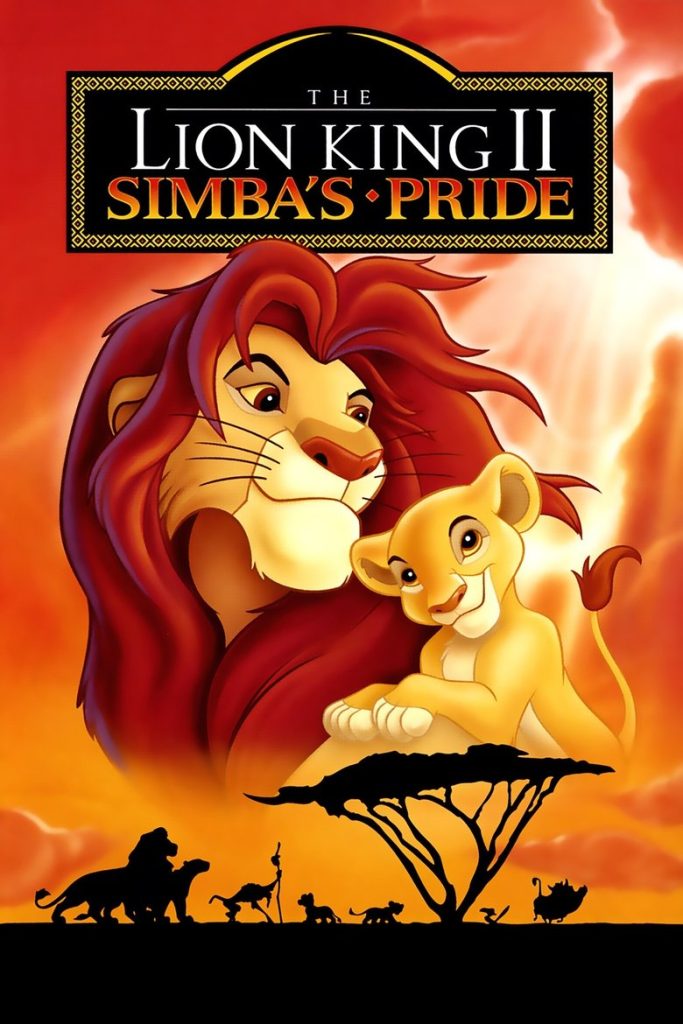
The Lion King II: Simba's Pride continues the story of Simba as king of Pride Rock, now with a daughter named Kiara who shares his rebellious nature. Kiara's friendship with Kovu, whose mother was part of Scar's exiled pride, creates tension as Simba worries about history repeating itself. The film explores themes of family legacy, prejudice, and finding one's own path while honoring the past.
Parent Guide
Family-friendly animated sequel with positive messages about forgiveness and overcoming prejudice, though some conflict scenes may be intense for preschoolers.
Content breakdown
Lions growl, chase, and engage in non-graphic fights; characters face peril from fire and falling rocks but all recover.
Some tense confrontations between lion prides and emotional family conflicts that might worry sensitive young viewers.
No offensive language; all dialogue is family-appropriate.
No sexual content; romantic elements are limited to affectionate nuzzling and singing.
No depiction of substance use.
Themes of family estrangement, parental worry, and intergroup conflict create emotional weight suitable for elementary-aged viewers.
Parent tips
This G-rated animated sequel deals with mature themes of intergenerational conflict, prejudice, and challenging parental authority in age-appropriate ways. While there's no graphic content, some scenes show lions fighting and emotional confrontations that might be intense for very young viewers. The film presents positive messages about forgiveness, breaking cycles of hatred, and the importance of looking beyond family history to judge individuals on their own merits.
Parent chat guide
Parent follow-up questions
- How did Kiara feel when her dad said no to playing with Kovu?
- What was your favorite animal in the movie?
- How did the lions show they were friends?
- What made you happy in the movie?
- How did the music make you feel?
- Why do you think Simba was worried about Kiara being friends with Kovu?
- How did Kiara and Kovu show they trusted each other?
- What does 'pride' mean in the movie besides a group of lions?
- How did the characters solve their problems without fighting?
- What lesson did Simba learn from his daughter?
- How does the movie show that people can change their minds about others?
- What responsibilities come with being a leader like Simba?
- How do family expectations affect the characters' choices?
- What does the movie say about judging people by their family history?
- How do the characters balance loyalty to family with doing what's right?
- How does the film explore the cycle of violence between groups?
- What parallels can you draw between the lions' conflicts and real-world prejudices?
- How do the characters navigate between tradition and progress?
- What does the movie suggest about the nature of forgiveness and reconciliation?
- How do parental fears sometimes limit children's growth and understanding?
🎭 Story Kernel
At its core, 'Simba's Pride' is a surprisingly mature exploration of intergenerational trauma and the burden of legacy. Simba, once the rebel who challenged tradition, has become the rigid king, his trauma from Scar's betrayal calcifying into an unbending rule: 'Never go to the Outlands.' This fear-driven dogma directly creates the conflict, mirroring how real-world cycles of prejudice are perpetuated. The driving force isn't mere villainy, but Kiara and Kovu's shared realization that their identities are not defined by their fathers' sins. The movie argues that healing requires the younger generation to consciously reject the narratives of the past, making peace not just with an enemy, but with the flawed, fearful parts of their own parents.
🎬 Visual Aesthetics
The film employs a distinct visual language to separate the Pridelands and the Outlands. The Pridelands are bathed in warm, golden-hour hues—a literal 'circle of life' glow that now feels sterile under Simba's anxious rule. In contrast, the Outlands are rendered in desaturated browns, sharp rock spires, and perpetual twilight, visually coding Kovu's pride as 'other.' The animation during pivotal scenes, like Kiara and Kovu's confrontation in the fire, uses dramatic silhouettes and intense red-orange lighting, externalizing their inner turmoil and passion. The action style is more intimate and character-driven than the original's epic scale, focusing on charged glances and the symbolic violence of a divided kingdom.
🔍 Details & Easter Eggs
💡 Behind the Scenes
This was the first Disney sequel produced by the studio's then-new animation studio in Orlando, Florida, not the main Burbank team. Voice actor Jason Marsden (Adult Kovu) was primarily known for comedic roles, making his casting as the brooding outcast an intentional stretch. The song 'Love Will Find a Way' was notably the first duet between a Disney hero and heroine who start the song on opposite sides of a conflict, a narrative risk for a direct-to-video musical.
Where to watch
Choose region:
- Disney Plus
- Amazon Video
- Apple TV
- Google Play Movies
- YouTube
- Fandango At Home
Trailer
Trailer playback is unavailable in your region.