
The Long Good Friday (1980)
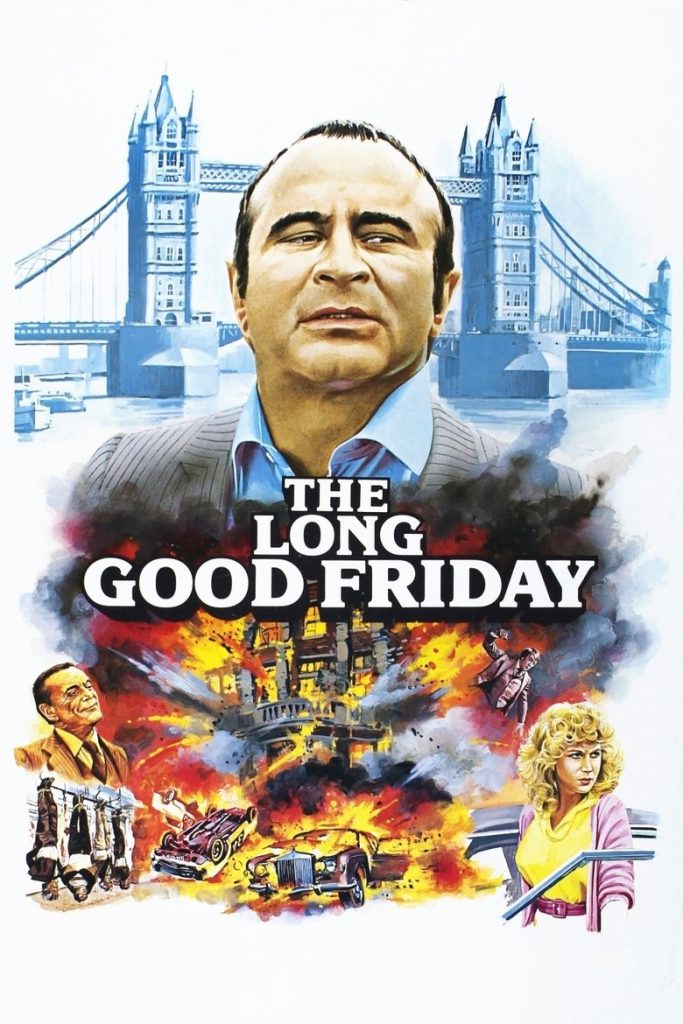
Story overview
The Long Good Friday is a gritty 1980 British crime thriller set in London's underworld. It follows Harold Shand, a Cockney gangster attempting to legitimize his business by partnering with American investors to redevelop a waterfront area. Over a tense Easter weekend, his empire comes under attack through bombings and assassinations. The film portrays Shand's increasingly desperate and violent hunt for the traitor within his organization, leading to a brutal confrontation that exposes the fragile nature of his criminal enterprise.
Parent Guide
This is a mature crime drama with intense violence, strong language, and adult themes. Suitable only for older teens who can handle graphic content and complex moral situations.
Content breakdown
Multiple bombings with visible injuries and deaths, shootings, stabbings, torture scenes including a man being stabbed with broken glass and another tortured with a hot iron. Gang violence and executions depicted realistically.
Tense atmosphere throughout with sudden violent attacks. Some disturbing scenes of torture and the aftermath of bombings. The final scene is particularly intense and unsettling.
Frequent use of strong profanity including f-words, c-words, and other crude language typical of the criminal underworld setting.
Brief sex scene with partial nudity (female breasts shown). Some sexual references and dialogue throughout the film.
Characters drink alcohol frequently in social and business settings. Smoking is common. Some references to drug dealing as part of criminal activities.
High tension throughout as the main character becomes increasingly desperate and violent. Themes of betrayal, revenge, and the collapse of a criminal empire create intense emotional moments.
Parent tips
This film contains strong violence including bombings, shootings, stabbings, and torture scenes. Language includes frequent strong profanity. There's brief sexual content including partial nudity in a sex scene. Substance use includes drinking and smoking. The film's tense atmosphere and criminal themes make it unsuitable for younger viewers.
Parent chat guide
Parent follow-up questions
—
—
—
- What makes someone choose a life of crime versus legitimate business?
- How does the film show that violence often creates more problems than it solves?
- What did you think about the ending and what it says about power and revenge?
- How does the film portray loyalty and betrayal in criminal organizations?
🎭 Story Kernel
At its core, 'The Long Good Friday' is about the violent collision between old-world criminality and new-world politics. Harold Shand isn't just fighting rival gangs—he's battling obsolescence. His drive to legitimize his empire through a massive London waterfront development represents the ultimate gangster fantasy: laundering not just money, but identity itself. Yet the film reveals this aspiration as tragic hubris. The IRA's surgical dismantling of his organization exposes how Harold's capitalist ambitions have made him vulnerable to ideological warfare. He's a dinosaur trying to negotiate with meteors, his carefully constructed world crumbling because he fundamentally misunderstood that some conflicts can't be resolved with money or territory.
🎬 Visual Aesthetics
Director John Mackenzie crafts London as a character through gritty, documentary-style cinematography that feels both immediate and claustrophobic. The camera lingers in tight spaces—pubs, cars, Harold's increasingly empty mansion—mirroring his shrinking world. The color palette moves from warm, confident browns and golds in early scenes to cold blues and grays as Harold's empire unravels. Action isn't glamorized but presented with brutal economy: the car bomb sequence uses minimal cuts, making the violence feel shockingly real. Visual symbolism peaks during the Thames river scenes, where water—typically representing life and commerce—becomes a conduit for death and betrayal.
🔍 Details & Easter Eggs
💡 Behind the Scenes
Bob Hoskins nearly turned down the role, believing himself 'not handsome enough' for a lead. His performance became definitive. The IRA plotline caused significant controversy during production, with crew members receiving threats. Much was filmed guerrilla-style at actual London locations, including the historic Billingsgate Market. Helen Mirren's casting was opposed by producers who wanted a 'glamorous' actress, but Mackenzie fought for her grounded intensity. The legendary final shot—Harold's face processing his fate in a car—was achieved by having real IRA supporters surround the vehicle off-camera.
Where to watch
Choose region:
- HBO Max
- HBO Max Amazon Channel
- Criterion Channel
- Shout! Factory TV
- Amazon Video
- Apple TV Store
- Fandango At Home
- MovieMe
Trailer
Trailer playback is unavailable in your region.