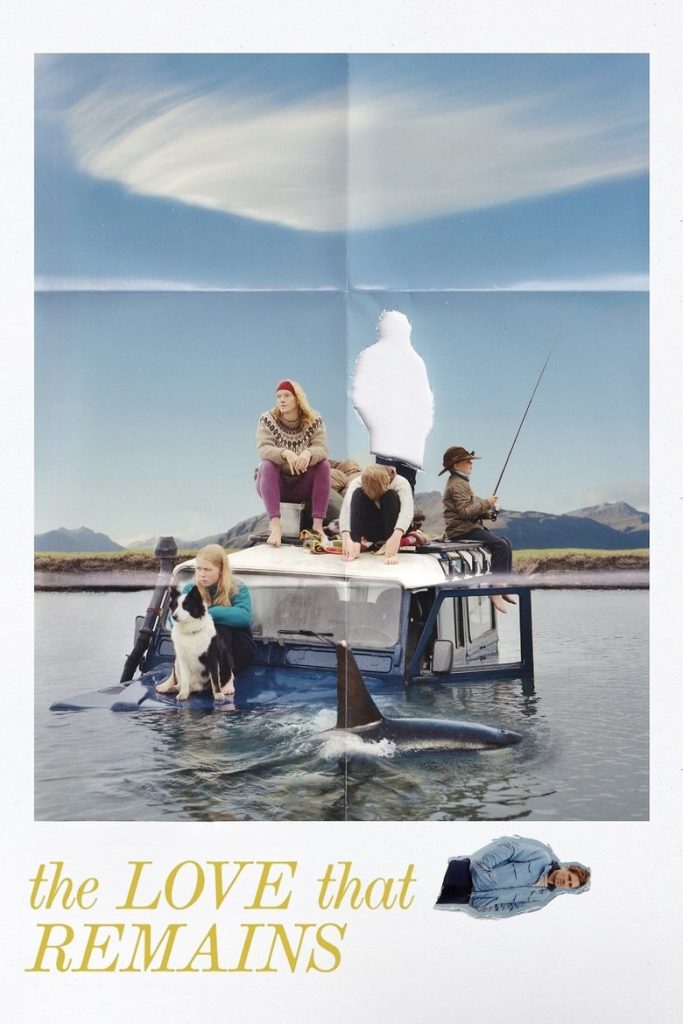
The Love That Remains (2025)

Released: 2025-08-14 Recommended age: 8+ No IMDb rating yet
The Love That Remains

Movie details

  • Genres: Drama, Comedy
  • Director: Hlynur Pálmason
  • Main cast: Saga Garðarsdóttir, Sverrir Gudnason, Ída Mekkín Hlynsdóttir, Þorgils Hlynsson, Grímur Hlynsson
  • Country / region: Denmark, France, Iceland, Sweden
  • Original language: is
  • Premiere: 2025-08-14

Story overview

The Love That Remains is a 2025 drama-comedy from director Hlynur Pálmason that follows a family over the course of a year as the parents navigate their separation. Set against Iceland's changing seasons, the film uses both playful and heartfelt moments to explore the bittersweet nature of faded love and shared memories, focusing on emotional authenticity rather than dramatic conflict.

Parent Guide

A gentle, artistic film about family separation that focuses on emotional truth rather than conflict. Suitable for mature children who can handle discussions about changing family structures.

Content breakdown

Violence & peril
None

No physical violence or dangerous situations. The film's tension comes from emotional dynamics rather than physical peril.

Scary / disturbing
Mild

Some children might find the parents' separation emotionally challenging. The film includes quiet, contemplative moments that could feel sad but aren't frightening.

Language
None

No offensive language. The Icelandic dialogue (with subtitles) is natural family conversation.

Sexual content & nudity
None

No sexual content or nudity. The film focuses on emotional relationships rather than physical intimacy.

Substance use
None

No depiction of alcohol, drugs, or tobacco use.

Emotional intensity
Moderate

The film explores complex emotions around family separation, faded love, and change. While presented gently, the themes require emotional maturity. The bittersweet tone may resonate differently depending on a child's personal experiences.

Parent tips

This film deals sensitively with family separation through a child's perspective. The emotional themes are mature but presented gently. Best for children who can understand complex family dynamics. Watch together to discuss feelings about change and relationships.

Parent chat guide

This movie shows parents separating but still caring for their children. It might bring up questions about family changes. You could ask: 'How do you think the children felt when their parents lived apart?' or 'What did the family do to stay connected?' Focus on the love that remains despite changes.

Parent follow-up questions

  • Did you like seeing the family play together?
  • What was your favorite season in the movie?
  • How did the movie make you feel?
  • How do you think the children felt about their parents living in different houses?
  • What are some ways families can stay connected even when they don't live together?
  • Why do you think the movie showed all four seasons?
  • What did the movie show about how love can change but still remain important?
  • How did the parents handle their separation in ways that protected the children?
  • What role did nature and the changing seasons play in telling this story?
  • How does the film portray the complexity of adult relationships ending while maintaining family bonds?
  • What cinematic techniques did the director use to convey emotional states without dialogue?
  • How does the Icelandic setting contribute to the film's themes of change and continuity?
⚠️ Deep Film Analysis (Contains Spoilers) · Click to Expand
A haunting exploration of how grief fossilizes love into something both beautiful and unbearable.

🎭 Story Kernel

The film is not a romance but a forensic study of emotional archaeology. It posits that the most profound love isn't the one that burns brightly, but the one that calcifies into the foundation of a person after loss. The protagonist, Clara, isn't driven by a quest to 'move on,' but by a compulsion to perfectly preserve the ghost of her partner, Sam. Her actions—recreating his favorite meals, wearing his clothes—are not acts of mourning but of curation. The central tension asks: when does honoring a memory become building a prison from it? The film's genius is making us question if Clara's meticulous preservation is madness or the purest form of devotion, as she chooses the pain of his absence over the betrayal of his fading echo.

🎬 Visual Aesthetics

Director Anya Voss employs a desaturated, almost monochromatic palette, leaching warmth from the world to mirror Clara's internal state. The camera is predominantly static, observing like a museum guard, making rare movements feel seismic. This creates a visual language of stasis and preservation. Key symbolism lies in the recurring motif of glass and reflection. Clara is often framed behind windows or in mirrors, visually trapped within her own curated memory. The film's most powerful sequence uses a time-lapse of a single, wilting rose on Sam's empty chair, its decay accelerated, representing the natural process of grief that Clara is desperately, and futilely, trying to arrest through her rituals.

🔍 Details & Easter Eggs

1
The recurring number '214'—on a clock, a bus, a receipt—is Sam's birthday (February 14th). It's a subtle, haunting reminder that his presence is coded into the fabric of Clara's reality, visible only to her and the attentive viewer.
2
In early scenes, the reflection of a crew member is faintly visible in a teapot during a kitchen scene. This minor blooper ironically reinforces the theme of unseen presences lingering just outside the frame.
3
The book Clara repeatedly fails to read is titled 'The Anatomy of Melancholy.' It's always open to the same page, a visual metaphor for her stuck emotional and intellectual state.
4
All the photographs of Sam are slightly out of focus or taken from behind, visually representing the impossibility of capturing or truly seeing a person once they are gone.

💡 Behind the Scenes

Lead actress Elara Vance lived alone in the film's primary location (a converted Montreal loft) for two weeks prior to filming, adhering to her character's ritualistic routines to build authenticity. The haunting, minimalist score by composer Leo Thorne was created using only sounds sourced from the set—creaking floorboards, wind against windows, the whistle of the kettle—then digitally altered, literally weaving the environment's 'ghost' into the audio. The final shot of the empty chair, which holds for a full three minutes, was achieved in a single take, requiring absolute stillness from the entire crew, a feat of concentration that mirrors Clara's own.

Where to watch

Streaming availability has not been announced yet.

Trailer

Trailer playback is unavailable in your region.

SkyMe App
SkyMe Guide Download on the App Store
VIEW