
The Place Promised in Our Early Days (2004)
Story overview
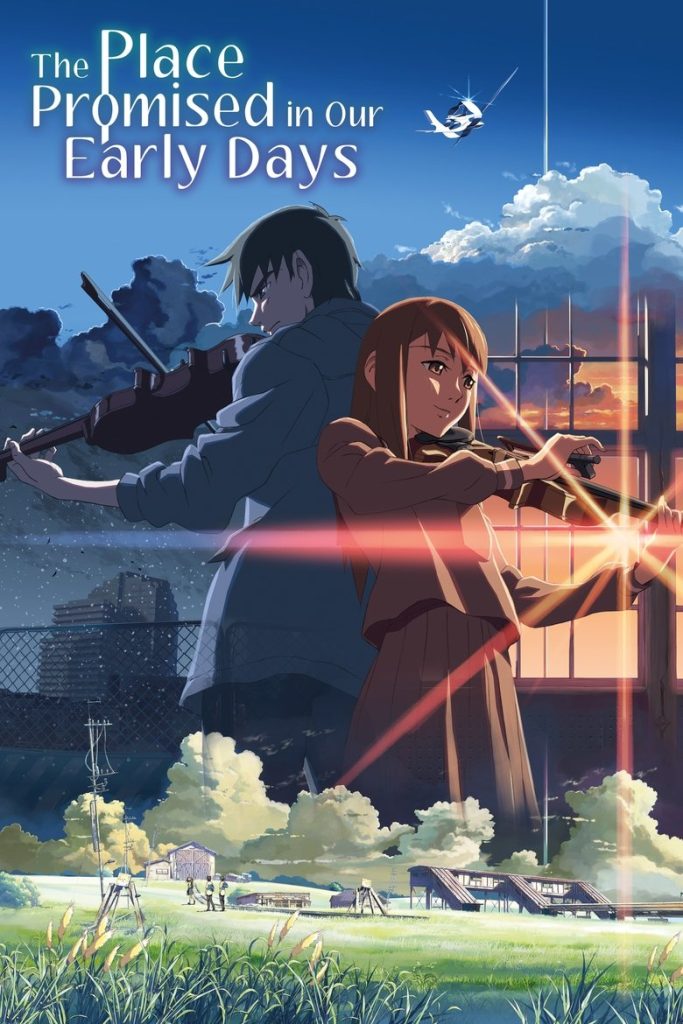
In an alternate post-war Japan divided between North and South, three high school friends build an airplane to fulfill their promise of exploring a mysterious tower in the North, blending themes of friendship, longing, and scientific mystery against a backdrop of political tension.
Parent Guide
Gentle animated drama with mild peril and emotional themes suitable for ages 8+ with parental guidance for younger viewers sensitive to separation themes.
Content breakdown
Some tense moments during flight sequences when characters encounter turbulence or mechanical issues. No physical violence between characters.
The mysterious tower and political division might create mild unease. Some melancholic themes of separation and unfulfilled promises.
No offensive language. Polite dialogue throughout.
No sexual content or nudity. Mild romantic themes of childhood crushes and longing.
No depiction of substance use.
Strong themes of nostalgia, separation, and unfulfilled promises. Emotional scenes of characters longing for connection and dealing with the passage of time.
Parent tips
This animated film features mild peril during flight sequences and emotional themes of separation and unfulfilled promises. The political division serves as backdrop rather than intense conflict. Suitable for ages 8+ with guidance on the film's melancholic tone and complex relationships.
Parent chat guide
Parent follow-up questions
- What was your favorite flying scene?
- How did the friends help each other?
- What colors did you like in the movie?
- Why do you think the tower was important?
- How did the characters feel when they were separated?
- What would you build to explore something mysterious?
- What does the divided Japan represent in the story?
- How does the film show the passage of time affecting friendships?
- What scientific concepts did you notice in the airplane building?
- How does the film use alternate history to explore personal themes?
- What commentary does the film make about political divisions?
- How are romance and friendship portrayed differently as characters mature?
🎭 Story Kernel
At its core, 'The Place Promised in Our Early Days' explores how trauma fractures identity and creates parallel existences. The film isn't about preventing war but about reconciling fragmented selves. Hiroki and Takuya aren't just building an airplane; they're constructing a vessel to reach their lost childhood selves. Sayuri's coma represents how collective trauma can suspend an entire society in stasis. The tower isn't merely a weapon but a physical manifestation of separation—between North and South, past and present, reality and memory. The characters' desperation to reunite stems from their inability to live whole lives while part of themselves remains trapped in that promised summer.
🎬 Visual Aesthetics
Makoto Shinkai's visual language here establishes his signature style: skies that feel like characters themselves, with clouds moving with emotional weight. The color palette shifts dramatically—the warm, saturated tones of childhood memories contrast with the cold, desaturated present. The tower's constant presence in nearly every exterior shot creates visual tension, a reminder of the division haunting every moment. Slow pans across landscapes emphasize emptiness and longing. The flight sequences use fluid, almost weightless animation that makes the mechanical plane feel organic, suggesting that their creation has become an extension of their youthful dreams.
🔍 Details & Easter Eggs
💡 Behind the Scenes
This was Makoto Shinkai's first feature film, created almost entirely by himself over seven months—he wrote, directed, animated, and even did some voice work. The film's distinct visual style emerged from technical limitations; Shinkai used digital tools innovatively to create his detailed skies. The setting was inspired by real locations around Hokkaido and Niigata, with the divided Japan reflecting Cold War tensions. Interestingly, the film's original title translates more literally to 'The Place Where We Promised That Day,' emphasizing the temporal dislocation central to its themes.
Where to watch
Choose region:
- HBO Max
- HBO Max Amazon Channel
- Amazon Video
- Apple TV Store
- Google Play Movies
- YouTube
- Fandango At Home
Trailer
Trailer playback is unavailable in your region.